

Most people in Web3 do not wake up thinking, “I need more infrastructure today.” They wake up facing a different problem: too many dashboards, too many chains, too many tools, too many steps, and too many projects claiming they will make everything easier.
That is where I think the real conversation around @OpenLedger and $OPEN should begin.
For years, Web3 has had a strange pattern. A project launches with strong words, technical diagrams, and big promises. But after the first wave of attention, users slowly disappear because the tool never becomes part of their daily behavior. It may be powerful, but if people do not return to it again and again, that power does not matter much.
This is why the OctoClaw launch caught my attention. Not because I think every new agent automatically changes everything, but because it points toward a real pain point: people want workflows that feel less broken.
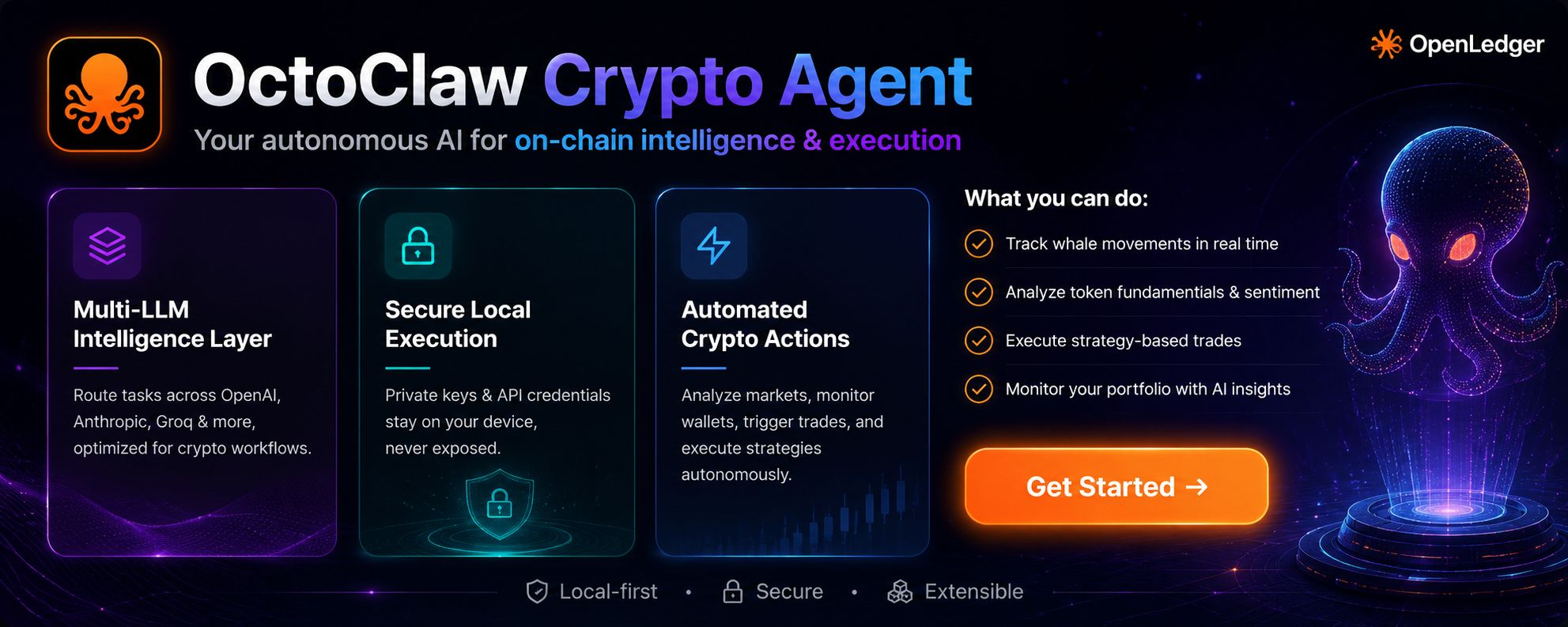
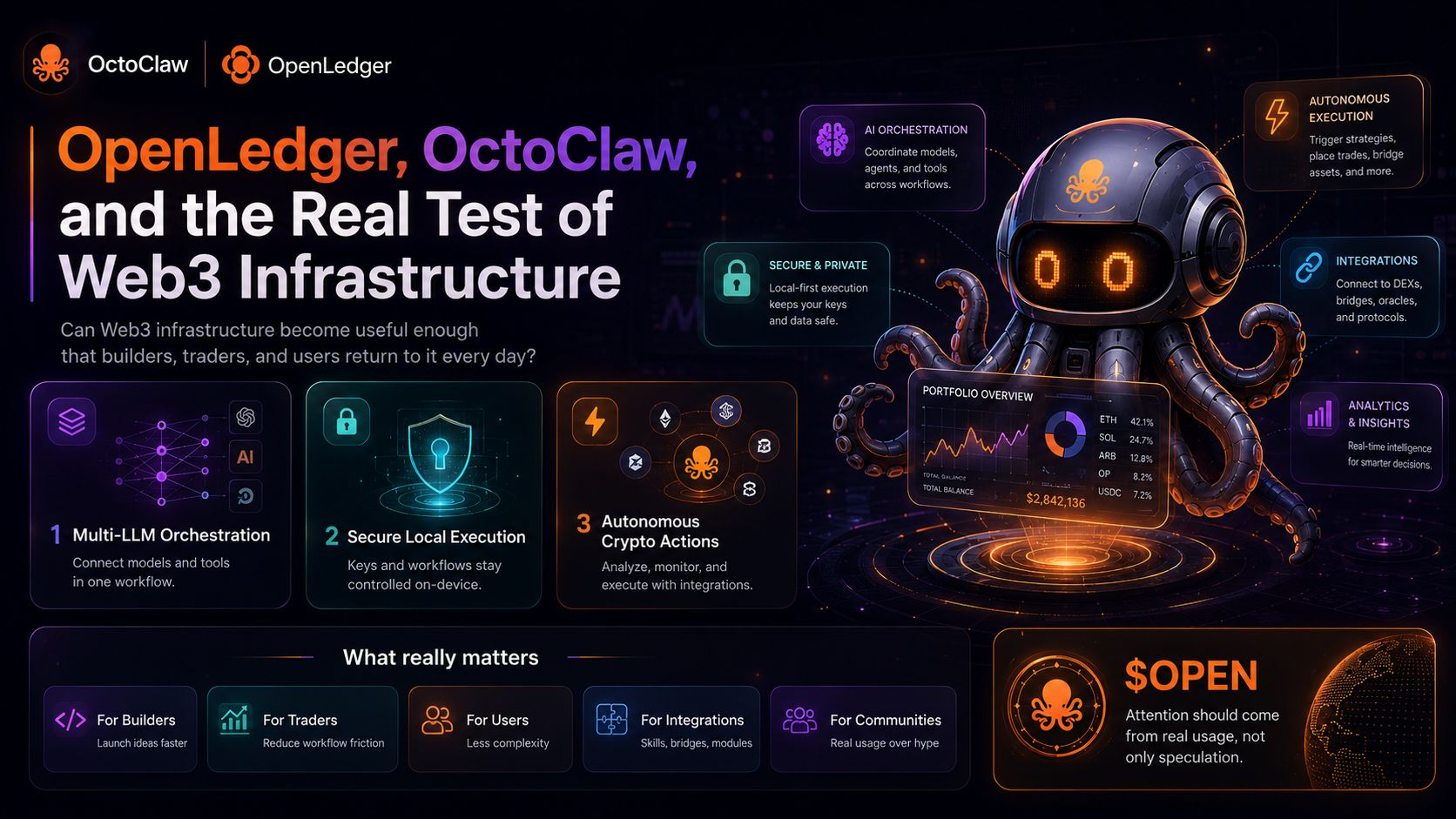
From what I understand, OctoClaw is an OpenLedger claw bot agent designed around multi-LLM orchestration, secure local execution of AI workflows, and autonomous crypto operations through integrations. That sounds technical, but the practical idea is simple: instead of jumping between tools, models, apps, exchanges, and chats, users may be able to bring more actions into one controlled environment.
Still, I am naturally cautious here.
AI agents in crypto can either reduce noise or create more noise. If an agent only gives random outputs, vague analysis, or overconfident trading suggestions, then it becomes another distraction. But if it helps a builder test ideas faster, helps a trader organize workflow better, or helps a user interact with apps more smoothly, then it starts becoming useful.
That difference matters.
OctoClaw’s setup also shows that this is not just a “click once and magic happens” product. It currently supports macOS, needs root-level access, and requires users to connect an AI provider with a valid API key. Users can choose providers like Anthropic, OpenAI, Google Gemini, Mistral, Groq, Cohere, OpenRouter, Ollama, and others. After installation, the dashboard becomes the main execution space, where users can chat, run commands, connect Telegram, explore skills, and even enable exchange-related modules.
For a normal user, this may still feel a little complex. For builders and more technical crypto users, it may feel more interesting.
And that is the point. OpenLedger should not be judged only by hype around $OPEN. It should be judged by whether tools like OctoClaw can become useful repeatedly. Can developers launch ideas without fighting too much complexity? Can traders use agents to manage information better instead of making emotional decisions? Can users move between ecosystems with less friction? Can integrations, bridges, and agent skills actually reduce the number of steps people face every day?
Because real value in Web3 is not created by announcement alone. It is created when people come back after the first try.
I have seen many “next big infrastructure” projects disappear because they were too invisible, too complicated, or too disconnected from real user behavior. Good infrastructure should not only sound powerful. It should quietly solve problems in the background until users start depending on it.
That is the possible opportunity for OpenLedger.
At the same time, maintaining reliable infrastructure in crypto is difficult. Markets change fast. User expectations change even faster. AI models improve, integrations break, exchanges update permissions, and security risks never fully disappear. If OctoClaw wants to matter, reliability and simplicity will be just as important as technical ability.
So my view is calm and conditional.
OpenLedger may work if it serves builders, traders, developers, and active communities with tools they actually use again and again. OctoClaw could become useful if it reduces friction instead of adding another layer of complexity. OPEN could gain attention through real usage, not only speculation.
But it could also fail if the setup remains too hard, if agents become noisy, or if users do not find a strong reason to return.
For now, I see #OpenLedger as infrastructure worth watching carefully not because it promises everything, but because it is trying to touch the part of Web3 that matters most: real behavior.
