Look, crypto has this habit of acting like every problem starts with technology.
I've seen this before. Over and over.
A project shows up, throws a pile of technical terms at everyone, talks about architecture and infrastructure, and suddenly people act like code alone fixes human behavior. It doesn't. It never has.
The ugly truth usually sits somewhere else.
People create value constantly, and systems keep failing at one simple thing: figuring out who actually deserves credit for creating it.
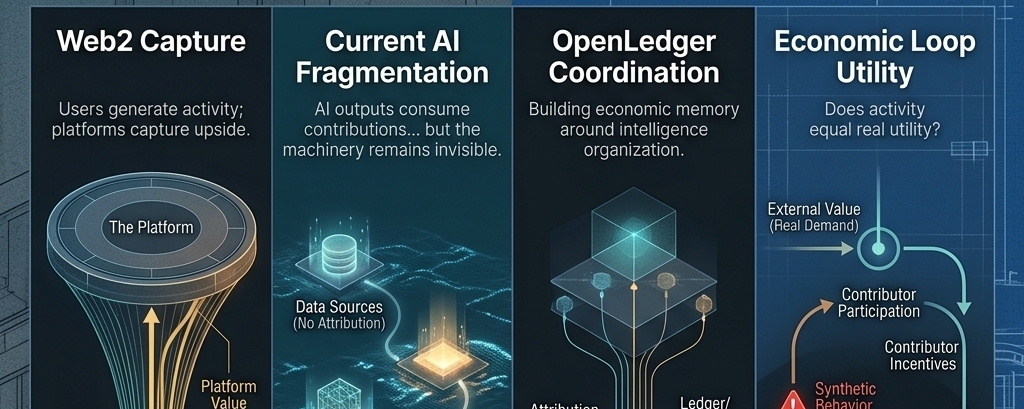
Web2 did this for years. Users generated the activity. Users created the behavior patterns. Users fed platforms with clicks, preferences, interactions, and mountains of information every day. Platforms captured most of the upside.
Simple story.
Now AI walks in and somehow makes the whole situation even messier.
Because AI doesn't just consume information.
AI consumes contribution.
That's where things get interesting.
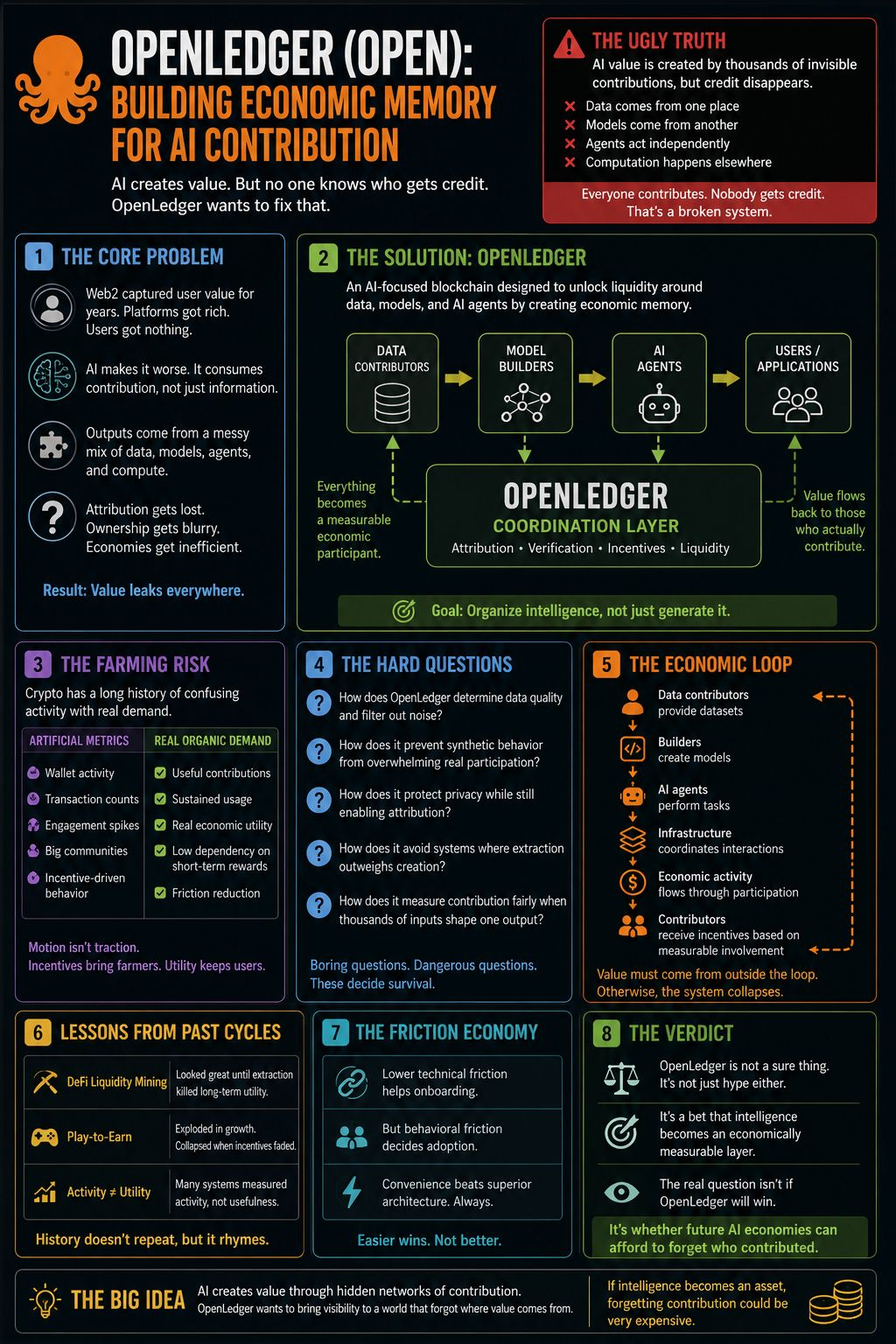
Think about it for a second. AI outputs don't magically appear from nowhere. Datasets come from somewhere. Models come from somewhere. Agents do specific work somewhere. Computation happens somewhere else entirely.
Then all these pieces crash together and produce a final output.
You see the answer.
You don't see the machinery.
And that's a problem.
Because economies usually work better when people can point at something and say, "Yeah, this came from here."
Factories know where parts came from.
Supply chains track movement.
Workers know who pays them.
Ownership has boundaries.
AI starts smearing those boundaries all over the place.
Data comes from one place.
Models come from another.
Computation happens somewhere else.
Agents pop up from different systems entirely.
Then all of it lands in front of the user as one smooth experience and suddenly nobody sees the ugly machinery underneath.
Everyone contributes.
Nobody fully knows who mattered most.
Messy.
And that's the wound OpenLedger seems to be staring at.
Not "How do we launch another AI narrative?"
Not "How do we create another token story?"
Something way less exciting.
How do you create economic memory around intelligence itself?
Honestly, people usually ignore these questions because infrastructure feels boring right up until something breaks.
Then everybody suddenly becomes an expert.
OpenLedger positions itself as an AI-focused blockchain trying to unlock liquidity around data, models, and AI agents. Strip away all the crypto language and the core idea feels pretty simple.
AI systems generate outputs.
Outputs come from inputs.
Inputs come from contributors.
Contributors should theoretically have measurable participation inside that system.
Sounds clean.
Execution probably won't be.
OpenLedger doesn't look at AI outputs like isolated endpoints. It tries to build a coordination layer where datasets, models, and agents become visible economic participants instead of disappearing into a black box.
That distinction matters more than people think.
Because right now huge parts of AI honestly feel like disconnected islands pretending they're one continent.
Data sits somewhere.
Models live somewhere else.
Agents keep showing up as their own little entities.
Computation happens elsewhere.
Yet value somehow moves through all of it.
Badly.
Actually, imagine manufacturing before supply chains started getting organized.
Factories existed.
Raw materials existed.
Transportation existed.
Everything technically existed.
But coordination sucked.
A company might struggle to track components. Delays piled on top of delays. Information broke apart. Value leaked all over the place.
Then people fixed visibility.
Not products.
Visibility.
Tracking improved.
Standards improved.
Flows became easier to understand.
Things moved better because people finally understood where things moved.
OpenLedger seems to push toward something similar for AI economies.
Not intelligence generation.
Intelligence organization.
Different problem entirely.
And honestly? People don't talk about that enough.
Crypto usually falls in love with visible numbers.
Wallet activity.
Transaction counts.
Community growth.
Engagement metrics.
Big social numbers.
People stare at dashboards and feel good.
I've seen that movie too.
Remember DeFi liquidity mining?
Remember play-to-earn systems?
Remember ecosystems showing explosive user growth only to watch users disappear the second incentives dried up?
Those systems didn't always fail because of technology.
A lot of them failed because incentives started driving behavior.
People farmed systems.
Systems confused farming with real demand.
Reality eventually showed up and punched everyone in the face.
OpenLedger runs into that same danger.
Because the second contribution becomes measurable, users start asking a completely different question.
Not:
"How do I create something useful?"
They ask:
"How do I maximize rewards?"
Big difference.
A farmer and a real contributor can create activity that looks almost identical on paper.
Wallets can generate transactions.
Bots can create interactions.
Agents can inflate engagement.
Artificial activity can look healthy while real demand quietly sits there doing almost nothing.
Crypto keeps making this mistake.
Motion isn't traction.
Never has been.
A network can show growing activity and still produce almost no meaningful economic utility underneath.
People click.
People interact.
People collect incentives.
Incentives disappear.
People disappear.
Simple.
OpenLedger can't afford that outcome because infrastructure only matters when people still need it after rewards stop pulling them in.
That's the line.
Artificial demand shows up because incentives exist.
Organic demand shows up because friction disappears.
Only one usually survives.
And friction matters way more than people think.
People love pretending superior systems always win.
They don't.
Better architecture loses all the time.
Cleaner systems lose.
I've watched it happen repeatedly.
Convenience wins ugly fights.
Companies choose control.
Developers choose speed.
Users almost always choose simplicity.
Always.
That creates harder questions too. Not exciting questions. Not the kind people post with rocket emojis.
The boring questions.
The dangerous ones.
How does OpenLedger determine whether contributed data actually has quality instead of noise?
How does it stop synthetic behavior from overwhelming useful participation?
How does it protect privacy while tracking attribution?
How does it avoid creating systems where extraction outweighs creation?
How does it measure contribution fairly when thousands of inputs shape one output?
People usually skip these questions because they're boring.
Bad idea.
The boring questions decide survival.
The economic loop matters too.
Crypto systems break here constantly.
Value can't just spin around inside a circle forever.
Something external has to enter.
OpenLedger's logic looks fairly straightforward on paper.
Data contributors provide datasets.
Builders create models.
Agents perform tasks.
Infrastructure coordinates interactions.
Economic activity flows through participation.
Contributors receive incentives based on measurable involvement.
Clean.
Maybe a little too clean.
Because humans always show up and complicate everything.
People optimize rules.
Then people optimize loopholes.
Then systems spend years patching loopholes.
Same story. Different cycle.
Crypto already carries scars from this.
Liquidity mining looked sustainable until extraction overwhelmed utility.
Play-to-earn looked sustainable until growth slowed down.
A lot of systems measured activity without measuring usefulness.
Numbers looked great.
Reality didn't.
None of this automatically kills OpenLedger's thesis.
Actually, I think the opposite.
The reason these questions matter so much is because the underlying problem feels real.
AI creates value through networks of hidden contribution. Current systems struggle to recognize those contributions clearly.
OpenLedger wants visibility where fragmentation currently dominates.
Fair target.
But let's be real.
Legitimate problems don't automatically create successful systems.
Execution decides everything.
OpenLedger sits somewhere in the middle right now.
Not a guaranteed winner.
Not some empty hype machine either.
I think it's making a bet on something bigger.
A bet that intelligence itself eventually becomes an economically measurable layer.
And honestly, maybe that's the real question.
Not whether OpenLedger succeeds.
Whether future AI economies eventually need systems that remember who contributed in the first place.
Because if intelligence starts acting like an asset, forgetting contribution could become very expensive.