
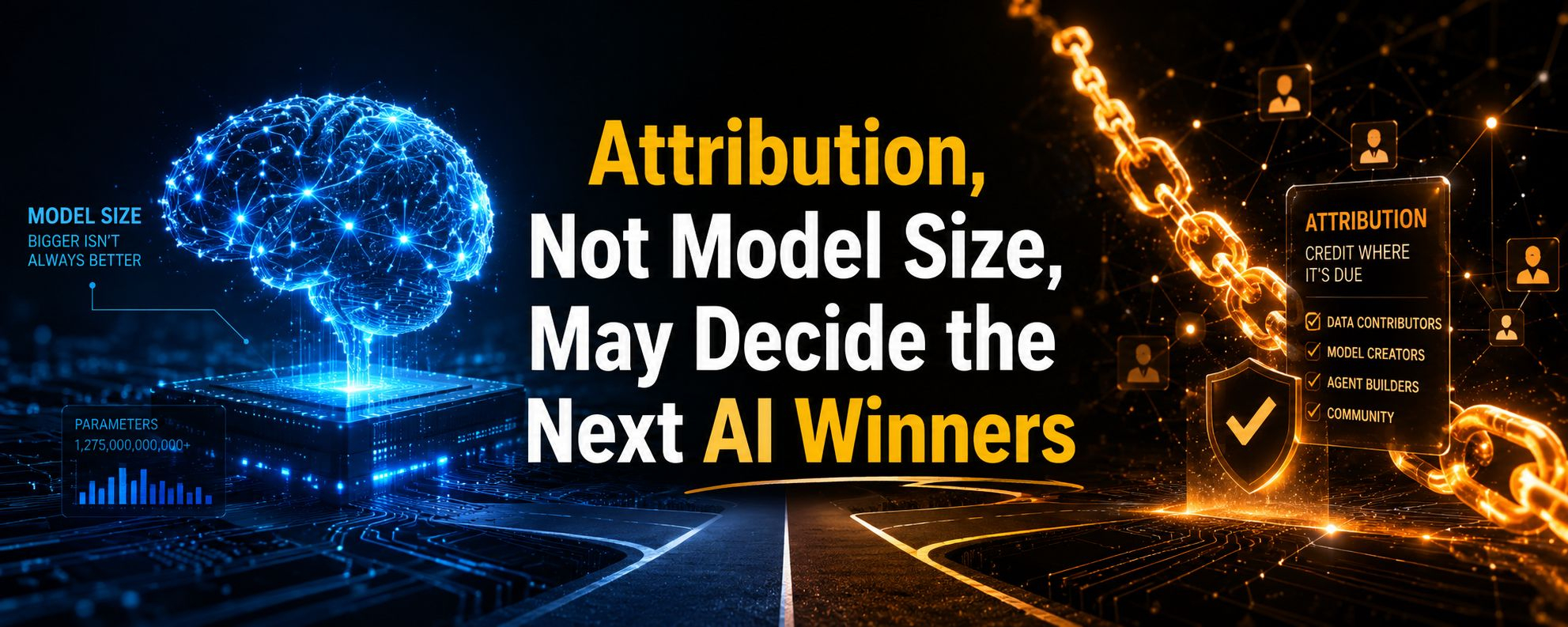
For the last two years, the AI race has mostly been framed around one thing: who has the biggest model. More parameters, more GPUs, more funding. But the deeper shift happening underneath the surface has less to do with size and more to do with ownership.
That is why OpenLedger caught my attention.
Most AI projects still treat data like invisible fuel. It goes in, the model improves, and nobody really knows which contributor created value inside the final output. OpenLedger approaches the problem differently. The idea is simple but powerful: if AI is built on contributions from people, datasets, models, and agents, then those contributions should be traceable and monetizable.
That changes the conversation completely.
Because once attribution becomes reliable, AI stops being just a technology layer and starts becoming an economic layer.
Right now, the AI industry has a strange imbalance. Everyone talks about scaling models, but very few talk about scaling trust. And trust is becoming the real bottleneck. Enterprises want explainability. Creators want ownership. Developers want transparent reward systems. Regulators want provenance. Users increasingly want to know where outputs actually come from.
A bigger model alone does not solve any of that.
In fact, I think the market is slowly realizing that raw intelligence is becoming commoditized faster than expected. Open source models are improving quickly. Smaller specialized models are getting stronger. Retrieval systems are reducing the need for giant parameter counts. The gap between “good enough” models keeps shrinking.
So the next competitive advantage may not come from producing the smartest output.
It may come from proving where the output came from.
That is where attribution becomes more valuable than scale itself.
You can already see hints of this shift across the ecosystem. Provenance standards are gaining traction. AI companies are emphasizing source transparency more aggressively. Onchain AI projects are experimenting with contributor rewards instead of centralized ownership. OpenLedger sits directly in that direction, especially with its focus on monetizing data, models, and agents through attribution infrastructure instead of just competing in the endless model-size war.
The interesting part is that attribution also changes incentives.
When contributors can actually be identified and rewarded, data quality suddenly matters more than data quantity. Smaller high-signal datasets become economically valuable. Niche experts become more important. Specialized agents become assets instead of disposable tools.
That creates a very different AI economy from the one we have today.
The market still thinks the biggest AI companies will win because they own the largest models. I am not fully convinced anymore. History shows that infrastructure layers controlling ownership and monetization often become more powerful than the layers generating raw content itself.
Search engines did not win because they created the internet. App stores did not win because they built apps.
They won because they controlled attribution, discovery, and economic routing.
AI may be heading toward the same outcome.