
Most discussions around AI focus on scale.
Larger models.
More compute.
More parameters.
But scaling intelligence alone does not solve one of AI’s deepest structural problems: attribution.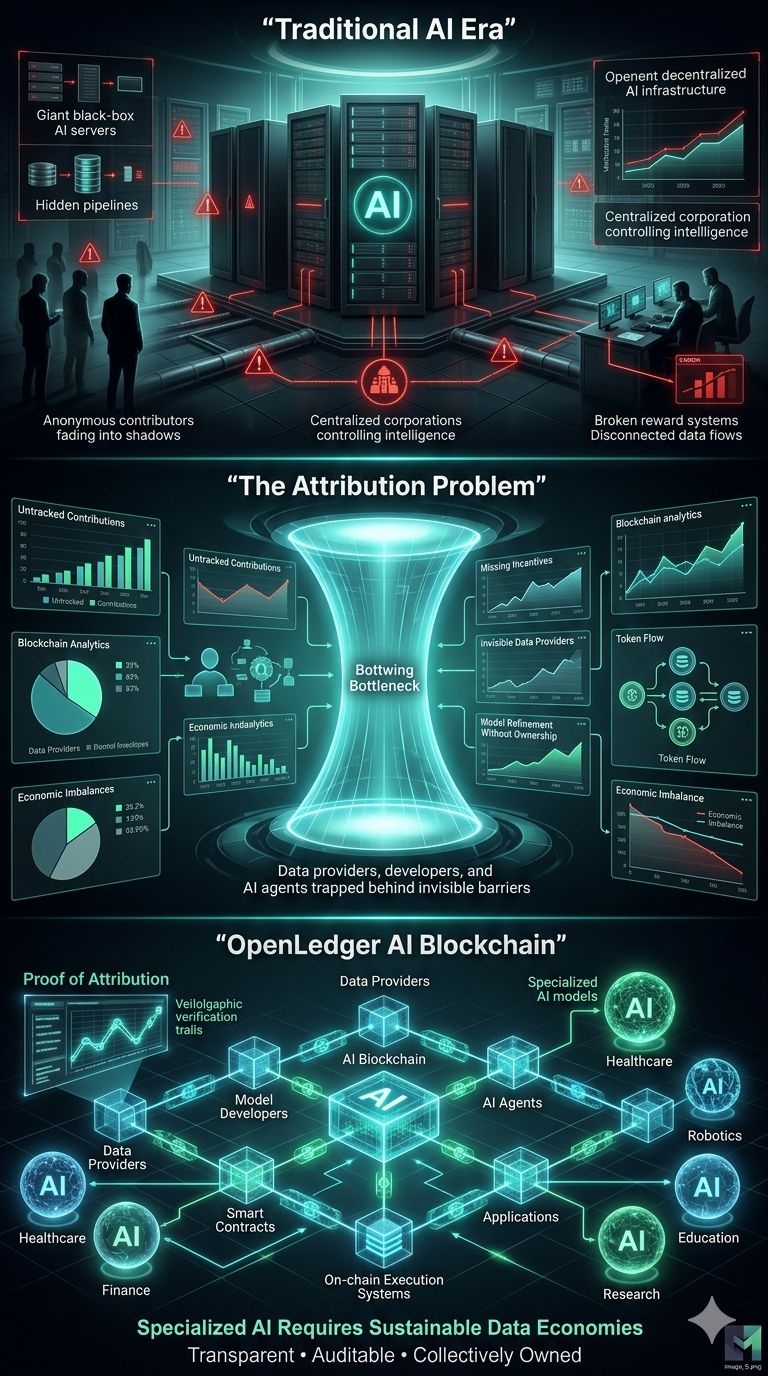

As AI systems become increasingly specialized, they require high-quality datasets tailored to specific industries, workflows, and real-world environments. The challenge is that today’s AI infrastructure offers very little transparency around where that data comes from, who improved the models, or how contributors should be rewarded.
This creates an economic imbalance.
Data providers often remain invisible.
Model refinements are difficult to trace.
Contributors generate value without receiving proportional incentives.
OpenLedger is attempting to redesign this framework through what it calls the AI Blockchain.
The key concept is Proof of Attribution — an on-chain mechanism designed to track contribution, provenance, and influence throughout the AI lifecycle.
Instead of treating AI development as a closed process, OpenLedger introduces transparent coordination between:
• Data providers
• Model developers
• AI agents
• Applications
• On-chain execution systems
This approach becomes increasingly relevant as the market shifts toward specialized AI rather than purely general-purpose systems.
Specialized models require sustainable access to niche datasets.
And sustainable datasets require economic alignment.
That is where attribution becomes critical infrastructure.
If contributors can verifiably prove impact, new AI economies can emerge around:
- Data monetization
- Model refinement
- Collaborative training
- Agent coordination
- Decentralized AI applications
The broader implication is important.
AI may eventually evolve from centralized black-box systems into open networks where intelligence creation is transparent, auditable, and collectively owned.
OpenLedger is positioning itself directly within that transition.