

The internet has always had a quiet imbalance inside it.
People contributed everywhere.
They wrote tutorials, answered questions, uploaded datasets, shared code, fixed mistakes, explained ideas, translated knowledge, reviewed products, trained communities, and built small pieces of value that later became part of something much bigger.
Most of them were never paid for it.
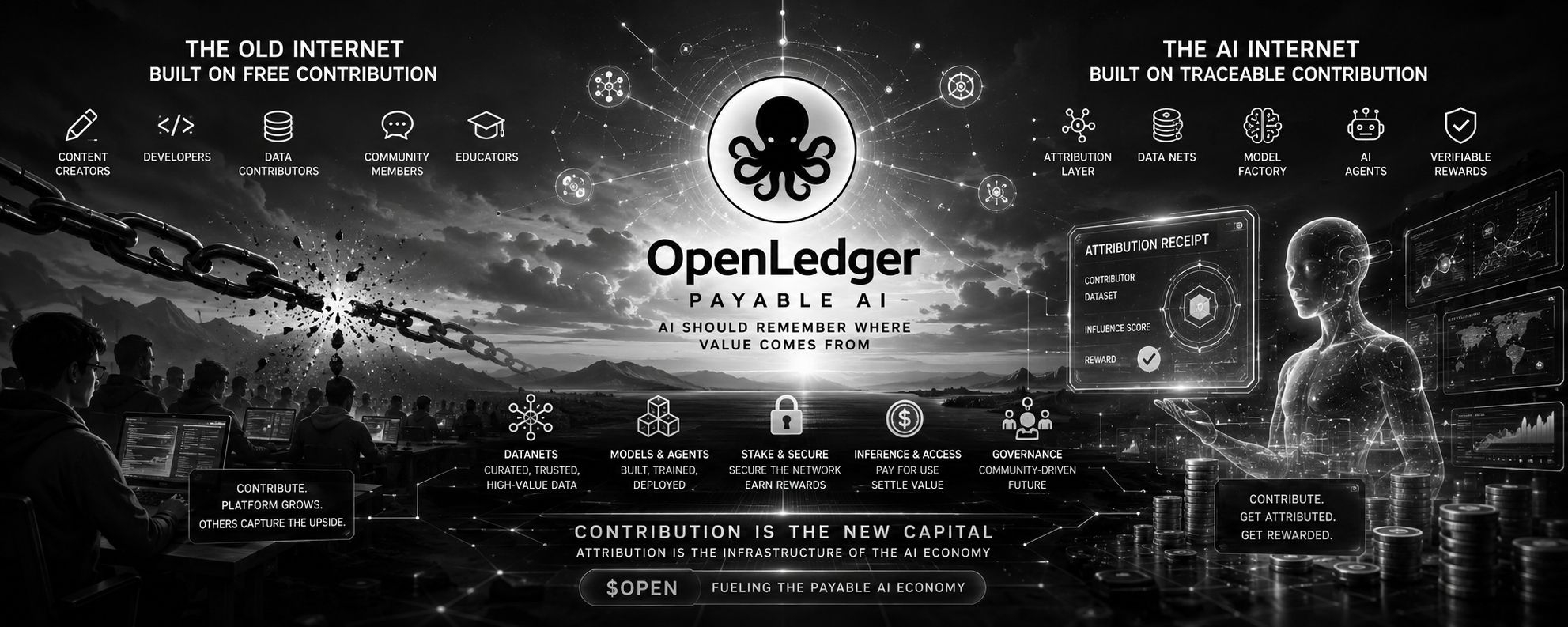
That was the old internet deal.
You contribute.
A platform grows.
Someone else captures the upside.
For years, this felt normal because the internet still sent people back to the source. A blog could get traffic. A forum answer could build reputation. A creator could turn attention into income.
But AI changes the deal completely.
AI does not simply send people to information. It consumes information, learns from it, compresses it, and gives the answer back as if the value appeared from nowhere.
That is why OpenLedger feels important to me.
Not because it is another AI blockchain project. There are already too many projects trying to wear that label.
OpenLedger is interesting because it is asking a more uncomfortable question:
If AI becomes valuable because of human and machine contributions, why should those contributions remain invisible?
This is where the idea of Payable AI begins to make sense.
The current AI economy is full of hidden labor. Data improves models. Fine-tuning improves performance. Domain knowledge makes outputs more accurate. Human corrections reduce mistakes. Specialized datasets give models an edge.
But once the model produces something useful, the contribution trail usually disappears.
OpenLedger is trying to bring that trail back.
Its core idea is attribution. Not in the shallow sense of saying “this data belongs to someone,” but in the deeper sense of asking how much a specific contribution actually influenced an AI result.
That difference matters.
Ownership is easy to talk about. Influence is much harder to measure.
A dataset may sit unused and have no real value. But if that same dataset helps a model answer legal questions better, improve a financial agent, or make a medical assistant more reliable, then it has created value. OpenLedger wants that value to be traceable and, eventually, payable.
This is where its DataNets become important.
A DataNet is not just a random folder of information. It is a focused data layer around a specific subject or use case. Instead of feeding AI with a messy ocean of general internet content, OpenLedger is trying to organize specialized data into useful networks.
That makes sense because the next phase of AI will probably not be won by the model that knows a little about everything. It may be won by models and agents that know specific things extremely well.
A healthcare AI needs trusted medical data.
A trading agent needs reliable market context.
A legal model needs structured legal knowledge.
A robotics agent needs real-world operational data.
General intelligence sounds exciting, but specialized intelligence is where a lot of real economic value appears.
The problem is that specialized data does not appear for free forever.
Experts, communities, researchers, developers, validators, and contributors need a reason to keep improving it. OpenLedger’s bet is that if those contributions can be traced, they can also become part of a reward system.
That is where OPEN becomes more than a token sitting beside the story.
The token’s role is tied to network activity: gas, staking, attribution rewards, inference fees, access to models, DataNet usage, governance, and ecosystem incentives.
That gives OpenLedger a very clear test.
The question is not whether the narrative sounds good.
The question is whether real usage can create real demand.
Are people building DataNets?
Are developers registering models?
Are agents using the network?
Are inference payments happening?
Are contributors being rewarded in a way that feels fair?
Is OPEN connected to actual AI activity rather than just market attention?
That is what matters.
The mainnet launch made this more serious because it moved OpenLedger from concept into execution. Before mainnet, Payable AI could be treated as a strong idea. After mainnet, it has to prove whether the idea can survive contact with real users, real data, and real economic behavior.
And this is where I think OpenLedger’s biggest opportunity sits.
AI is moving toward agents.
Agents will not behave like normal apps. They may hire other agents, pay for data, call models, use memory, verify outputs, and complete tasks without a human approving every small action.
But if agents are going to operate economically, they need infrastructure for trust.
They need to know what they are using.
They need to know who should be paid.
They need to know whether an output came from reliable sources.
They need to settle value quickly.
In other words, AI agents need receipts.
OpenLedger is trying to become that receipt layer.
That framing is more interesting to me than simply calling it “AI x blockchain.” Blockchain alone does not make AI better. But a transparent settlement layer for attribution, rewards, staking, model access, and agent activity could solve a real coordination problem.
The old internet was built around attention.
The next AI internet may be built around contribution.
That is a major shift.
Still, OpenLedger has difficult problems to solve.
Attribution is not simple. AI outputs are shaped by many signals at once. A single answer may be influenced by training data, fine-tuning, prompts, adapters, validation, and previous model behavior. Measuring who contributed what is not as clean as splitting revenue from a normal sale.
There is also the quality problem.
Once people are paid to contribute data, some will contribute useful knowledge. Others may try to game the system. If OpenLedger rewards volume more than value, the network could attract noise. The real challenge is not just collecting data. It is building a system where high-quality contribution wins.
Then there is the adoption problem.
Developers are practical. They will not use OpenLedger only because the idea sounds fair. They will use it if it gives them better data, better monetization, better transparency, or a better way to launch AI models and agents.
That is why the ecosystem pieces matter: AI Studio, Model Factory, OpenLoRA, DataNets, staking, explorer activity, and the wider push toward agent infrastructure. Each of these pieces only matters if they reduce friction for builders or increase value for contributors.
Otherwise, they are just features.
For me, the most compelling part of OpenLedger is not that it is trying to make data ownable.
It is that it is trying to make contribution visible.
That is a much bigger idea.
The internet trained us to accept that value can be extracted from millions of small contributions without ever paying the people behind them. AI takes that extraction to another level because it can turn those contributions into direct outputs, products, agents, and revenue.
OpenLedger is pushing back against that old pattern.
It is saying that if AI learns from people, improves through people, and earns because of people, then those people should not disappear from the economic map.
That does not mean OpenLedger has already solved the problem. It still has to prove attribution can work at scale. It has to prove rewards can be fair. It has to prove developers and data contributors will keep coming back. It has to prove OPEN can be tied to real utility, not just speculation.
But the direction feels relevant.
Because AI is not only creating a new technology market. It is creating a new ownership problem.
Who owns the value inside intelligence?
Who gets paid when a model improves?
Who benefits when an agent performs better because of shared data?
Who receives credit when invisible contribution becomes visible output?
OpenLedger’s answer is simple but powerful:
AI should not just generate value.
It should remember where the value came from.
That is why I think the project deserves attention.
Not as a perfect solution.
Not as a guaranteed winner.
But as one of the more serious attempts to redesign the economics behind AI.
The internet was built on free contribution.
OpenLedger is betting the AI era cannot afford to repeat that mistake.
