
A user does not care how many hands touched an AI answer. They ask, they get a response, and they move on.
OpenLedger is interesting because it refuses to let that moment stay that simple.
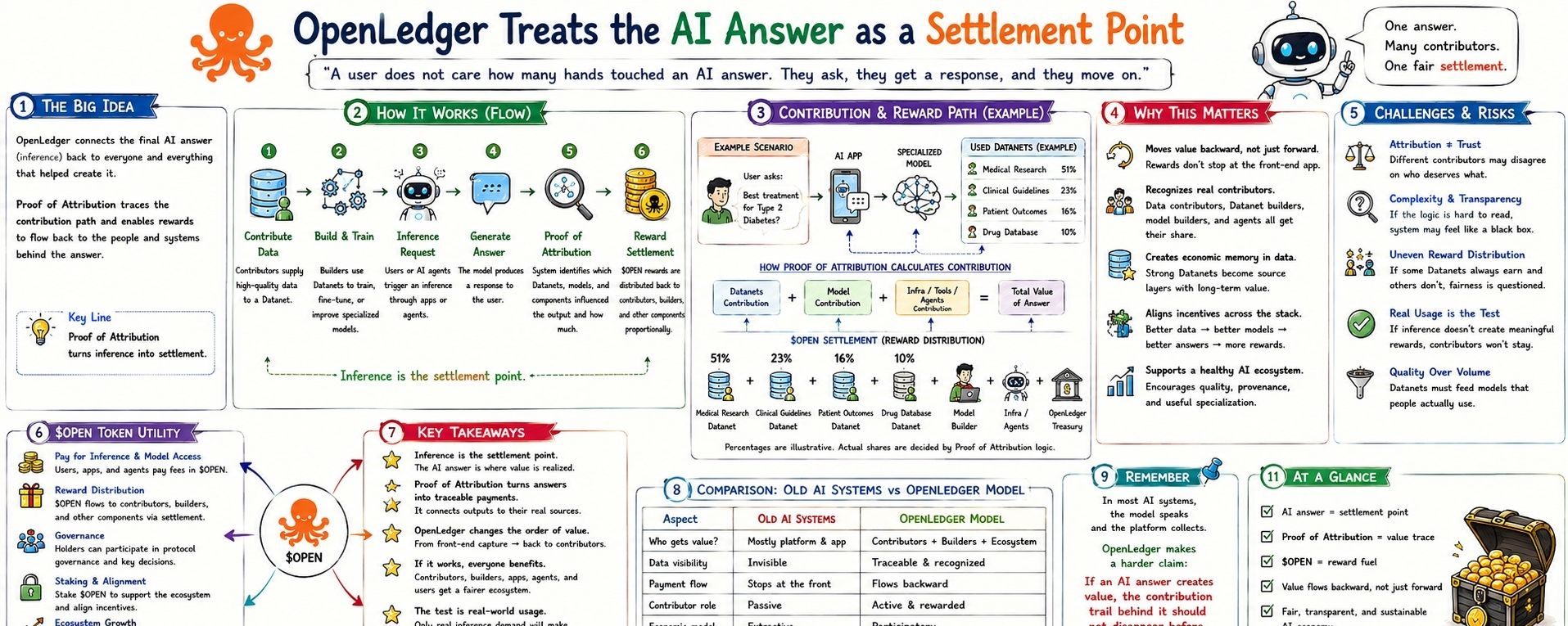
Behind one AI response, there may be a Datanet, a dataset contributor, a model builder, a fine-tuned model, an AI app, and maybe even an agent calling that model again and again. OpenLedger’s Proof of Attribution is trying to connect that final inference back to the people and systems that helped create it. If that route works, $OPEN is not just attached to a broad AI story. It becomes part of the reward path behind the answer.
That is the part worth paying attention to.
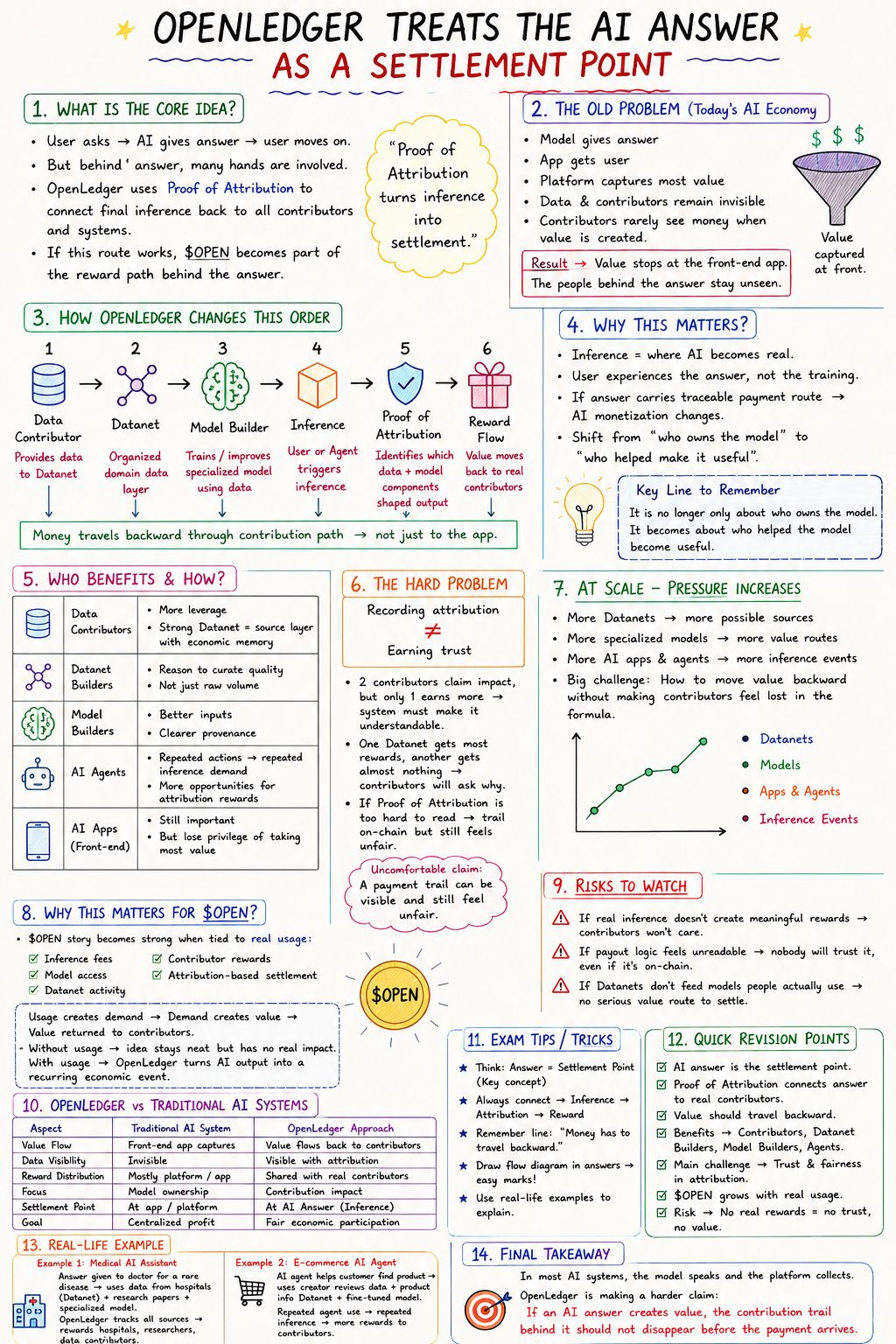
Most AI products put the model at the front of the economy. The model gives the answer, the app gets the user, and the platform usually captures the value. The data behind that answer becomes invisible. The person who contributed useful domain data, or helped build a better Datanet, or supported a specialized model, rarely stays visible when the money arrives.
OpenLedger is trying to change that order.
The mechanism is not hard to understand. A contributor helps supply data into a Datanet. A builder uses that data to train or improve a specialized model through OpenLedger’s AI stack. A user or agent triggers an inference. Proof of Attribution then tries to identify which data and model components shaped the output. From there, reward flow can move back through the contribution path instead of stopping only at the front-end app.
Proof of Attribution turns inference into settlement.
That line matters because inference is where AI becomes real. Training is important, but the user does not experience a training run. The user experiences the answer. If OpenLedger can make that answer carry a traceable payment route, then AI monetization starts to look very different.
It is no longer only about who owns the model.
It becomes about who helped the model become useful.
This gives useful contributors more leverage. A strong Datanet is no longer just a pile of data waiting to be used by someone else. It can become a source layer with economic memory. A model builder is no longer only selling access to a model. They are working inside a system where the ingredients behind the model can also be recognized. Even AI agents become more interesting here, because repeated agent actions can create repeated inference demand, and repeated inference demand is where attribution rewards have to prove they are real.
But there is a hard problem inside this design.
Recording attribution is not the same as earning trust.
If two contributors both believe their data shaped a model’s answer, but only one earns more, the system has to make that difference feel understandable. If one Datanet keeps receiving rewards while another gets almost nothing, contributors will ask why. If Proof of Attribution becomes too hard to read, OpenLedger could put the trail on-chain and still leave people feeling like value is being decided inside another black box.
That is the uncomfortable claim: a payment trail can be visible and still feel unfair.
This is where OpenLedger’s idea becomes serious. It is not just building a reward feature. It is building an economic argument about who deserves to be paid when AI creates value. That argument has to survive real usage, not just sound clean in a project description.
At scale, the pressure gets sharper. More Datanets means more possible sources. More specialized models means more routes for value to move through. More AI apps and agents means more inference events. The system has to decide how value moves backward without making contributors feel lost in the formula.
If it works, the power shift is clear.
Useful data contributors gain a stronger claim on the AI economy. Datanet builders gain a reason to curate quality instead of chasing raw volume. Model builders gain better inputs and clearer provenance. Front-end AI apps still matter, but they lose the old privilege of quietly absorbing most of the value just because they are closest to the user.
The money has to travel backward.
That is why this angle matters for $OPEN. The token story becomes stronger when it is tied to actual usage: inference fees, model access, Datanet activity, contributor rewards, and attribution-based settlement. Without that usage, the idea stays neat. With it, OpenLedger can turn AI output into a recurring economic event.
The risk is just as clear. If real inference does not create meaningful rewards, contributors will not care how elegant the attribution system sounds. If the payout logic feels unreadable, they will not trust it just because it is on-chain. If Datanets do not feed models people actually use, there is no serious value route to settle.
So the answer on the screen is not the whole product.
For OpenLedger, the real question starts after the model replies: who helped make that answer valuable, and does the money find its way back to them?
In most AI systems, the model speaks and the platform collects.
OpenLedger is making a harder claim: if an AI answer creates value, the contribution trail behind it should not disappear before the payment arrives.
