

I’ve been trying to understand OpenLedger for a while now, not in the way you skim a whitepaper and move on, but in the slower, more skeptical way you end up approaching anything that claims to sit at the intersection of AI and blockchain. It’s a crowded intersection. Everyone is building something “decentralized,” everyone is attaching “AI” to their architecture, and almost everyone is quietly converging on the same problem: none of it matters unless the system can actually coordinate value between machines, data, and humans without collapsing into abstraction.
So when I first started looking into OpenLedger’s Octoclaw launch, I didn’t treat it as an event. I treated it like a signal. Something you watch from a distance while trying to figure out whether it’s noise, or whether it’s the beginning of a longer structural shift that most people will only recognize in hindsight.
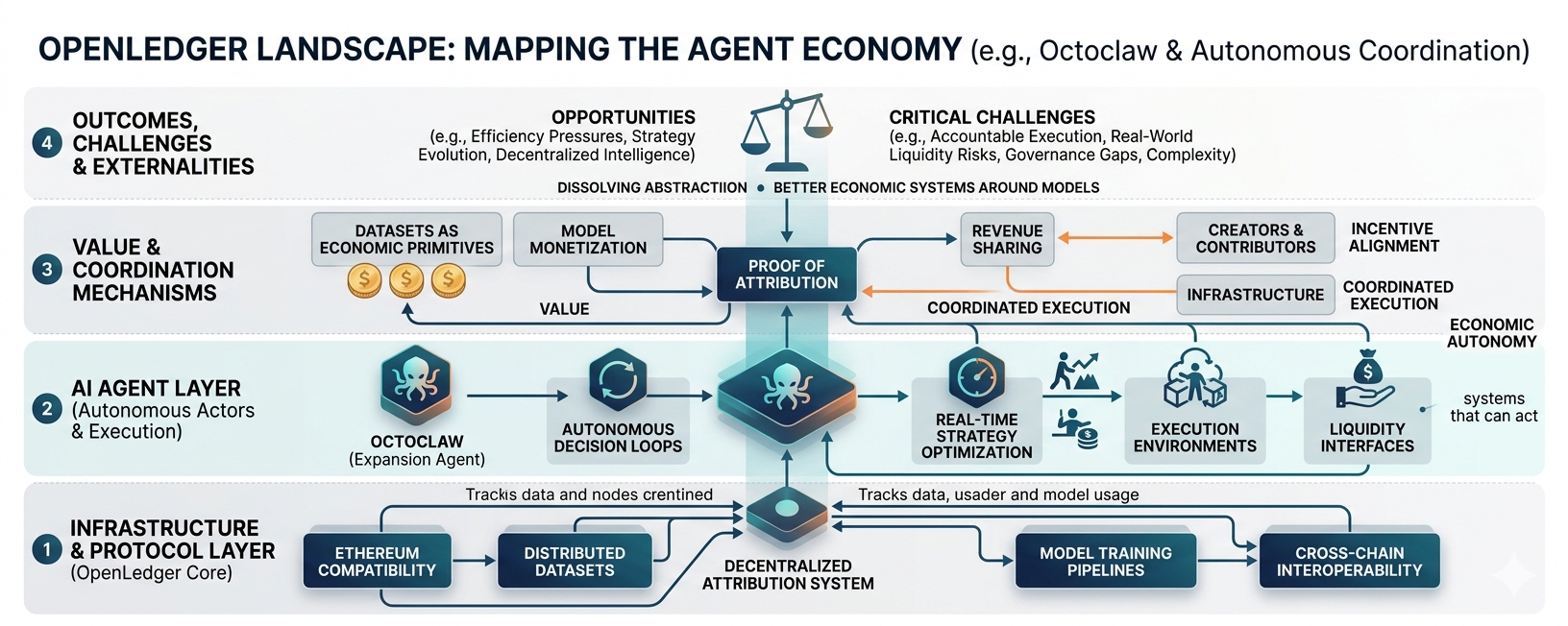
Octoclaw, at least in its framing, is positioned as an expansion of agent-driven infrastructure inside OpenLedger’s broader AI blockchain vision. But the interesting part isn’t the branding. It’s the direction it implies: AI systems that don’t just respond anymore, but execute. Agents that don’t sit idle waiting for prompts, but operate closer to autonomous economic participants.
That’s where things start to feel different.
Because we’ve already seen AI assistants. We’ve already seen copilots. We’ve even seen early agent frameworks that simulate decision-making loops. But most of them still feel like tools. Useful, yes, but fundamentally passive. They wait. They suggest. They optimize within boundaries set by humans.
Octoclaw, as part of this broader narrative, feels like an attempt—maybe still early, maybe still fragile—to move beyond that layer. Toward something more uncomfortable: systems that can act.
And honestly… that changes everything.
Not because autonomy is new, but because economic autonomy inside decentralized systems forces you to confront questions that most crypto projects quietly avoid. Who is accountable when an agent executes a trade that drains liquidity incorrectly? Who is liable when a model trained on misattributed data generates financial loss? And more importantly, how do you even define ownership when output is no longer traceable to a single human decision-maker?
OpenLedger’s framing around AI blockchain infrastructure seems to sit directly inside this tension. The idea of monetizing data, models, and agents sounds clean on paper, almost elegant. Proof of attribution, revenue sharing, datasets turning into economic primitives. But the real complexity appears when you try to imagine it functioning under real market conditions, where incentives shift faster than governance can react.
The infrastructure layer is the part most people ignore.
Everyone likes to talk about agents, about autonomy, about decentralized intelligence. But very few people want to sit with the reality that none of this works without a reliable attribution system that survives adversarial behavior. If OpenLedger is attempting to build that foundation, then Octoclaw becomes more than just a launch. It becomes a stress test of whether coordinated AI execution can exist without collapsing into centralized control.
And I keep coming back to that tension between decentralization and coordination.
Because in theory, decentralized AI sounds inevitable. Centralized models are already showing their limits: data silos, opaque training pipelines, regulatory pressure, geopolitical fragmentation. It feels almost obvious that intelligence systems will eventually need to be distributed the same way finance became distributed. But theory has never been the hard part. Execution is.
Execution is where most projects quietly fail.
Especially in the intersection of AI and crypto, where both fields are evolving faster than the infrastructure supporting them. You can design an elegant agent system, but if it cannot reliably interface with real-world liquidity, real execution environments, and real cross-chain constraints, it becomes an experiment rather than an economy.
And that’s where OpenLedger’s ambition becomes interesting again. The idea of cross-chain coordination through agents suggests a future where execution is abstracted away from human traders entirely. Where strategies are no longer manually deployed but continuously optimized by autonomous systems reacting to liquidity conditions in real time.
I’ve spent enough time watching markets to know how quickly that kind of abstraction can go wrong.
Because speed is an advantage until it becomes uncontrollable. Automation is an edge until it starts compounding errors faster than humans can intervene. We already see this in high-frequency trading environments where latency isn’t just a metric—it’s survival. Now imagine that same dynamic, but extended to autonomous AI agents managing multi-chain capital flows with partial or probabilistic understanding of their own constraints.
That’s not just a technical shift. That’s a structural redefinition of what “strategy” even means.
Strategy stops being something a human designs and becomes something that evolves.
And I don’t think the market has fully internalized what that implies yet.
OpenLedger’s emphasis on data ownership and attribution sits at the core of this problem. If datasets become monetizable assets, and models become composable economic units, then every output in the system carries a lineage of value. That sounds fair in theory. Creators get compensated, contributors get attribution, and AI systems become more transparent.
But the more I think about it, the more I wonder how messy attribution becomes in practice. Machine learning models don’t operate in clean causal chains. Outputs are statistical blends of thousands of influences. At what point does attribution become symbolic rather than accurate? And if it becomes symbolic, does the economic layer built on top of it still hold integrity?
This is where centralized AI systems currently have an advantage—they don’t need to solve attribution. They absorb it internally. The cost is opacity, but the benefit is control.
Decentralized systems, on the other hand, inherit the opposite problem: transparency without guaranteed coherence.
And somewhere between those two extremes, projects like OpenLedger are trying to carve out a middle path.
Octoclaw, in that sense, can be interpreted less as a product and more as a coordination experiment. A test of whether agent-based systems can operate under economic rules that are verifiable, distributed, and incentive-aligned.
But I remain cautiously curious.
Because every time I’ve seen “agent economies” discussed in crypto circles, there’s a tendency to skip over the hardest part: real-world integration. It’s one thing to simulate autonomous behavior inside controlled environments. It’s another thing entirely to let those systems interact with live markets, where slippage, manipulation, latency arbitrage, and unpredictable human behavior dominate outcomes.
And yet, despite all of that skepticism, I can’t dismiss the direction entirely.
There is something structurally inevitable about AI systems becoming economic actors. Not because it sounds futuristic, but because efficiency pressures in markets always push toward automation. Humans are slow. Humans are emotional. Humans introduce variance. And markets, over time, tend to price out inefficiency wherever possible.
So the question is not whether autonomous agents will participate in markets. The question is what kind of infrastructure will govern them when they do.
Ethereum compatibility and broader ecosystem integration matter here more than people realize. If systems like OpenLedger remain isolated, they become niche ecosystems. But if they can plug into existing liquidity layers, composability increases dramatically. The challenge, of course, is maintaining security and trust while expanding surface area. Every new integration becomes another potential attack vector, another assumption that can fail under adversarial conditions.
And this is where regulatory uncertainty starts to loom in the background.
Because once AI agents begin executing financial decisions at scale, regulators are no longer dealing with human traders—they’re dealing with partially autonomous systems whose decision logic may not be fully interpretable in real time. That creates a governance gap that existing frameworks are not prepared for. Whether that leads to stricter control or more adaptive regulatory systems is still unclear, but the pressure will inevitably increase as these systems evolve.
The more I sit with it, the more OpenLedger feels less like a single project and more like a bet on a future architecture of coordination. A belief that the next evolution of AI won’t just be better models, but better economic systems around those models.
Still, belief is not execution.
And execution is where narratives usually break.
Most AI + crypto projects don’t fail because the idea is wrong. They fail because the system they are trying to build requires simultaneous breakthroughs in multiple difficult domains: cryptography, distributed systems, machine learning, market design, and governance. Any one of those domains can stall progress.
Octoclaw, if it is meaningful, will eventually be judged not by its launch, but by its ability to sustain behavior under pressure. Under adversarial conditions. Under real economic load.
That’s the part we don’t see in announcements.
We only see the surface.
But underneath, the real question is still the same one I started with: can decentralized AI infrastructure actually coordinate value better than centralized systems, or does it eventually converge back toward centralization under the weight of complexity?
I don’t think there’s a clean answer yet.
What I do know is that systems like OpenLedger are pointing at a direction that feels increasingly hard to ignore. Even if they don’t fully succeed in their current form, they are mapping out a design space that will likely be revisited again and again as AI becomes more embedded in economic systems.
And Octoclaw, whether it becomes a meaningful step or just another early experiment, sits inside that exploration phase where ideas are still fluid and outcomes are still uncertain.
Maybe that’s the most honest way to look at it.
Not as a revolution already happening, but as a set of systems trying—imperfectly, and somewhat audaciously—to define what coordination between intelligence and capital is supposed to look like when neither is fully human anymore.
And I keep thinking… we’re still early in that conversation.