
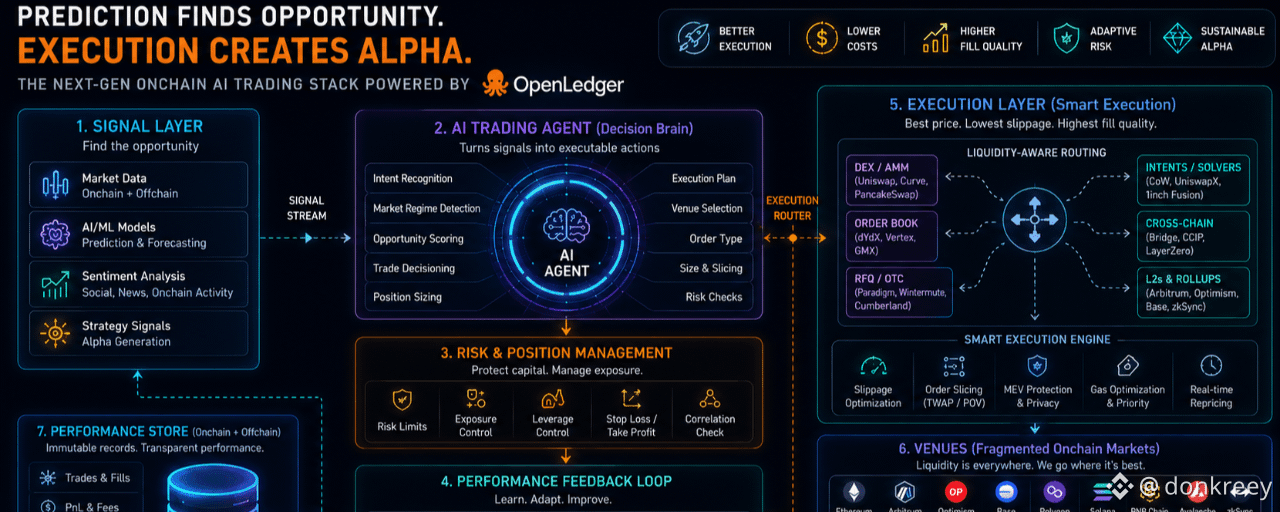
Most conversations around AI trading still focus almost entirely on prediction accuracy — finding the next move before everyone else. But in fragmented onchain markets, prediction alone is no longer enough. The real edge is increasingly coming from execution quality. As autonomous trading systems evolve, the infrastructure behind the trade matters just as much as the signal itself. Modern AI trading stacks are shifting toward real-time signal ingestion, liquidity-aware routing, slippage optimization, dynamic risk management, cross-venue coordination, and continuous performance feedback loops. In decentralized environments where liquidity is fragmented across multiple venues and latency varies constantly, poor execution can completely erase a profitable prediction. This is why the next generation of onchain AI systems will likely compete less on “who predicts better” and more on “who executes smarter.” The ability to adapt position sizing, manage exposure dynamically, minimize execution costs, and respond instantly to changing market conditions is becoming the true differentiator. Execution is no longer a backend detail. In modern onchain trading infrastructure, execution itself has become part of the alpha.
Prediction Finds Opportunity. Execution Creates Alpha. The Next Evolution of Onchain AI Trading with OpenLedger
Most conversations around AI trading still revolve around one thing: prediction accuracy. The industry remains obsessed with finding the next market move before everyone else — better models, faster signals, and increasingly complex forecasting systems.
But in modern onchain markets, prediction alone is no longer enough.
As decentralized liquidity becomes increasingly fragmented across DEXs, order books, RFQ systems, bridges, rollups, and appchains, the real competitive edge is shifting away from prediction and toward execution quality.
In this new environment, execution itself has become part of the alpha.
The Problem with Prediction-Only AI Trading
A profitable signal means very little if execution destroys the trade before it settles.
Two AI agents can generate the exact same prediction:
One captures profit efficiently. The other loses value through slippage, latency, failed fills, MEV exposure, poor routing, or fragmented liquidity access.
The difference is no longer intelligence alone.
The difference is infrastructure.
In decentralized markets:
liquidity constantly moves, gas conditions fluctuate, execution latency changes block by block, and market depth varies across venues in real time.
Without intelligent execution infrastructure, even highly accurate predictions can become unprofitable.
This is why the next generation of AI trading systems will compete less on:
“Who predicts better?”
and more on:
“Who executes smarter?”
The Rise of Execution-Centric AI Systems
Modern AI trading architecture is evolving far beyond simple signal generation.
Instead of acting as isolated forecasting engines, next-generation systems are becoming fully autonomous trading stacks capable of:
ingesting real-time market signals, evaluating fragmented liquidity, dynamically managing risk, optimizing execution paths, adapting position sizing, and continuously learning from performance feedback.
Execution is no longer a backend process.
It is now an active intelligence layer.
OpenLedger and the New AI Trading Stack
OpenLedger represents this emerging shift toward execution-aware AI infrastructure.
Rather than focusing purely on predictive intelligence, the architecture emphasizes the full lifecycle of autonomous trading:
Signal Layer
The system continuously ingests:
market data, onchain activity, social sentiment, macro conditions, and strategy signals.
This creates a real-time stream of actionable market awareness.
AI Trading Agent
At the center sits the decision engine.
The AI agent evaluates:
opportunity quality, market regime, execution feasibility, venue selection, order structure, and position sizing.
The goal is not simply predicting direction.
The goal is converting signals into executable, risk-adjusted opportunities.
Risk & Position Management
Execution-aware systems must constantly adapt exposure.
Modern AI trading infrastructure now includes:
dynamic leverage control, slippage guardrails, stop-loss automation, exposure balancing, correlation monitoring, and volatility-sensitive position sizing.
Risk management becomes continuous rather than reactive.
Smart Execution Layer
This is where execution becomes alpha.
Instead of routing trades blindly, intelligent execution systems optimize for:
liquidity depth, slippage minimization, gas efficiency, fill probability, latency conditions, MEV protection, and cross-venue coordination.
The execution engine dynamically decides:
where orders should go, how large they should be, whether they should be split, and how market conditions impact expected execution quality.
This transforms execution into a real-time optimization problem.
Fragmented Liquidity Changes Everything
Onchain markets are fundamentally fragmented.
Liquidity now exists across:
AMMs, order books, intents systems, rollups, bridges, and multiple blockchain ecosystems.
The best execution path is constantly changing.
This means successful AI trading systems can no longer rely on static routing logic.
They require:
liquidity intelligence, adaptive execution, and continuous market-state awareness.
In fragmented markets, infrastructure intelligence becomes a competitive moat.
Why Execution Quality Compounds
Execution quality impacts every single trade.
Small improvements in:
slippage reduction, gas optimization, routing efficiency, fill consistency, and inventory management
can compound into significant long-term performance advantages.
This is especially important in high-frequency or autonomous systems where execution inefficiencies scale rapidly over time.
Prediction may identify opportunity.
Execution determines realized profit.
The Future: Autonomous Capital Allocation
The future of AI trading is likely moving toward fully autonomous capital allocators.
These systems will continuously optimize:
signal interpretation, execution timing, cross-chain liquidity access, exposure management, hedging, settlement efficiency, and portfolio adaptation.
At that point, AI trading stops being purely about forecasting.
It becomes about intelligent coordination across fragmented financial infrastructure.
The winners will not necessarily be the systems with the best predictions.
The winners will be the systems that:
adapt faster, execute smarter, manage risk dynamically, and compound efficiency over time. Execution Is the New Alpha
For years, prediction dominated the AI trading conversation.
But decentralized markets are changing the rules.
As onchain ecosystems grow more fragmented and execution complexity increases, the real edge is shifting toward infrastructure intelligence and adaptive execution systems.
Execution is no longer a backend detail.
In modern autonomous trading architecture, execution itself has become the alpha.
And platforms like #OpenLedger are helping define what that future looks like.
