
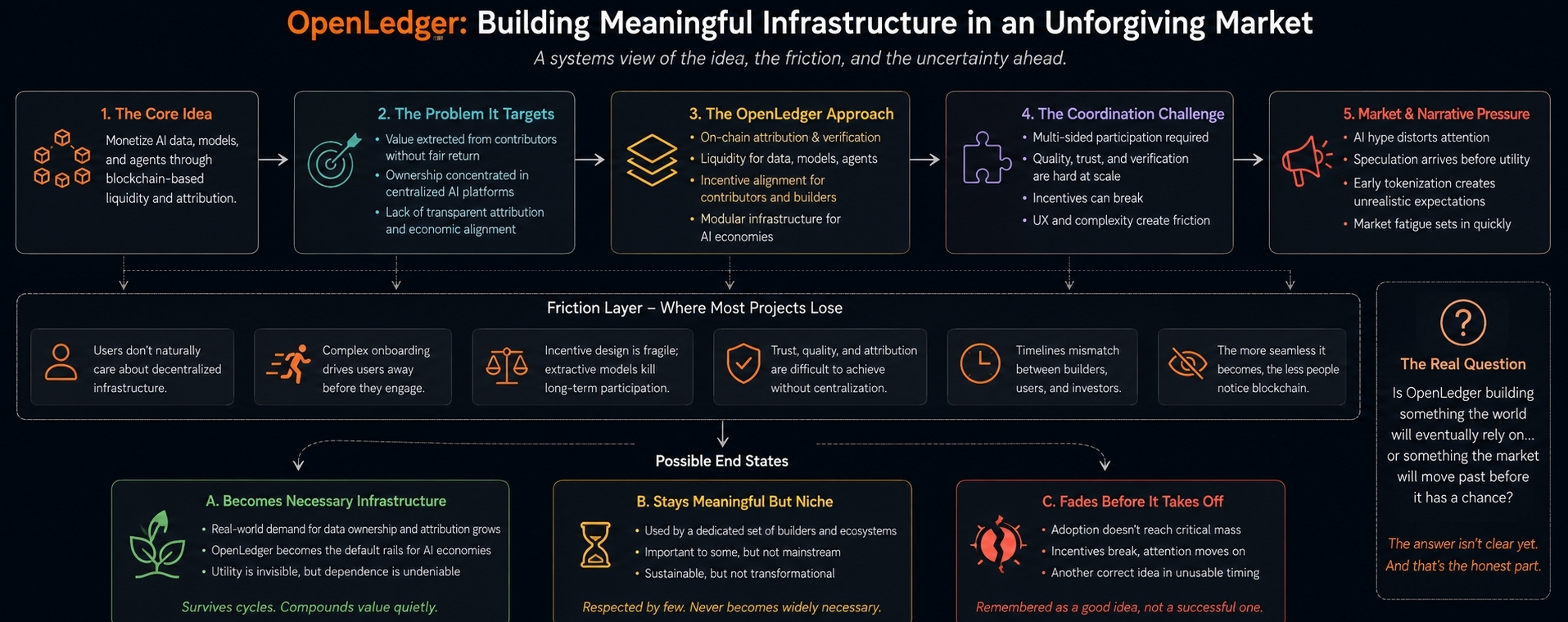
There’s a certain kind of crypto project that doesn’t arrive loudly.
No countdown timer. No artificial cult energy. No founder posting vague philosophical threads every six hours about reshaping civilization. Just a system appearing quietly in the background while the rest of the market screams over itself like it always does near the middle of a cycle.
OpenLedger feels like one of those projects.
Not invisible. Just restrained.
And maybe that’s why it caught my attention for longer than most AI-related tokens do now. The market has become so saturated with synthetic excitement that anything attempting seriousness almost feels suspicious. You stop trusting polished narratives after enough years in this space. Every cycle teaches the same lesson in different packaging. Strong branding can hide weak foundations for surprisingly long periods of time. Sometimes entire ecosystems are built on momentum alone. Then liquidity dries up and suddenly nobody remembers why the thing mattered in the first place.
That’s the emotional state a lot of older market participants live in now. Not bearish exactly. Just difficult to impress.
The AI narrative only intensified that fatigue. It became the new universal solvent for attention. Every project suddenly claimed to be building infrastructure for autonomous agents, decentralized intelligence, machine economies, synthetic labor. Most of it sounded assembled from leftover investor presentations. Words arranged to trigger funding rather than communicate ideas.
OpenLedger sits near that same narrative lane, but it doesn’t feel entirely manufactured.
At least not yet.
The premise underneath it is actually coherent. A blockchain framework designed around monetizing AI data, models, and agents sounds obvious once you hear it out loud. Which is usually where interesting ideas begin. Not with complexity, but with uncomfortable simplicity. AI systems consume enormous amounts of value from contributors who rarely benefit proportionally from what they help create. Data becomes fuel. Models become property. Ownership concentrates upward. OpenLedger is trying to introduce economic structure around that imbalance before it calcifies permanently.
That’s the theory anyway.
Crypto has always loved theories.
The difficult part starts when theories encounter actual human behavior.
People underestimate how fragile coordination systems really are. Especially decentralized ones. Everybody talks about incentives as if humans behave rationally once tokens are involved. They don’t. Most users abandon systems the second friction outweighs curiosity. They leave quietly too. No dramatic collapse. Just gradual absence. A wallet that stops interacting. A dashboard never reopened. Liquidity thinning at the edges until the ecosystem starts feeling hollow.
That’s the part whitepapers never capture properly.
OpenLedger’s architecture looks thoughtful. More thoughtful than most. There’s an awareness in the design that suggests the team understands the structural problems around AI ownership instead of simply chasing market trends. You can feel the difference when reading between the lines. Some projects are clearly engineered for immediate speculation. Others are trying to survive long enough to matter later.
Those are very different ambitions.
Still, surviving long enough to matter is brutally hard now.
The crypto market punishes patience almost mechanically. Infrastructure projects especially. Speculators arrive before utility exists, inflate expectations beyond reason, then disappear before the product has time to mature. What remains is usually a technically competent network carrying the emotional baggage of a failed price chart.
I’ve seen good ideas die that way more times than I can count.
Not because the technology failed completely. Because adoption arrived slower than capital expected. In crypto, timing mistakes are often fatal even when the underlying idea is correct.
And OpenLedger depends on timing more than people probably realize.
For a system like this to work meaningfully, several layers have to develop simultaneously. Data contributors need reasons to participate. Developers need incentive to build within the ecosystem. Buyers need confidence in quality and attribution. Verification mechanisms need trust. The economics need to remain attractive without turning predatory. That’s an enormous coordination burden.
Even worse, most normal users do not naturally care about decentralized AI infrastructure.
That sounds cynical but it’s true.
People care about convenience first. Outcomes second. Ideology somewhere far below both. The average person won’t participate in a decentralized data economy because it philosophically redistributes value more fairly. They’ll participate if it becomes easier, cheaper, or materially beneficial compared to existing systems.
Crypto still struggles with this reality.
It often builds for imagined future citizens instead of current human beings. Entire protocols designed around theoretical behavior patterns that collapse the second real users arrive with impatience and short attention spans. There’s always this assumption that people will endure complexity for the sake of decentralization. History keeps proving otherwise.
That tension sits underneath OpenLedger constantly.
The stronger and more seamless the product becomes, the less visible the blockchain layer should feel. Which creates a strange irony because crypto markets still reward visibility over invisibility. Speculators want narratives they can see. Infrastructure succeeds when nobody notices it anymore.
The internet itself worked that way. The foundational protocols became important precisely because ordinary people never had to think about them. Nobody romanticizes backend architecture while sending a message or opening a map application. Utility erases awareness over time.
I’m not sure crypto has emotionally accepted that yet.
There’s still this lingering obsession with identity. Chains wanting cultural relevance instead of functional dependence. Ecosystems trying to become movements before becoming useful.
OpenLedger feels more restrained than that, but the market around it definitely isn’t.
And the AI sector complicates everything further because attention is now heavily distorted. Investors are desperate to find exposure to anything adjacent to artificial intelligence before the next wave fully matures. That creates dangerous conditions for evaluation. Weak projects receive temporary legitimacy through association alone. Stronger projects get buried under the same noise because nobody separates infrastructure from marketing anymore.
Eventually the narrative overheats and people stop listening altogether.
That’s another thing long market cycles teach you. Fatigue matters more than optimism.
Sometimes technically impressive systems fail simply because the audience becomes emotionally exhausted before adoption arrives. Timing again. Wrong moment. Wrong atmosphere. The market moves on while the builders keep building anyway.
I could see something like that happening here.
Not because OpenLedger lacks intelligence behind it. If anything, the opposite concern exists. The project may actually be trying to solve problems too early, before users fully understand why the problems matter. That happens often in technology. Certain ideas appear before behavioral demand catches up. By the time the world finally needs the solution, the original builders are either forgotten or financially destroyed.
And honestly, there’s another uncomfortable possibility.
Maybe people don’t actually want ownership over their data in the active sense crypto imagines. Maybe they only want compensation once exploitation becomes impossible to ignore. Those are different emotional thresholds. One is philosophical. The other is reactive.
Markets tend to discover that distinction painfully late.
I keep coming back to the difference between meaningful systems and necessary systems. Crypto produces plenty of things that sound meaningful. Necessary is rarer. Necessary systems survive ugly conditions because users depend on them regardless of sentiment. Everything else eventually becomes optional entertainment for capital.
I don’t know which category OpenLedger falls into yet.
Some days it looks like one of the few AI-related crypto projects attempting to engage with real structural issues instead of decorative narratives. Other days it feels like another sophisticated framework waiting for a level of user participation that may never fully arrive.
Maybe both can be true at the same time.
That uncertainty is probably the most honest part of it.
