When I first looked at OpenLedger token, I thought the main question was whether the market would like another AI crypto narrative. That now feels too shallow. The real question is whether OPEN can move from being priced like a speculative story to being used like a quiet settlement tool inside an AI economy.
Speculative markets judge a token by attention first. Price, volume, listings, social rotation, and short bursts of belief matter more than actual usage. OPEN trading near $0.215 with around $30.4 million in 24 hour volume and about $62.5 million market cap shows exactly that early tension. The volume is large compared with the market cap, which means the token is still being actively traded as a liquid narrative, not yet calmly held as infrastructure.
But utility markets work differently. They do not ask whether a token sounds exciting. They ask whether real activity keeps returning to the token because the system needs it. In OpenLedger’s case, the surface story is AI plus blockchain. Underneath, the more important design is attribution, meaning the system tries to track which data, model, or contributor actually influenced an AI output. That matters because rewards only become fair when contribution can be seen.
The tokenomics create both foundation and pressure. OPEN has a total supply of 1 billion, with 21.55% listed as initial circulating supply and 61.71% allocated to community and ecosystem. That tells me the project is not only about today’s float. It is about whether future distribution can produce real participation instead of just future sell pressure. A large ecosystem allocation can fund growth, but if usage does not deepen, the same allocation becomes an overhang.
That is where speculative and utility markets separate. In speculation, supply unlocks are watched as price events. In utility, supply is judged by whether it pays for work that strengthens the network. If data contributors, model developers, validators, and users are only present during reward campaigns, the market remains fragile. If they stay because attribution creates repeatable income and better AI outputs, the token begins to earn its place.
The wider crypto environment makes this harder. Global crypto market cap is around $2.64 trillion, Bitcoin dominance is about 58.2%, and stablecoins sit near $320 billion, or 12.09% of the market. That means capital is still concentrated in safety, liquidity, and cash-like rails. Smaller AI tokens are not competing only with each other. They are competing with a market that is cautious and increasingly selective.
ETF behavior says the same thing from another angle. US spot Bitcoin ETFs still show about $57.7 billion in cumulative net inflows, but May 18 alone saw roughly $648.6 million in outflows. That contrast is important. It shows institutional access exists, but flows can still reverse quickly when macro pressure rises. In that kind of market, AI token narratives can move fast, but they also get tested faster.
Meanwhile, regulation is no longer just background noise. The US Senate Banking Committee advanced the Clarity Act in May 2026, but Reuters noted that its path still depends on negotiations and bipartisan support. For OpenLedger, that matters because real utility markets need predictable rules. If attribution, rewards, and token payments sit in unclear legal territory, serious builders may hesitate even if the technology works.
So my view is cautious but not dismissive. OPEN’s speculative market will probably keep reacting to AI sentiment, exchange liquidity, and broader risk appetite. But its real utility market will be built more slowly, through consistency, payout credibility, contributor quality, and whether Proof of Attribution survives messy real usage.
That momentum creates another effect. The token becomes less interesting as a symbol and more interesting as a coordination test. Can an AI network reward useful work without turning every participant into a short term optimizer? Can it make ownership feel earned instead of claimed? Can it keep value moving toward contribution rather than attention?
The market will price the story first. Utility will decide whether the story deserved a market at all.

مقالة
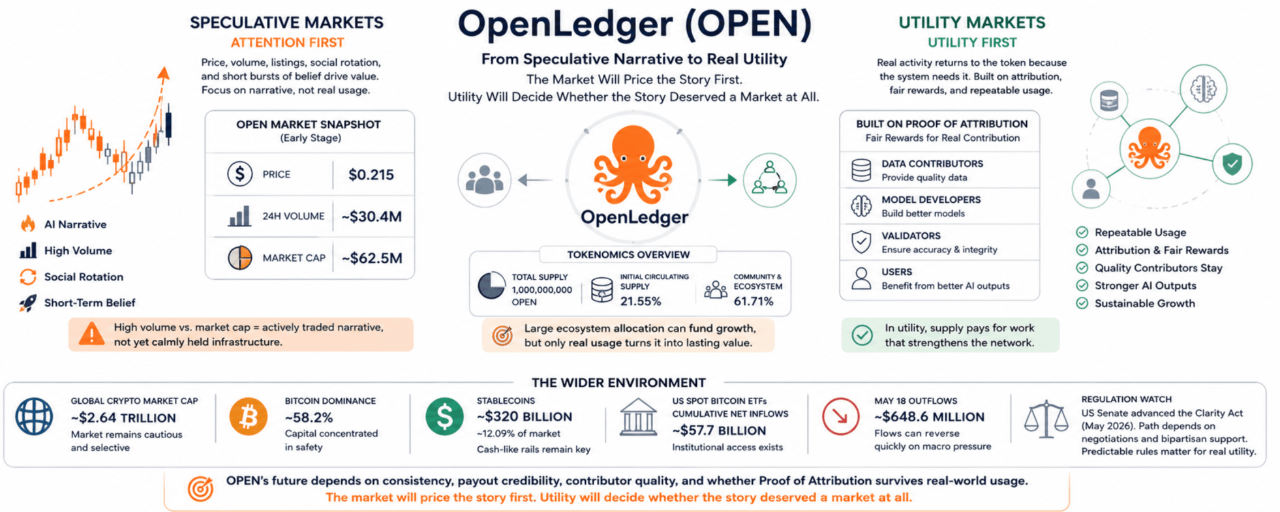
OpenLedger token in speculative markets versus real utility markets
إخلاء المسؤولية: تتضمن آراء أطراف خارجية. ليست نصيحةً مالية. يُمكن أن تحتوي على مُحتوى مُمول. اطلع على الشروط والأحكام.