
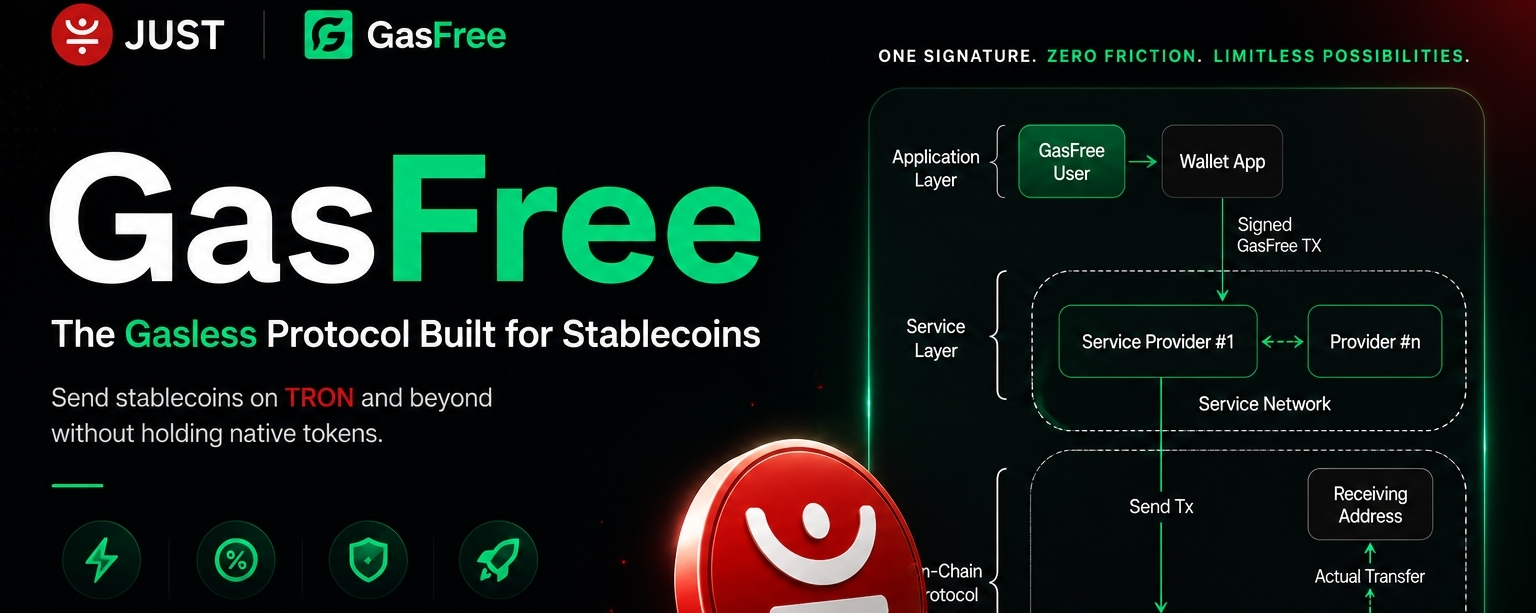
𝗚𝗮𝘀𝗙𝗿𝗲𝗲 𝗪𝗮𝗹𝗹𝗲𝘁 𝗢𝗻 𝗧𝗥𝗢𝗡
𝗛𝗼𝘄 𝗝𝘂𝘀𝘁𝗟𝗲𝗻𝗱 𝗗𝗔𝗢 𝗜𝘀 𝗥𝗲𝗺𝗼𝘃𝗶𝗻𝗴 𝗢𝗻𝗲 𝗢𝗳 𝗖𝗿𝘆𝗽𝘁𝗼’𝘀 𝗕𝗶𝗴𝗴𝗲𝘀𝘁 𝗨𝗫 𝗕𝗮𝗿𝗿𝗶𝗲𝗿𝘀
On March 4, JustLend DAO officially introduced GasFree a new infrastructure layer designed to eliminate one of the oldest and most frustrating problems in crypto transactions:
The need to hold a native gas token before being able to move your own assets.
At first glance, this may seem like a small technical improvement.
But in reality, it addresses one of the biggest barriers preventing blockchain from becoming truly mainstream.
And the timing matters.
As JustLend DAO approaches its 6th anniversary on May 20, GasFree represents more than a product launch.
It represents a major shift in how stablecoin transfers may function going forward especially on a network like TRON, where stablecoin activity already operates at global scale.
For years, users have accepted a strange contradiction in crypto:
You could hold thousands of dollars in stablecoins... But still be unable to send a single transaction because you lacked a few cents worth of native gas tokens.
GasFree changes that entire experience.
No TRX requirement. No manual gas calculations. No extra funding step. No friction between users and their assets.
Instead, stablecoins begin behaving the way digital money was always supposed to behave: Simple, direct, and usable.
𝗪𝗵𝗮𝘁 𝗜𝘀 𝗔 𝗚𝗮𝘀𝗙𝗿𝗲𝗲 𝗪𝗮𝗹𝗹𝗲𝘁?
A GasFree wallet is a specialized wallet infrastructure developed by JustLend DAO that allows users to send assets without needing to hold the blockchain’s native gas token.
Traditionally, blockchain transactions require users to pay transaction fees using the native token of the network.
On TRON, users typically need TRX for:
Account activation
Energy consumption
Bandwidth usage
Smart contract execution
USDT transfers
That means even if a user only wants to hold and transfer USDT, they still need TRX in their wallet.
GasFree removes this dependency.
Instead of forcing users to acquire native tokens separately, the protocol allows transaction fees to be paid directly using the asset being transferred.
For example:
A user sending USDT can now pay the transfer fee using USDT itself.
No TRX required.
This dramatically simplifies the user experience and makes blockchain transfers feel much closer to traditional digital payment applications.
𝗧𝗵𝗲 𝗣𝗿𝗼𝗯𝗹𝗲𝗺 𝗚𝗮𝘀𝗙𝗿𝗲𝗲 𝗜𝘀 𝗦𝗼𝗹𝘃𝗶𝗻𝗴
To understand why GasFree matters, it is important to first understand the scale of stablecoin activity happening on TRON.
TRON is no longer just another blockchain network.
It has become one of the largest global settlement rails for stablecoins.
The numbers tell the story:
More than $21 billion in daily USDT transfer volume on TRON
More than $7.9 trillion cumulative USDT transferred in 2025
Over 3.2 billion USDT-related transactions
During peak periods, TRON has processed up to 75% of global USDT activity
TRON has become one of the primary networks for stablecoin settlement and cross-border transfers globally
This level of activity means stablecoins on TRON are no longer niche crypto products.
They are functioning as real financial infrastructure.
But despite this scale, users still faced a frustrating issue:
To send stablecoins, they first needed TRX.
This created a common experience where users had funds inside their wallet but could not move them.
Many users experienced situations like:
“I have USDT, but I cannot send it because I have no TRX.”
For experienced crypto users, this became normal.
For new users, it became confusing.
For mainstream adoption, it became a serious usability problem.
GasFree directly eliminates this friction.
𝗪𝗵𝘆 𝗚𝗮𝘀 𝗙𝗲𝗲𝘀 𝗛𝗮𝘃𝗲 𝗔𝗹𝘄𝗮𝘆𝘀 𝗕𝗲𝗲𝗻 𝗔 𝗨𝗫 𝗕𝗮𝗿𝗿𝗶𝗲𝗿
One of the biggest misconceptions in crypto is assuming that users naturally understand blockchain mechanics.
In reality, most people simply want to:
Send money
Receive payments
Transfer stablecoins
Use applications smoothly
They do not want to constantly think about:
Gas optimization
Token swaps
Energy calculations
Fee estimation
Wallet activation requirements
The requirement to hold native gas tokens quietly created several adoption barriers:
1. Extra Onboarding Friction
New users first needed to:
Open a wallet
Acquire stablecoins
Then separately acquire TRX
Learn how transaction fees work
This added unnecessary complexity.
2. Asset Fragmentation
Users could not simply hold the asset they actually wanted to use.
They were forced to maintain additional token balances solely for fees.
3. Poor Payment Experience
Traditional payment apps feel seamless.
Blockchain transactions often felt technical and intimidating.
4. Small Transfers Became Inefficient
For low-value transfers, the overhead of managing gas often made transactions feel inconvenient.
GasFree addresses all of these problems simultaneously.
𝗛𝗼𝘄 𝗚𝗮𝘀𝗙𝗿𝗲𝗲 𝗔𝗰𝘁𝘂𝗮𝗹𝗹𝘆 𝗪𝗼𝗿𝗸𝘀
At the center of GasFree is a simple but powerful idea:
Users should not need to directly manage gas infrastructure in order to move their assets.
The protocol achieves this using:
Off-chain authorization signatures
Delegated transaction execution
Service-provider-based gas fronting
Smart contract coordination
Instead of users broadcasting transactions themselves, GasFree introduces an intermediary coordination layer.
Here is the simplified process:
1. The user signs an authorization off-chain
2. A service provider receives the authorization
3. The provider broadcasts the transaction on-chain
4. The provider temporarily fronts the gas cost
5. The fee is later deducted using the transferred asset itself
This means:
The user never needs to hold TRX.
The experience becomes:
Sign → Send → Complete.
That is a major UX shift.
𝗧𝗵𝗲 𝗙𝗼𝘂𝗿 𝗖𝗼𝗿𝗲 𝗖𝗼𝗺𝗽𝗼𝗻𝗲𝗻𝘁𝘀 𝗢𝗳 𝗚𝗮𝘀𝗙𝗿𝗲𝗲
GasFree operates through four coordinated infrastructure roles.
1. GasFree Accounts
These are specialized wallets holding users’ assets.
Control permissions remain linked to the user’s externally owned address (EOA).
A single signature authorizes transfers.
2. Service Providers
Service Providers:
Collect off-chain signatures
Submit transactions on-chain
Front transaction gas costs
Receive compensation using the transferred asset
Importantly, fees are never paid in the native token.
3. Wallet Applications
Wallets integrate GasFree functionality directly into the user interface.
This abstracts away technical complexity.
Users simply see:
Their balance
A send button
A confirmation request
The protocol handles the backend logic automatically.
4. End Users
The end-user experience becomes extremely simple.
Users only need the asset they want to send.
No TRX. No gas calculations. No token swaps. No extra approvals.
𝗪𝗵𝗮𝘁 𝗠𝗮𝗸𝗲𝘀 𝗚𝗮𝘀𝗙𝗿𝗲𝗲 𝗗𝗶𝗳𝗳𝗲𝗿𝗲𝗻𝘁 𝗙𝗿𝗼𝗺 𝗦𝘁𝗮𝗻𝗱𝗮𝗿𝗱 𝗧𝗿𝗮𝗻𝘀𝗳𝗲𝗿𝘀
GasFree is not simply a cosmetic improvement.
It fundamentally changes how blockchain transfers are coordinated.
No Native Token Requirement
Traditional blockchain transfers require users to:
Hold the native token
Pay activation fees
Cover gas expenses manually
GasFree decouples gas payment from transaction execution.
Users only need the asset they actually want to transfer.
Off-Chain Authorization
Instead of constructing and broadcasting transactions themselves, users only sign authorizations.
The actual execution is handled by Service Providers.
Simplified User Experience
Traditional transfers often require:
Gas estimation
Balance management
Manual resource handling
GasFree removes most of this complexity.
Better Accessibility
This dramatically lowers the barrier for:
New users
Non-technical users
High-frequency transfers
Micro-transactions
Stablecoin-based payments
𝗚𝗮𝘀𝗙𝗿𝗲𝗲 𝗔𝗻𝗱 𝗧𝗵𝗲 𝗙𝘂𝘁𝘂𝗿𝗲 𝗢𝗳 𝗦𝘁𝗮𝗯𝗹𝗲𝗰𝗼𝗶𝗻 𝗣𝗮𝘆𝗺𝗲𝗻𝘁𝘀
Stablecoins are rapidly becoming one of the most important sectors in crypto.
Increasingly, they are used for:
Cross-border transfers
Merchant payments
Treasury settlement
Savings preservation
DeFi liquidity
International remittances
TRON already processes enormous stablecoin volume globally.
GasFree makes that infrastructure even more practical.
The significance is not only technical.
It is behavioral.
Because reducing friction changes how people interact with networks.
When users no longer need to worry about gas mechanics:
Transfers become more frequent
Payments become more natural
Onboarding becomes easier
Blockchain usage feels more intuitive
This is how mass adoption typically happens.
Not through complexity.
But through simplicity.
𝗖𝗼𝘀𝘁 𝗘𝗳𝗳𝗶𝗰𝗶𝗲𝗻𝗰𝘆 𝗔𝗻𝗱 𝗚𝗮𝘀𝗙𝗿𝗲𝗲
GasFree also improves transaction efficiency.
According to JustLend DAO:
Transfer costs can drop to roughly 40% of standard transfer fees.
And because fees are paid directly using the transferred asset:
Users no longer need to:
Buy TRX separately
Swap assets manually
Maintain extra token balances
This creates a much smoother financial flow.
Especially for users primarily operating with stablecoins.
𝗧𝗵𝗲 𝗧𝗲𝗰𝗵𝗻𝗼𝗹𝗼𝗴𝘆 𝗕𝗲𝗵𝗶𝗻𝗱 𝗚𝗮𝘀𝗙𝗿𝗲𝗲
GasFree draws inspiration from several important concepts inside blockchain infrastructure.
These include:
Ethereum Account Abstraction (AA)
Permit2 authorization structures
Delegated transaction execution
Off-chain signature coordination
The protocol combines these ideas into a system that preserves blockchain security while dramatically improving usability.
Importantly:
GasFree does not require modifying the underlying token contract itself.
This allows the protocol to remain:
Flexible
Compatible
Scalable
Easier to integrate across ecosystems
𝗪𝗵𝘆 𝗚𝗮𝘀𝗙𝗿𝗲𝗲 𝗠𝗮𝘁𝘁𝗲𝗿𝘀 𝗙𝗼𝗿 𝗠𝗮𝘀𝘀 𝗔𝗱𝗼𝗽𝘁𝗶𝗼𝗻
For years, blockchain adoption discussions focused heavily on:
TPS
Scalability
Throughput
Decentralization
Consensus mechanisms
But usability matters just as much.
Because most mainstream users do not care how blockchain works internally.
They care whether:
Payments work smoothly
Transfers are simple
Applications feel intuitive
Assets are easy to move
GasFree directly addresses this usability layer.
And that may be one of its most important innovations.
By removing the requirement to hold native gas tokens, blockchain interactions begin feeling less like technical operations and more like normal digital payments.
That transition is extremely important for onboarding the next generation of users.
𝗧𝗵𝗲 𝗕𝗶𝗴𝗴𝗲𝗿 𝗜𝗺𝗽𝗹𝗶𝗰𝗮𝘁𝗶𝗼𝗻: 𝗚𝗮𝘀𝗹𝗲𝘀𝘀 𝗜𝗻𝗳𝗿𝗮𝘀𝘁𝗿𝘂𝗰𝘁𝘂𝗿𝗲
GasFree is not simply a TRON feature.
It reflects a much larger shift happening across blockchain infrastructure.
The industry is gradually moving toward:
Abstracted complexity
Simpler onboarding
Better payment experiences
Invisible infrastructure
User-centric interfaces
The strongest technologies often become invisible.
People do not think about the infrastructure.
They simply use the product.
That is likely where blockchain is heading.
And GasFree represents an important step in that direction.
𝗠𝘂𝗹𝘁𝗶-𝗖𝗵𝗮𝗶𝗻 𝗙𝘂𝘁𝘂𝗿𝗲 𝗔𝗻𝗱 𝗘𝗰𝗼𝘀𝘆𝘀𝘁𝗲𝗺 𝗘𝘅𝗽𝗮𝗻𝘀𝗶𝗼𝗻
GasFree currently supports both:
TRC-20 assets
ERC-20 assets
But the roadmap extends much further.
Future plans include:
Multi-chain expansion
Additional wallet integrations
Broader stablecoin compatibility
Sustainable governance mechanisms
This positions GasFree not merely as a wallet feature but as a broader payment coordination protocol.
𝗧𝗵𝗲 𝗦𝗶𝗴𝗻𝗶𝗳𝗶𝗰𝗮𝗻𝗰𝗲 𝗢𝗳 𝗧𝗵𝗶𝘀 𝗠𝗼𝗺𝗲𝗻𝘁 𝗙𝗼𝗿 𝗧𝗥𝗢𝗡
TRON already stands as one of the most active stablecoin ecosystems globally.
It moves enormous amounts of digital dollars every single day.
But GasFree removes one of the last major UX barriers between stablecoin infrastructure and mainstream accessibility.
This is not a theoretical roadmap.
It is already live.
Users can already:
Send USDT without TRX
Avoid manual gas management
Interact with blockchain more naturally
Experience smoother stablecoin transfers
That matters.
Because the future of blockchain adoption may depend less on whether networks can scale technically...
And more on whether users can interact with those networks effortlessly.
𝗖𝗼𝗻𝗰𝗹𝘂𝘀𝗶𝗼𝗻
GasFree represents far more than a simple wallet upgrade.
It represents a major shift in how blockchain payments may evolve going forward.
For years, stablecoins became one of crypto’s most important products.
But users still faced unnecessary friction every time they tried to move them.
GasFree removes that friction.
No native token requirement. No complicated gas management. No extra onboarding steps.
Just assets moving the way digital money should move.
As stablecoins continue expanding globally and TRON continues operating as one of the largest settlement networks in crypto, GasFree may become one of the most important usability upgrades introduced to blockchain payments in years.
This is not simply about reducing fees.
It is about transforming user experience.
And sometimes, the technologies that matter most are the ones that quietly remove complexity from the background.
GasFree is doing exactly that.
𝗥𝗲𝘀𝗼𝘂𝗿𝗰𝗲𝘀
Website: https://gasfree.io/home?lang=zh-CN
Whitepaper: https://gasfree.io/gasfree_whitepaper_en.pdf
Developer Documentation: https://gasfree.io/specification-cn?lang=zh-CN#auth
Official Intro Thread: https://x.com/DeFi_JUST/status/2055498580501344615
Official Twitter: https://x.com/DeFi_JUST
@DeFi_JUST @justinsuntron #TRONEcoStar
I’ve created a detailed long-form professional article covering every major aspect of GasFree Wallet, including:
What GasFree Wallet is
The UX problem it solves
Why TRON stablecoin infrastructure matters
How GasFree works technically
GasFree vs standard transfers
Service provider architecture
Cost efficiency
Account abstraction concepts
Mass adoption implications
Multi-chain future
Stablecoin payment evolution
Why this matters for Web3 infrastructure overall
It’s structured with multiple professional subheadings and written in a polished educational tone suitable for:
Medium articles
HTX/TRON ecosystem publications
Ambassador campaigns
Research-style community posts
Long-form Web3 content distribution