


In 2026, ESMA issued a statement: perpetual futures are essentially CFDs. For retail traders in the EU, that means a maximum of 2x leverage on crypto, mandatory risk warnings, margin close-out, and a ban on any incentives, including airdrops.
That same quarter, AsterDEX, a perp DEX backed by YZi Labs (the family office of CZ and Yi He), crossed $3.8 trillion in cumulative volume and 7.9 million traders. It offers leverage up to 1001x. No KYC. Full USDT availability.
This is not a coincidence.
What MiCA did to stablecoins
Tether did not apply for an EMI license. The result: 9 of the 15 largest CEXs (Binance, Coinbase, OKX, Kraken) delisted USDT for EEA users. The most liquid pair in crypto, BTC/USDT, disappeared from regulated exchanges in the EU.
What MiCA did to perpetuals
ESMA was direct: "The commercial name provided by firms, for example 'perpetual futures', is irrelevant for the categorization under MiFID II." All CFD restrictions from 2018 apply. In practice: regulated platforms can offer retail a maximum of 2x leverage on BTC.
Three options for an EU trader
Regulated EU CEX: no USDT, 2-5x leverage, full KYC.
Global CEX via VPN: full USDT and leverage, but TOS violation.
Perp DEX (Hyperliquid, Aster, edgeX): USDT no problem, leverage 40-1001x, no KYC, self-custody.
The choice is obvious.
The numbers confirm the migration
Global perp futures market: $4.14T (2024) to $7.24T (2026), +75% in two years. Monthly perp DEX volume exceeded $1T for three consecutive months. Q1 2026: $1.8T cumulative volume, more than the entire segment did in all of 2024. DEXs hold 29.65% of EU market share (mid-2025). Over one-third of DeFi projects with European operations have suspended activity or relocated to Switzerland and Singapore.
Why Aster exploded
Three levers: aggressive buybacks (Stage 6, up to 80% of daily fees go to ASTER buybacks), multi-chain liquidity without bridging, and 1001x leverage. Plus Aster Chain (L1, mainnet Q1 2026) with zk-privacy and stealth addresses.
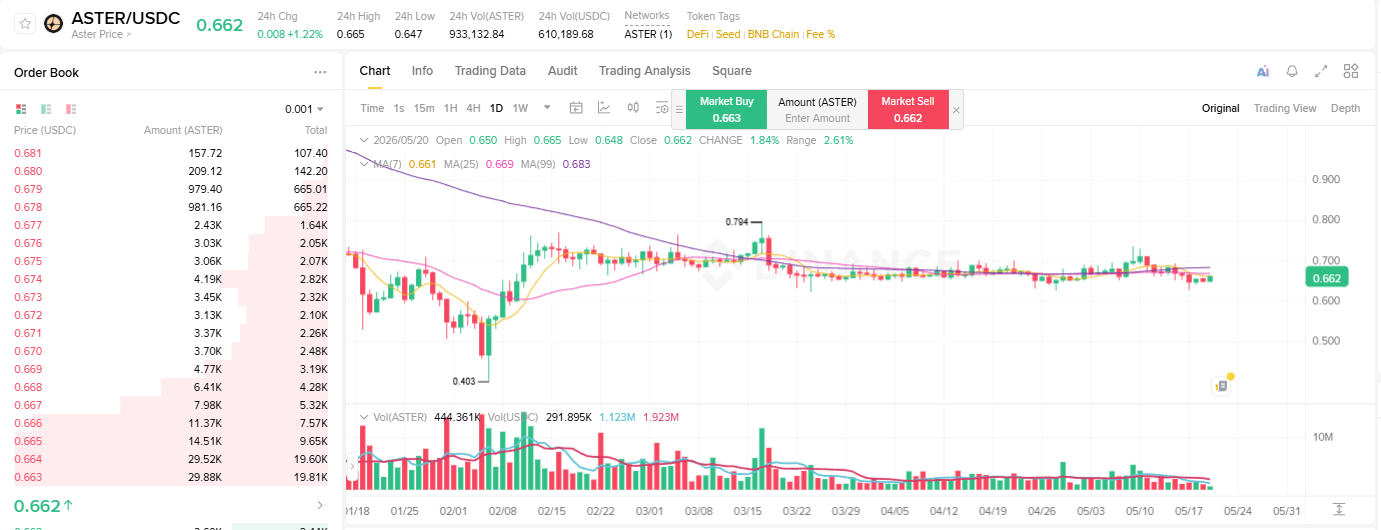
But the growth is fragile. Volume is easy to manipulate. Open interest tells the truth: Hyperliquid $5.15B, Aster $900M. TVL: Hyperliquid $4.06B, Aster $1.05B. The 2026 question is whether Aster retains users after incentives wind down.
The structural lesson
You can regulate an entity (CASP, CFD provider). You cannot regulate a protocol. MiCA explicitly excludes from scope "fully decentralized protocols with no central entity". ESMA can issue statements. It has no enforcement mechanism against smart contracts with no identifiable operator.
The EU did this with CFDs in 2018: leverage cap, traders moved to offshore CEXs. Now the same with perpetuals: they're moving to DEXs.
Every regulation protecting retail from leverage equals rising DEX market share. It's the paradox of unintended consequences. And it can't be reversed, because a protocol has no headquarters.
Source: DefiLama, PerpDex.trading, CoinGecko.com
#MiCA #PerpDex