
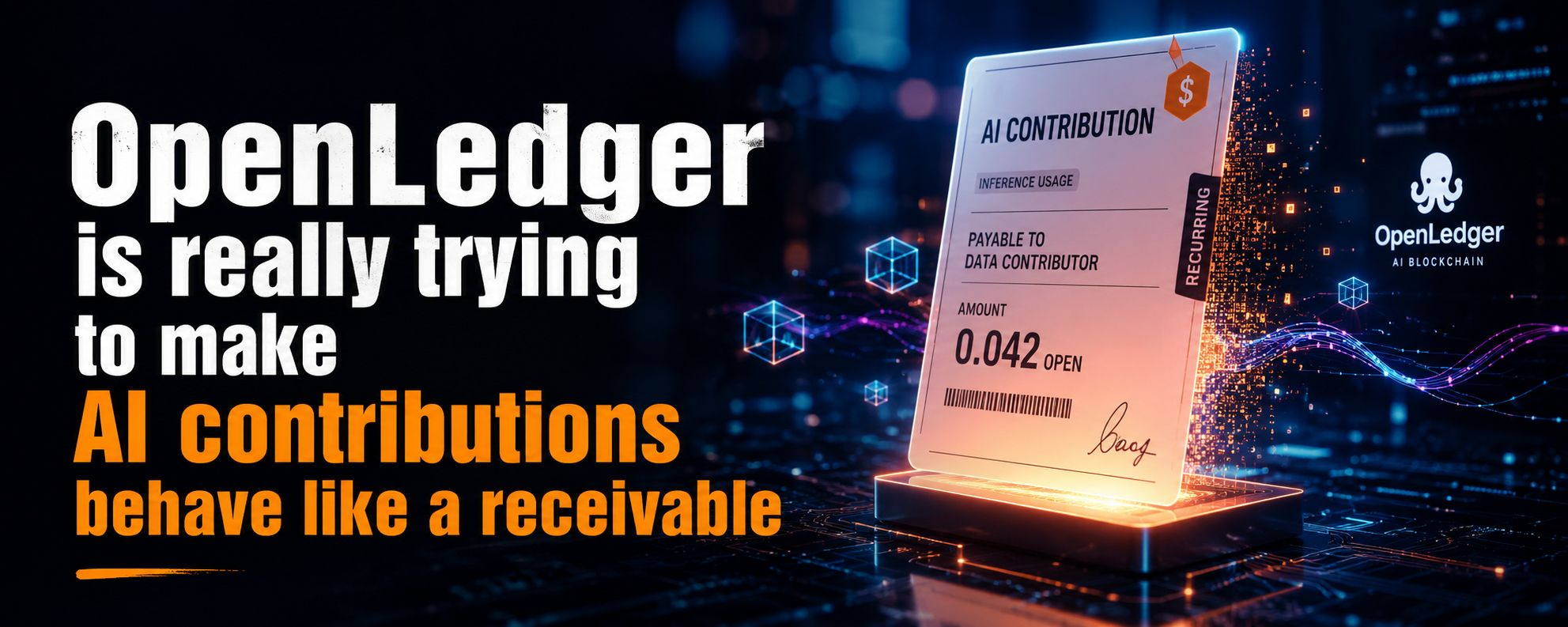
What I keep coming back to with OpenLedger is this: the project is not interesting because it says it rewards data. It is interesting because it is trying to reward data again and again, at the moment a model actually uses it. That is a much harder claim. In its paper, OpenLedger says Proof of Attribution is designed to trace data influence into model inference, then distribute rewards at the inference level through onchain DataNets. That is the difference between a one-time bounty and something closer to a royalty stream.
That framing matters because AI value does not sit at upload. It accumulates in reuse. A dataset can be ordinary on day one and still become economically important after it shapes several model outputs. OpenLedger seems to understand that the real battle is not for ownership in the abstract, but for measurable influence over time. Its own blog pushes the same logic, saying that every model inference can calculate data influence and reward contributors based on impact, while the ecosystem page shows live products like OctoClaw and a mainnet entry point rather than just a static narrative.
That is also why the community mechanics matter. The Yapper Arena is not just marketing noise to me. It reveals the protocol’s instinct to price sustained contribution, not just first-touch engagement. OpenLedger’s own post describes a 6-month leaderboard with rewards for the top 200 contributors, which is basically the social version of the same economic idea: continued relevance deserves continued compensation.
There is still a gap between the elegance of the model and the reality of adoption. Bybit shows OPEN trading around $0.216 with a market cap near $46.64 million and 24-hour volume of $14.35 million as of May 20, 2026, which tells me the market is treating this as a real but still experimental infrastructure bet, not a finished cash-flow machine.
My takeaway is simple. OpenLedger’s best case is not that it becomes another AI chain. Its best case is that it helps the market finally price AI contribution like an ongoing right instead of a one-time donation. If that happens, the project will have built something more durable than a token story. It will have built a payment logic for the AI economy.