
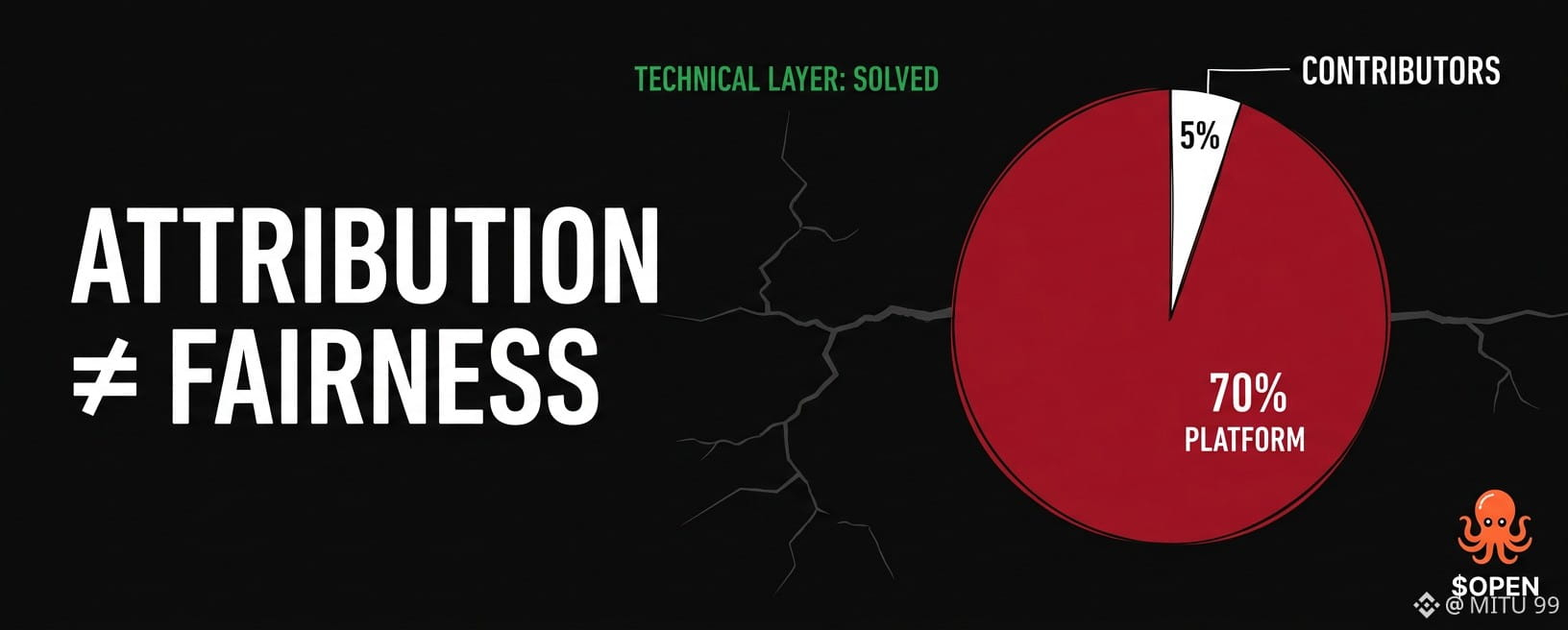
I keep watching @OpenLedger and trying to figure out if they've solved the right problem or if they've built technically elegant infrastructure around a question that isn't actually the hard one.
What I'm watching isn't whether attribution works. It does. What I'm watching is whether attribution's the same thing as fairness, and whether conflating the two creates a system that's transparent about extraction rather than one that stops it.
The attribution versus fairness problem in decentralized AI.
Not the technical layer. That's solved. Data contributor uploads data. Model trainer trains the model. Inference user runs a query. It's all tracked on-chain. Formulas are transparent. You can see exactly who contributed what.
That part's working.
What I can't tell is whether seeing exactly how little you're getting is meaningfully different from not seeing it at all.
@OpenLedger 's system records everything. Every data contribution, every training run, every inference. When OctoClaw makes a trade, the system knows which model it used, which dataset it trained on, who contributed the data, and it compensates them. That's genuinely new. Most AI platforms don't do this. Contributors remain invisible. Value gets extracted without acknowledgment.
But, here's what I'm not sure about.
Transparent formulas don't guarantee fairness. They guarantee legibility. You can see exactly how little you're getting. That's different from getting a fair amount.
The economic distribution question's what I'm watching. If the platform's capturing most of the value while contributors receive small token rewards and participation credits, then on-chain attribution hasn't redistributed value. It's just made the redistribution visible.
Legibility isn't equity. It's visible inequity.
Maybe OpenLedger's distribution is genuinely fair. Maybe $OPEN's token economics actually weight contributor rewards appropriately against what the platform costs to run.
Maybe they don't and what's being built is something more subtle: an extraction system that feels consensual because it's transparent.
I'm watching to see which one.
What I'm particularly watching is what percentage of value actually flows to contributors versus the platform. Not the formulas. The actual numbers. Most platforms don't publish this because the numbers reveal extraction.
The stakes for decentralized AI depend on whether attribution leads to fair compensation or just legible compensation. Better than centralized AI isn't the same as fair. It's just less unfair.
Maybe OpenLedger closes that gap. Maybe their economics are designed to genuinely compensate contributors at rates that reflect the value those contributions actually generate.
Maybe they haven't and $OPEN's building something that feels revolutionary because it's transparent, while the underlying economics aren't that different from what it's replacing.
I'd prefer decentralized AI infrastructure that questions whether attribution equals fairness. That doesn't assume solving the technical layer automatically solves the economic one.
I'm just not convinced that transparent formulas on-chain mean contributors are getting what they're worth. Especially when the comparison isn't against other decentralized platforms. It's against the value being created.
The fairness question's fundamental. You can solve attribution without solving compensation. If contributors can see exactly how little they're getting, that's not a solution. That's a better-designed version of the original problem.
And honestly, I trust teams that question whether their attribution system is fair more than teams that assume transparent formulas prove the economics are right.
