
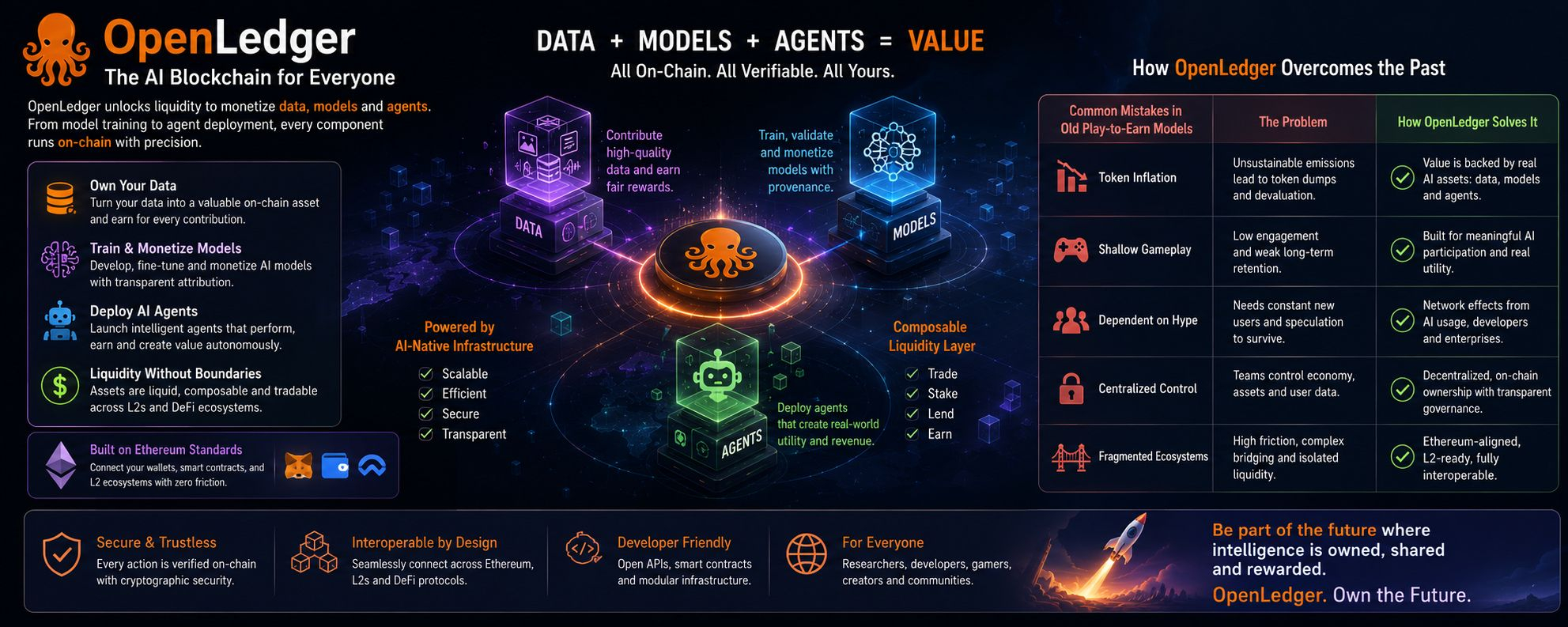
OpenLedger and the Next Evolution of Play-to-Earn
For years, the play-to-earn sector promised a future where users could finally own their digital time. The idea sounded revolutionary. Play games, contribute activity, participate in ecosystems, and receive economic upside instead of being treated like unpaid engagement metrics for centralized platforms. Yet most early projects collapsed under the weight of their own design mistakes. Token inflation destroyed sustainability, shallow gameplay failed to retain users, and speculative capital replaced real utility. That is exactly why OpenLedger feels different.
While most people still classify projects into simple categories like AI, GameFi, or infrastructure, OpenLedger is quietly positioning itself at the intersection of all three. Instead of building another isolated ecosystem dependent on hype cycles, OpenLedger is constructing an AI-native blockchain where data, models, and agents become productive on-chain assets. That shift changes the conversation entirely because the future value of digital ecosystems will not come only from gameplay. It will come from intelligence, contribution, and liquidity coordination.
OpenLedger approaches blockchain infrastructure from a completely different angle compared to earlier play-to-earn ecosystems. Previous generations focused heavily on extracting value from users through repetitive reward loops. OpenLedger focuses on enabling users to monetize participation in a more meaningful way. Data contribution, AI model training, agent deployment, and ecosystem coordination are treated as economic primitives rather than side activities.
This distinction matters more than most people realize.
Traditional play-to-earn ecosystems such as early farming simulators or NFT battle games depended on constant new user inflows. Their economies behaved more like circular reward machines than sustainable digital economies. Users earned tokens, sold them immediately, and weakened the ecosystem for the next participant. Once growth slowed, the entire structure became fragile.
OpenLedger avoids this trap because its infrastructure is not dependent on artificial token velocity alone. AI participation creates an entirely different economic layer. Data has value. Models have value. Agents performing tasks have value. Liquidity can flow around productive intelligence instead of purely speculative assets.
That creates stronger long-term alignment between users, developers, and the network itself.
Another major weakness in older play-to-earn systems was friction. Wallet onboarding was complicated, smart contract interaction felt intimidating, and moving assets between ecosystems created unnecessary barriers. OpenLedger directly addresses this through Ethereum compatibility and seamless integration with wallets, smart contracts, and Layer 2 ecosystems. This may sound technical on the surface, but the impact is actually psychological.
Mass adoption rarely happens because users suddenly become experts. It happens because systems become invisible. The best infrastructure reduces complexity until participation feels natural. OpenLedger understands that future users will not tolerate fragmented experiences where every interaction requires manual bridging, excessive fees, or confusing interfaces.In many ways, OpenLedger reflects a broader maturity shift happening across Web3.
The first generation of blockchain gaming focused on ownership. The second focused on rewards. The next generation will focus on productivity. Users no longer want ecosystems that simply distribute inflationary tokens. They want systems where their activity creates measurable value that persists beyond speculative cycles.
That is where AI changes the equation. An AI-native blockchain allows contribution itself to become monetizable infrastructure. A model trained today can continue generating value tomorrow. An intelligent agent can execute tasks autonomously. Data pipelines can become liquid assets rather than trapped resources owned by centralized entities.
Compared to older play-to-earn economies that depended heavily on emotional excitement and short-term momentum, OpenLedger appears designed for composability and longevity. There is also an important market psychology angle here that many overlook.
Crypto participants have become significantly more skeptical after multiple GameFi cycles failed to sustain user retention. Communities now pay closer attention to utility, infrastructure depth, and ecosystem resilience. Projects can no longer survive purely on token incentives and viral marketing. The market increasingly rewards ecosystems capable of generating real network effects.
OpenLedger enters at a moment when AI narratives and blockchain infrastructure are beginning to converge. Most projects talk about AI as a feature. OpenLedger treats AI as the foundation of the chain itself. That positioning could become increasingly important as developers search for environments specifically optimized for autonomous agents, intelligent coordination, and scalable model deployment. Personally, what makes OpenLedger interesting to me is not just the technology stack. It is the timing.
The market often prices visible excitement first and foundational infrastructure later. During previous cycles, people chased surface-level engagement while ignoring the backend systems that eventually captured the most durable value. We saw similar patterns with cloud infrastructure, Layer 1 ecosystems, and even decentralized finance.
OpenLedger feels like a project attempting to solve the structural weaknesses that limited earlier digital economies. Instead of rewarding passive speculation, it aims to create a system where participation itself becomes economically productive.
That is a much stronger foundation than simple reward farming. Of course, no ecosystem becomes successful automatically. Execution still matters. Developer adoption matters. Community growth matters. But the direction itself feels aligned with where blockchain infrastructure is naturally evolving.
The future of digital economies will likely belong to ecosystems that combine intelligence, ownership, interoperability, and sustainable liquidity design. OpenLedger is positioning itself directly inside that transition. And unlike the first generation of play-to-earn ecosystems that relied heavily on temporary hype, this model appears built around something far more durable: value created by intelligent participation itself.