
The internet changed human life so quietly that most people never realized how deeply it was reshaping the world while it was happening. At first it felt simple. People were just posting photos, searching for information, sharing opinions, talking to friends, watching videos, and spending time online without thinking too much about where all of that information was going. But behind the screens, something much bigger was slowly forming. Every click, every sentence, every behavior pattern, every preference, every emotion, and every interaction became part of an enormous digital learning system. The internet was no longer only storing information anymore. It was learning from humanity itself.
Now artificial intelligence is becoming the result of that learning process.
AI is no longer a small experimental technology sitting in the background of the internet. It is becoming one of the most important systems in the modern world. It writes code, creates media, analyzes data, automates businesses, powers recommendation engines, assists financial systems, helps governments, and increasingly shapes how information moves across society. The speed of this transformation feels almost unreal because only a few years ago many people still viewed advanced AI as science fiction. Today it is becoming infrastructure.
But while AI grows more powerful every month, one uncomfortable truth keeps becoming harder to ignore. The people helping create the intelligence economy still own almost none of it.
That is the exact problem OpenLedger is trying to challenge.
OpenLedger is not trying to present itself as another loud crypto project built only around hype cycles and temporary narratives. The deeper idea behind it feels much larger than price speculation or market excitement. The project is attempting to rethink the relationship between artificial intelligence, data ownership, blockchain infrastructure, and economic participation. It is built around a belief that if AI becomes one of the most valuable systems humanity has ever created, then the people contributing to that intelligence should not remain invisible inside the process.
For years the digital economy has worked in a very one-sided way. Large technology companies collect enormous amounts of information from billions of users across the internet. They use that information to train increasingly advanced AI models, build powerful algorithms, improve recommendation systems, and create products that generate massive economic value. Meanwhile, the average user usually receives convenience in return but almost never receives ownership or participation in the upside created from their data and behavior.
OpenLedger was born from the idea that this imbalance may become even more dangerous as AI becomes deeply integrated into global infrastructure. If intelligence itself turns into an economic resource, then ownership around intelligence becomes one of the defining questions of the future internet.
That is where the project begins separating itself from many other blockchain ecosystems.
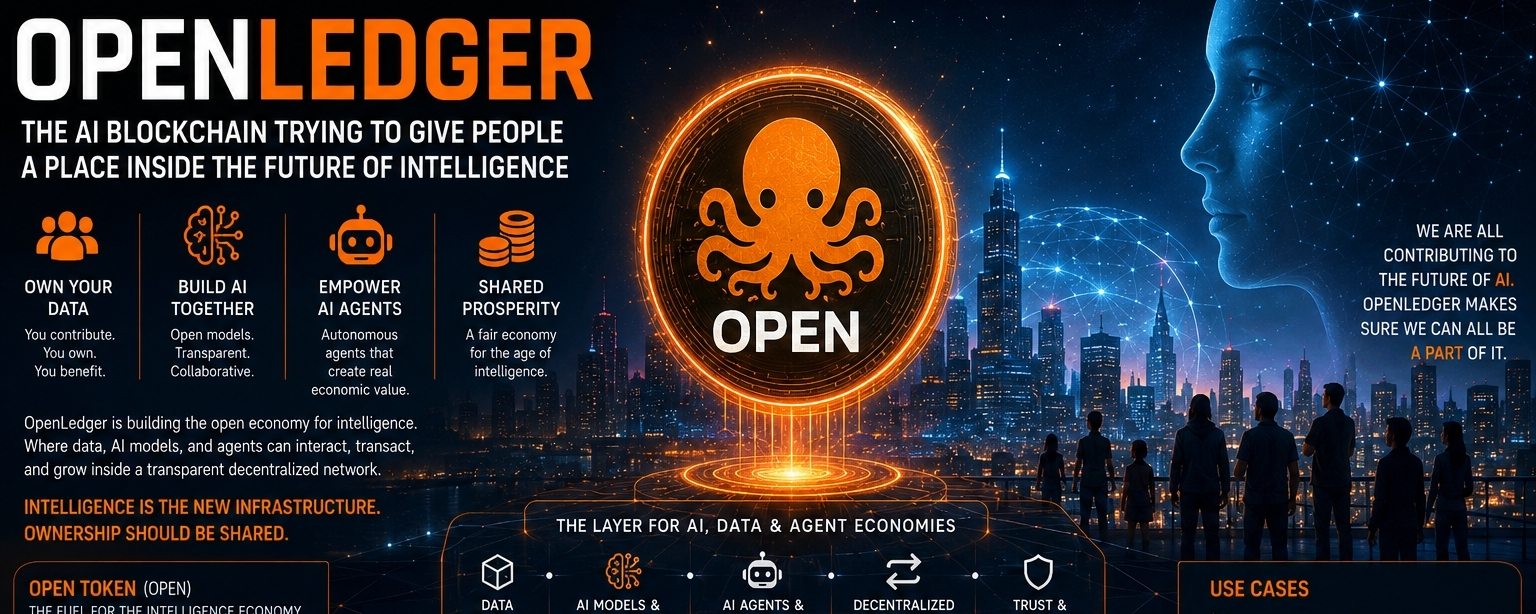
Instead of focusing only on transactions or decentralized finance, OpenLedger is trying to create what can best be described as an open economy for intelligence itself. The vision revolves around building infrastructure where data, AI models, and autonomous agents can operate inside transparent decentralized systems rather than existing entirely behind closed corporate walls. In simple terms, the project wants intelligence to become part of an open network instead of a privately controlled black box.
The emotional force behind this idea is actually very human.
Most people already understand that they are contributing to digital systems every day, even if they do not always think about it consciously. Every conversation online improves language understanding models. Every search improves recommendation systems. Every interaction helps algorithms become smarter. Humanity is collectively training machine intelligence all the time. But the economic structure around that process has remained heavily centralized.
OpenLedger is asking a very simple but very important question. If millions of people are helping create the future of artificial intelligence, should the rewards and ownership remain concentrated in only a few places?
The project believes the answer should be no.
That belief shapes the architecture of the system itself. OpenLedger combines blockchain infrastructure with AI-focused coordination systems designed to support data flows, models, decentralized participation, and autonomous agents operating across digital environments. The blockchain layer handles trust, ownership verification, transparency, and incentive coordination. On top of that sits the AI infrastructure where models, applications, and intelligent systems can interact inside the ecosystem.
What makes this especially interesting is the project’s focus on turning intelligence into something economically active.
Normally when people think about liquidity, they think about money or assets moving through financial markets. OpenLedger expands this idea into the world of AI by treating data, AI models, and autonomous agents as productive digital assets capable of generating ongoing value across open systems. Instead of intelligence sitting passively inside corporate servers, the project imagines a future where AI systems interact continuously with decentralized applications, services, and users while creating transparent economic activity around those interactions.
That sounds futuristic, but the internet is already moving in this direction.
AI agents are becoming one of the most important parts of this conversation. Right now most people still interact with AI like a tool. They ask questions, automate tasks, generate content, or analyze information manually. But technology is rapidly evolving toward autonomous systems capable of operating independently. AI agents are already beginning to manage workflows, coordinate operations, execute tasks, analyze markets, interact with software systems, and make decisions with less human supervision than before.
OpenLedger appears to believe these agents may eventually become active participants inside digital economies.
If that future arrives, entirely new infrastructure will be required. Autonomous systems need identity, payment coordination, memory systems, ownership structures, and transparent economic rails that allow them to interact securely with applications and users. OpenLedger is trying to position itself as part of that future infrastructure.
The deeper vision here is not really about crypto alone. It is about creating coordination systems for a world where intelligence itself becomes programmable and economically valuable.
At the center of the ecosystem sits the OPEN token, which helps coordinate participation and incentives across the network. In projects like this, tokenomics are not simply about speculation. The token becomes part of the behavioral structure of the network itself. Incentives influence contribution, validation, ecosystem growth, and long-term sustainability. OpenLedger’s challenge is creating a system where useful participation is rewarded fairly without allowing the ecosystem to become overwhelmed by manipulation, spam, or short-term extraction.
That challenge is extremely difficult because measuring value inside AI ecosystems is complicated. A useful dataset, an efficient AI model, a productive agent, or a computational contribution may all generate value differently. Building a fair economic structure around intelligence is one of the hardest coordination problems in modern technology.
And yet this is exactly the kind of problem OpenLedger is trying to solve.
Of course, the risks surrounding the project are very real too. Combining blockchain infrastructure with artificial intelligence systems is incredibly complex. AI workloads consume enormous computational resources, decentralized governance is difficult to coordinate at scale, and the regulatory environment surrounding both crypto and AI remains uncertain globally. Open systems sound powerful in theory, but maintaining security, transparency, decentralization, and scalability simultaneously is one of the hardest balancing acts in the technology world.
There is also the issue of hype. Both AI and crypto are industries driven heavily by emotion, narratives, and speculation. Excitement can grow faster than infrastructure itself. Expectations can become unrealistic. Many projects fail because storytelling moves ahead of actual execution.
That is why OpenLedger’s future will depend less on marketing and more on whether the ecosystem can create real participation, meaningful developer activity, useful AI integrations, and sustainable economic coordination over time.
Still, people continue watching closely because the project touches something much bigger than temporary market trends.
We are entering a period where artificial intelligence may become one of the foundational systems shaping the global economy. The deeper AI integrates into society, the more important ownership around intelligence becomes. Questions that once sounded philosophical are quickly becoming economic realities. Who owns the data? Who controls the models? Who receives the rewards? Who gets excluded from the value being created?
OpenLedger is trying to imagine a future where the answers to those questions become more open than they are today.
Whether the project succeeds fully or not, the fact that these conversations are happening at all matters deeply. For years the internet evolved toward greater centralization while most users accepted it without resistance because the systems felt convenient and inevitable. But AI is changing the scale of the conversation. People are beginning to realize that intelligence itself may become one of the most valuable resources of the modern era.
And if humanity collectively contributes to building that intelligence, then perhaps humanity should not remain invisible inside the economy formed around it.
That is the future OpenLedger is betting on.
A future where artificial intelligence does not only belong to giant corporations. A future where data contributors, developers, autonomous systems, and communities can participate more openly inside the next generation of digital infrastructure. A future where blockchain technology becomes more than speculation and evolves into a coordination layer for intelligent economies.
Maybe that future is still far away. Maybe the road ahead will be messy, difficult, and unpredictable. Technology rarely evolves in straight lines. Markets rise and collapse. Narratives change. Competition grows. Powerful centralized companies still control enormous amounts of capital, compute power, and influence.
But sometimes projects matter not only because of what they build, but because of the questions they force people to ask.
And OpenLedger is asking one of the most important questions of the AI era.
If artificial intelligence becomes part of the foundation of modern civilization, then should its value belong only to a few closed systems, or can the future of intelligence become something more open, transparent, and shared?
OpenLedger is trying to build toward the second possibility.
And maybe that is why so many people continue paying attention to it.
