
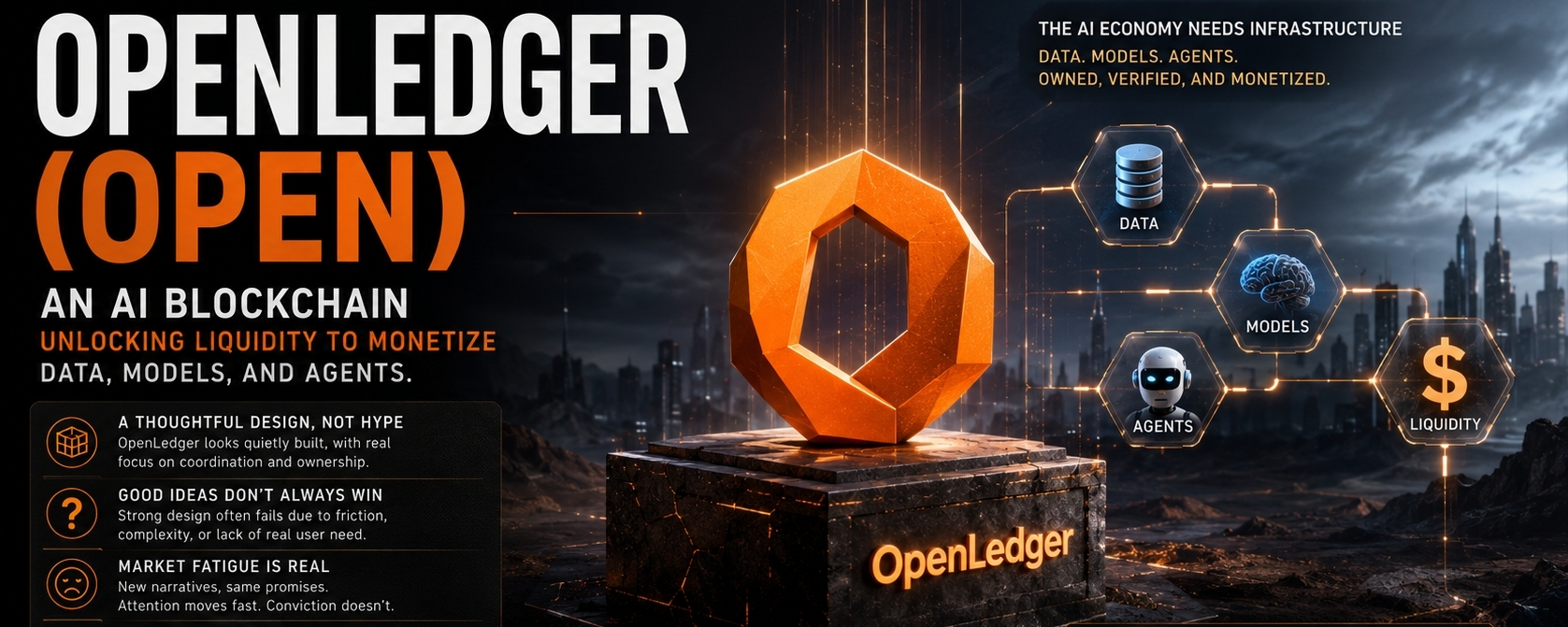
I’ve been around this market long enough to stop reacting to polished narratives. AI. Modular. DePIN. Restaking. Data economies. Every cycle finds new language for the same old hunger. Attention first. Utility later. Sometimes never.
That’s probably why OpenLedger caught my attention in a different way. Not because it looked explosive. More because it didn’t seem built entirely for applause.
Most crypto projects today feel reverse-engineered for engagement metrics. The architecture comes after the branding. You can almost feel the pitch deck before you even understand the protocol. Big words stacked on top of each other until nobody asks the obvious question anymore.
Who actually needs this?
OpenLedger sits in an uncomfortable category because the idea underneath it is not completely irrational. An AI-focused blockchain trying to create liquidity around data, models, and agents makes sense on paper. Data has value. Models have value. Autonomous systems probably become markets eventually. The infrastructure problem is real. Ownership and monetization around AI outputs will become messy as these systems grow.
But crypto has a habit of identifying real problems years before anyone actually cares enough to solve them.
That gap matters more than people admit.
I remember watching similar optimism around storage networks years ago. Technically elegant. Philosophically compelling. Economically logical. Yet adoption moved like wet concrete because normal users do not wake up wanting decentralized infrastructure. They want convenience. They want speed. They want not having to think.
That’s the part crypto builders consistently underestimate. Friction kills almost everything.
OpenLedger feels aware of this problem, at least partially. The design language suggests they understand coordination layers better than most AI-chain projects floating around right now. There’s less noise in the way they present the system. Less desperation. I respect that. Quiet teams usually understand how brutal survival actually is.
Still, I can’t ignore how crowded this entire sector already feels. Every week another protocol claims it will become the foundation layer for machine economies. Another tokenized intelligence marketplace. Another decentralized data rail. Different diagrams. Same underlying assumption that demand will naturally appear because the infrastructure exists.
It rarely works like that.
The market has become strange lately. Not bearish exactly. Just tired. You can feel it in the way people react now. Narratives burn out before they even mature. Communities form around ticker symbols instead of products. Liquidity rotates faster than conviction can develop. Most people aren’t investing in systems anymore. They’re renting attention.
And AI narratives inside crypto are especially vulnerable to this. Too many projects leaning on abstract futures. Too many promises about agents transacting autonomously while actual users still struggle to bridge assets without anxiety.
Sometimes I wonder if the entire sector confuses inevitability with timing.
Because yes, machine economies probably arrive eventually. AI-generated data probably becomes monetizable infrastructure. Models will likely need transparent ownership rails. But “eventually” is a dangerous word in crypto. Markets punish timelines harder than bad ideas.
OpenLedger might genuinely be early. Or it might simply be another technically competent system searching for a problem large enough to justify its existence.
There’s a difference between something being meaningful and something becoming necessary. Crypto rarely respects that distinction. Builders fall in love with elegant mechanics while users continue ignoring them completely.
And honestly, users are usually right.
The older I get in this market, the more I distrust clean narratives. The projects that survive are almost never the ones everyone intellectually agrees with at the beginning. Survival tends to look uglier than that. Messier. Accidental, even.
What makes OpenLedger interesting to me is not certainty. It’s tension.
You can see pieces of something potentially durable in the structure. The attempt to treat data and AI coordination as actual economic layers instead of just marketing themes. But you can also see how easily it could disappear into the endless graveyard of “important” infrastructure nobody truly needed badly enough.
That uncertainty feels more honest than hype ever did.
And maybe that’s why I keep watching it quietly without feeling the need to convince anyone else.
