
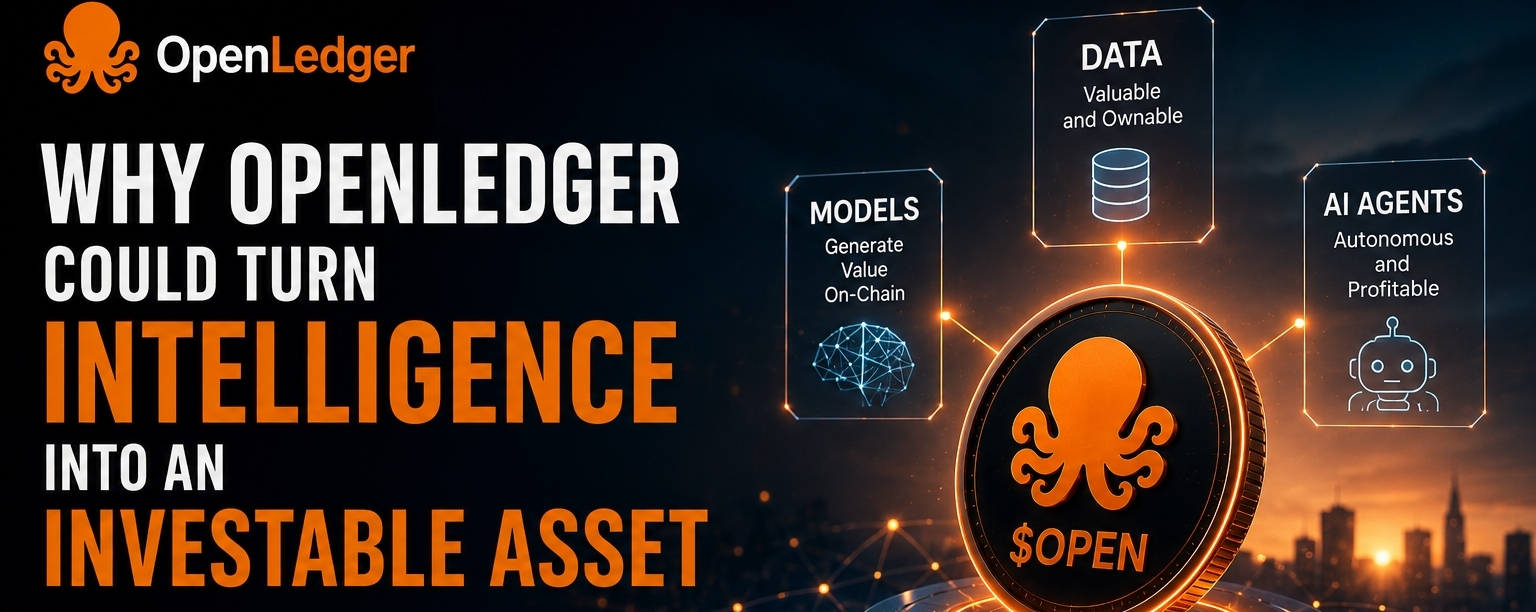

When people talk about investing, they usually think about stocks, real estate, or cryptocurrencies
But after learning more about OpenLedger, I started thinking about a different kind of asset altogether: intelligence.
That may sound abstract at first, but the idea is surprisingly practical.
A New Type of Productive Asset
Artificial intelligence depends on three essential ingredients
Data
Models
Agents
These components create enormous value, yet most contributors never have a direct way to participate in the economic upside.
@OpenLedger is building a blockchain designed to change that.
Its goal is to make these AI components ownable, trackable, and monetizable on-chain.
In other words, intelligence itself could become an investable asset.
How I See the Opportunity
If someone contributes valuable data, trains a useful model, or deploys an effective AI agent, that contribution can potentially generate recurring revenue whenever it is used.
That changes the economics of AI.
Instead of value flowing primarily to centralized platforms, contributors may be able to build assets that produce ongoing income.
To me, that is one of the most interesting ideas emerging at the intersection of AI and crypto.
Where $OPEN Fits In
The OPEN token acts as the economic layer of the network.
It is used to:
Pay for model inference
Reward contributors
Support staking
Participate in governance
What I find compelling is that the token is tied to actual network activity rather than a purely speculative narrative.
As adoption grows, demand for the token could become increasingly connected to real usage.
Why This Narrative Feels Different
Many crypto projects focus on infrastructure.
#OpenLedger appears to focus on ownership.
That distinction matters.
The project is exploring a future where people do not just use AI—they can own a piece of the value their contributions help create.
That is a much more powerful concept than simply offering another blockchain for developers.
Questions I Still Have
I find the thesis compelling, but there are still uncertainties.
The long-term outcome will depend on:
Whether contributors are willing to onboard their data and models
Whether developers choose to build on the platform
Whether real demand emerges for on-chain AI services
How effectively the ecosystem competes with established players
The idea is ambitious, and adoption will be the true test.
My Takeaway
The more I think about OpenLedger, the more I believe it is proposing a new category of digital ownership.
Not just owning tokens.
Owning the economic value of intelligence itself.
If this model gains traction, data, models, and agents could become some of the most productive assets in the next generation of the internet.
That is why OpenLedger and the OPEN token are on my radar.
Would you consider intelligence an asset worth owning?