
Most people do not think much about how a city’s water system works until something goes wrong. When the pipes function properly, water arrives quietly and consistently. Homes, restaurants, hospitals, and factories all depend on it without needing to understand the underlying infrastructure. But the real complexity sits beneath the surface. Someone has to maintain the pipes, measure flow, detect leaks, verify quality, manage incentives, and make sure the entire system does not collapse under misuse or neglect. The system only works because trust, coordination, and economic incentives are aligned closely enough to sustain it over time.
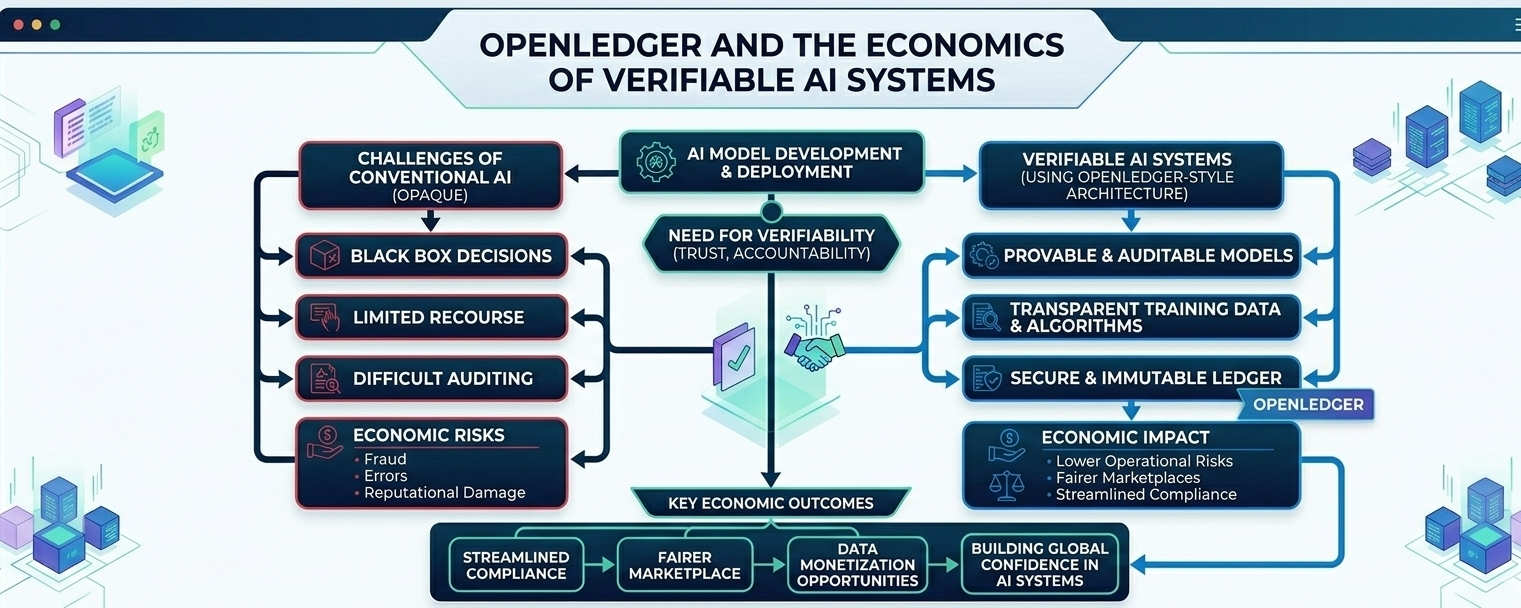
I keep thinking about that kind of infrastructure when I look at projects like OpenLedger. The project presents itself as an AI-focused blockchain designed to unlock liquidity around data, models, and agents. On paper, the idea sounds straightforward enough. Artificial intelligence systems increasingly depend on large quantities of data, specialized models, and distributed computational activity. Yet ownership, monetization, and attribution across these components remain fragmented. OpenLedger appears to be positioning itself as a coordination layer where contributors can provide data, models, or AI services and receive economic value in return.
What interests me is not the headline itself, but the operational assumptions hiding underneath it.
The phrase “unlocking liquidity” often sounds abstract in crypto discussions, but in practical terms it usually means making something transferable, measurable, and economically tradable. In traditional industries, liquidity does not emerge simply because someone creates a marketplace. It emerges because there are reliable standards, predictable enforcement, measurable quality, and enough participants who trust the system to transact repeatedly. Financial markets rely on clearing systems. Logistics networks rely on tracking and verification. Manufacturing depends on quality control and accountability. None of these systems survive on theory alone.
The same logic applies to AI infrastructure.
Data is only economically useful if buyers trust its quality and provenance. Models only become valuable if their outputs are reliable under real conditions. AI agents only matter if they can perform tasks consistently without introducing unacceptable operational risk. Once money enters the system, incentives immediately become adversarial. Participants begin optimizing for extraction rather than contribution. Low-quality data gets packaged as valuable input. Synthetic engagement appears. Attribution becomes contested. Metrics become targets rather than measurements.
That is where many blockchain-AI projects encounter friction with reality.
The difficult question is not whether OpenLedger can create a tokenized system around AI assets. Technically, many teams can build marketplaces, incentive structures, and on-chain coordination layers. The harder question is whether the system can distinguish useful contributions from noise at scale. That sounds simple conceptually, but it becomes extremely difficult operationally.
Real-world AI systems already struggle with verification problems. Large language models absorb low-quality or duplicated data. Evaluation benchmarks become gamed once incentives are attached to them. Contributors optimize toward measurable outputs instead of meaningful quality. Even centralized technology firms with enormous resources face these problems constantly. A decentralized environment introduces another layer of complexity because coordination costs increase while enforcement becomes weaker.
This is why I think the verification layer matters more than the monetization layer.
A blockchain can record ownership or transactions efficiently enough, but recording something immutably does not automatically make the underlying asset valuable or trustworthy. If a dataset is inaccurate, duplicated, manipulated, or legally questionable, immutability simply preserves the problem permanently. In infrastructure terms, a perfectly documented shipment system still fails if the goods themselves are defective.
The economic side is equally important. Many decentralized systems initially appear sustainable because incentives subsidize participation. Tokens compensate for weak organic demand during early growth phases. But subsidies are not the same as sustainable economic activity. Eventually the system has to justify itself through actual utility rather than internal speculation.
That transition is where many systems weaken.
If OpenLedger aims to create a marketplace around AI data and models, then long-term sustainability likely depends on whether external users genuinely need the infrastructure badly enough to pay for it independent of token incentives. Developers, enterprises, researchers, and AI operators are generally pragmatic. They prioritize reliability, cost efficiency, legal clarity, uptime, and measurable performance improvements. Ideological arguments about decentralization matter far less when operational requirements become serious.
I think this creates a practical test for the system.
Can OpenLedger reduce friction in a way that centralized alternatives cannot? Can it provide verifiable attribution for training data? Can it create transparent compensation mechanisms for contributors? Can decentralized coordination improve access to specialized models or datasets that would otherwise remain siloed? Most importantly, can these benefits survive under adversarial economic conditions rather than only during optimistic market cycles?
Those questions are measurable. They are not philosophical.
I also find the “agents” aspect particularly interesting because autonomous systems introduce a different category of operational risk. Once AI agents begin executing actions, interacting economically, or making decisions autonomously, accountability becomes more complicated. Traditional institutions solve this through contracts, regulation, insurance, and centralized responsibility structures. Decentralized systems often attempt to replace institutional trust with protocol-based trust, but the replacement is rarely complete.
In practice, somebody still absorbs risk when failures occur.
If an AI agent behaves unpredictably, produces harmful outputs, manipulates information, or creates financial damage, the problem is no longer purely technical. It becomes legal, economic, and institutional. A blockchain can document activity, but documentation alone does not resolve liability or enforcement. That distinction matters because real-world adoption tends to slow down whenever accountability becomes ambiguous.
I think this is where the comparison to infrastructure becomes useful again. Mature infrastructure systems succeed not because they eliminate failure, but because they contain it predictably. Airlines still experience mechanical issues, but operational processes reduce catastrophic outcomes. Banks still encounter fraud, but layered verification systems limit systemic collapse. Industrial systems survive because they expect adversarial conditions rather than assuming ideal behavior.
For OpenLedger, the real challenge may not be building functionality. It may be building resilience.
Can the network continue functioning when participants attempt to manipulate incentives? Can low-quality contributions be filtered without centralizing authority too aggressively? Can economic rewards remain aligned with actual utility rather than speculative activity? Can governance adapt without becoming bureaucratically paralyzed? These are less glamorous questions than product announcements or ecosystem growth metrics, but they are usually the questions that determine survival.
Another point that stands out to me is timing. AI infrastructure is currently expanding faster than institutional norms around ownership and compensation. There is a genuine gap here. Data contributors rarely capture proportional value. Model training pipelines remain opaque. Smaller participants struggle to monetize specialized knowledge or domain-specific datasets. In theory, decentralized coordination systems could improve this imbalance.
But theory alone is insufficient.
History shows that markets eventually converge toward systems that minimize friction while maximizing trust. Sometimes decentralization helps achieve that. Sometimes centralized coordination proves more efficient. Often the winning systems are hybrids that combine distributed participation with strong operational oversight.
That is why I see OpenLedger less as a guaranteed breakthrough and more as an experiment in economic coordination under AI conditions. The interesting part is not the branding around “AI blockchain.” The interesting part is whether the system can create measurable improvements in attribution, verification, and incentive alignment while remaining operationally stable under stress.
My own view is cautiously interested rather than fully convinced. I think the underlying problem OpenLedger is addressing is real. AI systems do create unresolved questions around ownership, value distribution, and coordination. But solving those problems requires more than token mechanics or infrastructure claims. It requires durable verification systems, sustainable economics, adversarial resilience, and actual user dependence beyond speculative participation.
In the end, I think the future of projects like OpenLedger will depend less on market excitement and more on whether they quietly become useful infrastructure people rely on without needing to think about it. That is usually how real systems prove themselves. Not through promises, but through consistent operation under real-world pressure.
