
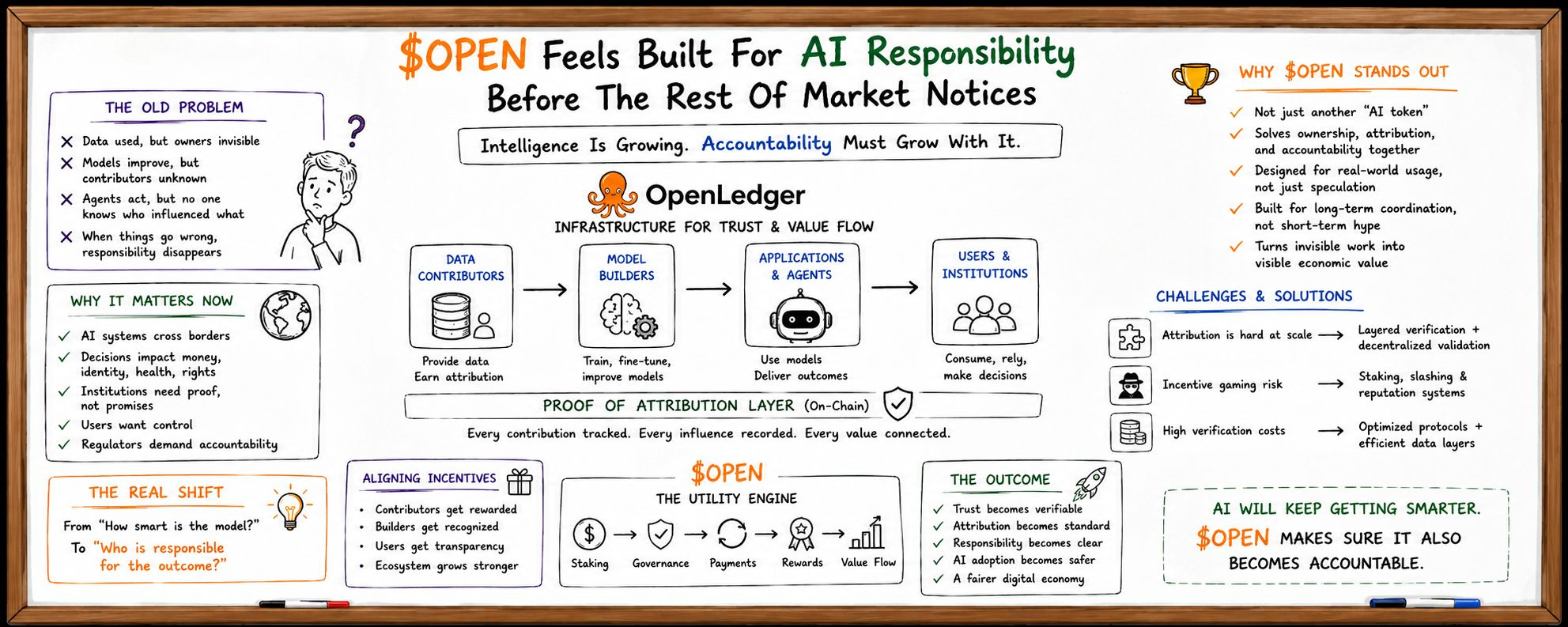
I think most people still evaluate AI projects using the wrong lens.
Faster models. More compute. Better responses. Cleaner demos.
That works in early markets because speed is easy to understand.
But the deeper I look at @OpenLedger , the more I feel the bigger problem in AI may not be intelligence itself.
It may be coordination around responsibility.
Because once AI starts touching finance, healthcare, legal systems, identity, or autonomous agents, the conversation changes very fast.
Nobody serious asks how “smart” the model sounds anymore.
They ask harder questions.
Where did the training data come from?
Who shaped the output?
Who verifies the process?
Who carries responsibility if the system makes a bad decision later?
That’s where #OpenLedger started feeling different to me from most crypto AI narratives.
The ecosystem seems less focused on selling excitement and more focused on building traceable infrastructure around intelligence itself.
Datanets. Proof of Attribution. Model tracking. Onchain contribution history. Open settlement and governance flows.
All of these pieces connect back to one bigger idea: making AI systems economically accountable instead of operating like invisible black boxes.
And honestly, that feels much more important long term than another temporary AI hype cycle.
What really caught my attention is how OpenLedger treats attribution almost like an operational layer instead of just a rewards feature.
Because attribution is not only about paying contributors fairly.
It’s also about reducing uncertainty.
If AI outputs become commercially important, institutions will eventually need audit trails, provenance, explainability, and contribution visibility before fully trusting these systems.
That changes the entire market dynamic.
The AI network with stronger coordination and verification layers may become more valuable than the network with slightly faster outputs.
That’s why I think OpenLedger’s thesis feels early but important.
Not because it promises magic.
Because it understands that intelligence without accountable lineage eventually creates friction.
Of course there are still challenges.
Attribution at scale is difficult. Incentive systems can be gamed. Verification costs can rise under heavy usage.
But at least the direction feels realistic.
The ecosystem seems built around making contribution, ownership, and value movement stay connected as AI systems expand over time.
And if AI becomes part of everyday infrastructure, then trust around machine decisions may quietly become one of the most valuable layers in the entire economy.