
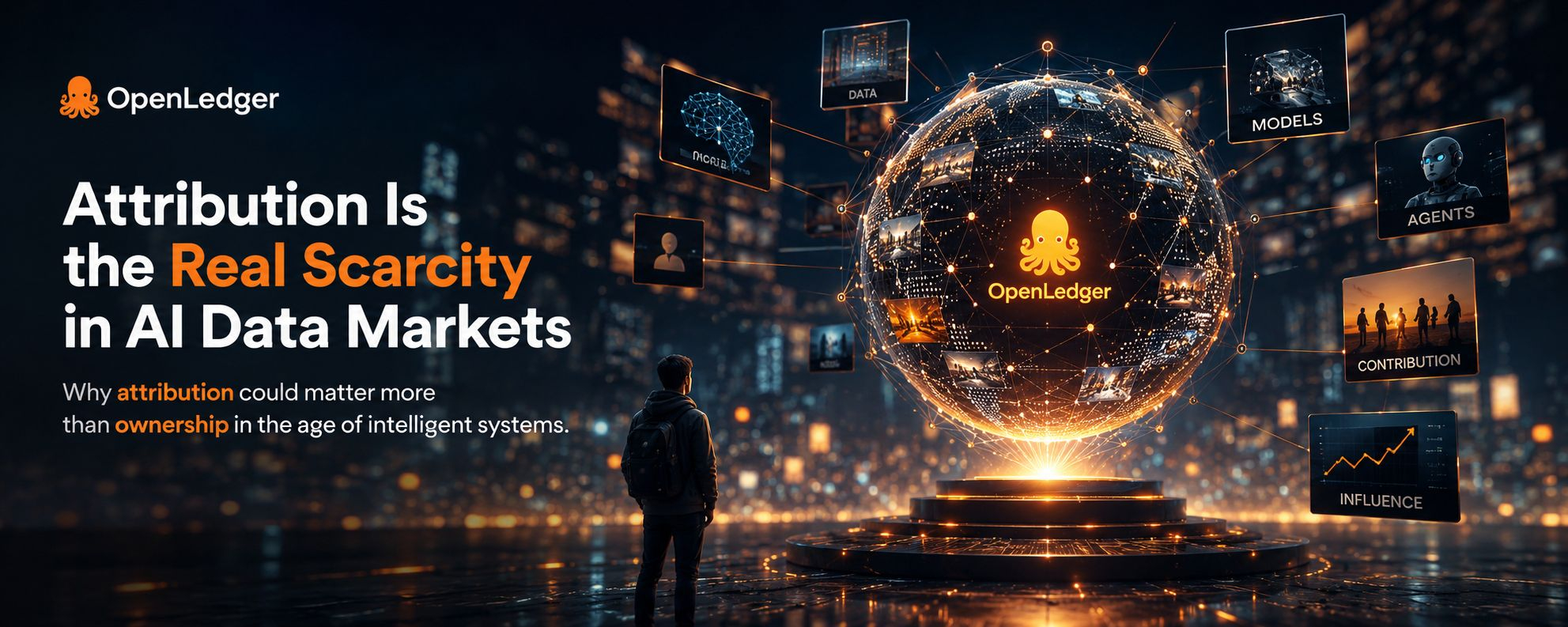
The more I think about AI data markets, the less I believe ownership is the main issue. Everyone talks about owning datasets, protecting datasets, licensing datasets. But AI does not really care who locked the file in a vault. What matters is which data actually changed the model. Which examples shaped the responses. Which contributions made the system smarter, sharper, or more useful.
That is why OpenLedger caught my attention in the first place.
Most blockchain conversations around AI still revolve around control. OpenLedger feels different because the bigger idea underneath it is attribution. Not just proving that data exists, but proving that it mattered. That changes the entire economic model.
Think about how strange the current AI landscape really is. Thousands of people contribute information online every day. Researchers publish work. Communities generate discussions. Users create niche datasets. Annotators spend hours cleaning messy information. Then a model absorbs all of it and the value gets compressed into a black box. By the time the AI produces something useful, nobody can clearly tell whose contribution made the difference.
Ownership alone does not solve that problem.
You can own a dataset and still have no idea which part of it created value during inference. At the same time, someone with a tiny but highly influential contribution might receive nothing because their role disappears inside the system. That feels like one of the biggest structural flaws in AI economics right now.
OpenLedger seems to be approaching the problem from another angle. Instead of treating data like static property, it treats it more like measurable influence. Its whole Proof of Attribution direction is built around tracing contributions and rewarding them based on impact, not just possession. That sounds technical at first, but honestly the idea feels very human to me.
In real life, contribution matters more than ownership all the time.
A movie succeeds because of dozens of people most viewers never notice. Restaurants become famous because of ingredients sourced from invisible suppliers. Even in sports, the player who changes the flow of the game is not always the one holding the trophy at the end. Influence is often hidden beneath the surface. AI markets are starting to run into the same reality.
What makes OpenLedger more interesting recently is that the project is no longer speaking only in abstract theory. The ecosystem has started showing more practical layers, from AI studio tools to the OctoClaw agent infrastructure now sitting prominently on the platform. That matters because attribution only becomes meaningful once people can actually build with it. A system cannot claim fairness if contributors never see where value flows.
The January roadmap direction stood out to me for that reason too. The emphasis on accountable AI, agent infrastructure, and onchain attribution feels less like marketing language and more like an acknowledgment that AI systems are becoming too economically important to remain opaque forever. Once agents start generating revenue autonomously, people will naturally ask where the intelligence came from and who deserves compensation.
That question becomes uncomfortable very quickly for the broader AI industry.
Right now, most value in AI flows upward. The model owner captures the majority of the upside while contributors fade into the background. OpenLedger’s model seems to challenge that imbalance by trying to build attribution directly into the infrastructure layer itself. Not as an afterthought, but as part of the system’s memory.
And honestly, I think memory is the right metaphor here.
AI today is incredibly good at remembering patterns but surprisingly bad at remembering origins. It can generate sophisticated outputs from countless learned fragments while losing track of the people, datasets, and signals that shaped those outputs in the first place. Attribution tries to restore that missing context.
That is why I suspect attribution could become more valuable than ownership over time. Ownership creates boundaries. Attribution creates accountability. Ownership tells us who controls access. Attribution tells us who actually contributed to intelligence.
Those are not the same thing anymore.
The deeper AI becomes embedded into economic systems, the more important that distinction will feel. Especially in open ecosystems where data, models, and agents constantly interact with each other, value will not come from isolated ownership alone. It will come from proving meaningful contribution inside a network of moving parts.
That is the bigger idea I see behind OpenLedger.
Not just monetizing data, but building a system where AI can finally remember who helped it become useful in the first place.
