

Most AI tokens are built around a very simple pitch.
AI is growing. Crypto wants exposure. A token becomes the shortcut.
That is why so many AI projects start to sound the same after a while. They talk about compute, agents, data, automation, and the future of intelligence. The words are big, but the actual economic question is often missing.
OpenLedger feels different to me because its core idea is not just “AI on-chain.”
It is asking something more specific:
When AI creates value, who actually deserves to get paid?
That question is much more important than it first appears.
Because AI is not magic. Every model is built from something. Data, human feedback, domain knowledge, fine-tuning, evaluation, model adapters, usage patterns, and constant improvement all sit behind the final answer a user sees on screen.
But in most AI systems, those contributions disappear.
Someone provides the data. Someone improves the model. Someone adds context. Someone helps make the output better.
Then the final product captures the value, while the people and resources behind it become invisible.
OpenLedger is trying to make that invisible layer visible.
And that is why I do not see it as just another AI token.
I see it more like an ownership layer for intelligence.
The most interesting part of OpenLedger is its focus on attribution.
Not hype. Not just AI branding. Attribution.
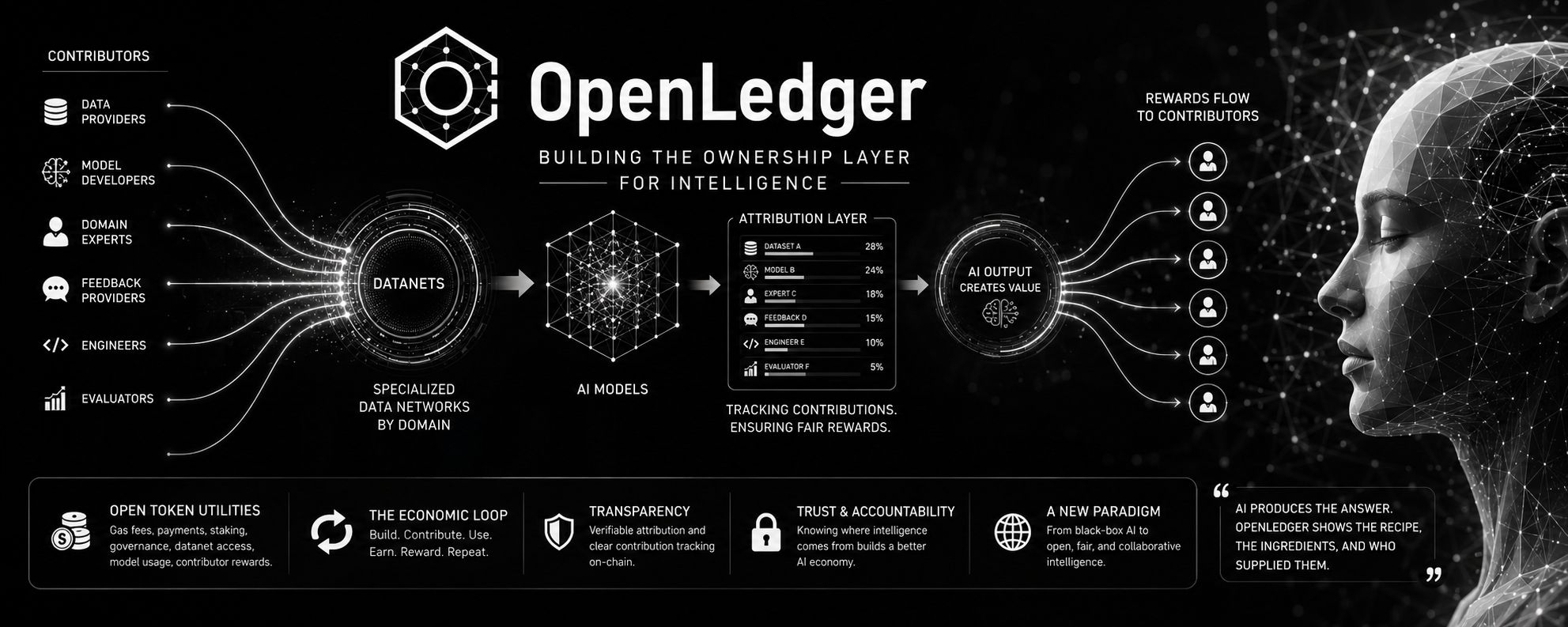
In simple words, OpenLedger wants to track which data, models, and contributors helped create a useful AI output. Once that contribution can be tracked, it can also be rewarded.
That changes the conversation completely.
Think about music for a second. A finished song may only be three minutes long, but behind it there can be a songwriter, producer, vocalist, engineer, sample creator, and label. The final song is one product, but the value comes from many hands.
AI has the same issue, but on a much bigger scale.
A useful model may be shaped by thousands of pieces of data, multiple fine-tuning layers, and many contributors. The end user only sees the answer. They do not see the supply chain behind that answer.
OpenLedger is basically asking:
What if AI had royalties?
That is the part I find powerful. Not because it sounds futuristic, but because it solves a real tension in the AI economy. Data is valuable, but data contributors are often treated like raw material suppliers. OpenLedger tries to give them a role inside the value loop.
The word “Datanet” may sound technical, but the idea is simple.
A Datanet is a focused data network around a specific domain or use case. Instead of throwing everything into one giant general dataset, OpenLedger allows communities and builders to create specialized data layers.
That matters because AI is moving from broad intelligence to useful intelligence.
A general AI model can answer many things. But the next wave of value will likely come from models that understand specific fields deeply: finance, healthcare, smart contracts, mapping, legal workflows, gaming, robotics, research, and other narrow but valuable areas.
In those fields, generic data is not enough.
You need clean data. Relevant data. Trusted data. Fresh data. Data with context.
That is where OpenLedger’s Datanets become important. They are not just storage buckets. They are a way to organize specialized knowledge and connect it to model creation.
To me, this is the difference between building a library and building a random pile of books.
A pile of books may contain information. A library gives that information structure.
OpenLedger is trying to build libraries for AI.
This is where I think many people get AI tokens wrong.
They look at the ticker first and the system second. But with OpenLedger, the token only becomes interesting if the network itself becomes useful.
OPEN is not just meant to sit there as a speculative AI coin. Its role is tied to gas, payments, staking, governance, Datanet usage, model access, and contributor rewards.
But listing token utilities is easy. Every project can do that.
The real question is whether those utilities connect to actual activity.
For OpenLedger, the important activity would look like this:
Builders creating specialized models. Data contributors joining Datanets. Users paying to access useful AI outputs. Models generating fees. Attribution deciding who helped create value. Rewards flowing back to contributors.
That loop is what matters.
If that loop grows, OPEN becomes more than a narrative asset. It becomes part of an economic machine.
If that loop does not grow, then it risks becoming just another AI label in a crowded market.
That is why OpenLedger should not be judged only by price movement or short-term attention. It should be judged by whether people actually use its data and model economy.
The AI industry today is still obsessed with performance.
Which model is faster? Which one is smarter? Which one is cheaper? Which one can reason better?
Those questions matter, but they are not the whole story.
As AI becomes more embedded in real work, another set of questions will become unavoidable:
Where did this output come from? What data influenced it? Can we trust the source? Who owns the improvement? Who gets paid when the model generates value?
These are not abstract questions. They become very real in serious fields.
A healthcare AI cannot be treated like a meme generator. A legal AI needs traceability. A DeFi risk model needs reliable inputs. A security model needs trusted training data. A business automation agent needs accountability.
This is where OpenLedger’s thesis becomes stronger.
It is not just trying to make AI decentralized for the sake of decentralization. It is trying to add memory, ownership, and accountability to AI systems.
That may not be as flashy as “AI agents will run the world,” but it may be more useful.
The way I personally think about OpenLedger is this:
AI produces the meal. OpenLedger wants to show the recipe, the ingredients, and who supplied them.
That is the missing layer.
Right now, most AI systems serve the final dish without showing where anything came from. OpenLedger wants to attach a receipt to the process.
Not just a financial receipt, but a contribution receipt.
This dataset helped. This model was used. This output created value. This contributor deserves a share. This interaction generated a fee.
That is a very different kind of blockchain use case.
It is not only about moving tokens. It is about recording contribution in a system where contribution is usually hidden.
I do not think OpenLedger is risk-free.
Attribution is hard.
AI outputs are not simple. A model does not always use data in a clean, obvious way. Influence can be indirect. Multiple datasets can shape the same result. Fine-tuning can blur the original source. Measuring contribution fairly is a serious technical challenge.
That means OpenLedger has to prove more than vision.
It has to prove that its attribution system is useful. It has to attract real data contributors. It has to support models people actually want to use. It has to make rewards feel fair. It has to avoid becoming too complex for developers.
This is the part I respect about the project, though. The problem it is trying to solve is not small. If it works, the reward layer for AI contribution could become very important. But if the attribution logic feels weak or unclear, the whole system loses weight.
So the project should be watched with both curiosity and discipline.
Not blind hype. Not lazy dismissal. Actual observation.
A lot of AI tokens are basically market narratives wrapped around future promises.
OpenLedger has a more grounded angle because it focuses on the economics behind AI.
It is not only asking, “How do we build AI?”
It is asking:
Who owns the data? Who improves the model? Who earns from usage? Who gets rewarded when intelligence becomes valuable?
That is a deeper question.
And in my opinion, that is why OpenLedger deserves a different kind of analysis. It should not be viewed only as an AI coin. It should be viewed as an attempt to build economic infrastructure around data and model contribution.
The token is just the visible part.
The real story is the system underneath.
OpenLedger is more than an AI token narrative because it is not only chasing the AI trend. It is trying to fix one of the biggest gaps inside the AI economy: contribution without ownership.
If AI becomes one of the most valuable industries in the world, then data, models, and contributors cannot remain invisible forever. Someone will need to track value creation. Someone will need to reward useful inputs. Someone will need to build trust around where intelligence comes from.
OpenLedger is making a bet that this layer should be open, on-chain, and economically connected.
That is why I find the project interesting.
Not because it has AI in its name. Not because the market likes AI narratives. But because it is trying to answer a question that every serious AI economy will eventually face:
When intelligence becomes valuable, who gets remembered — and who gets paid?