
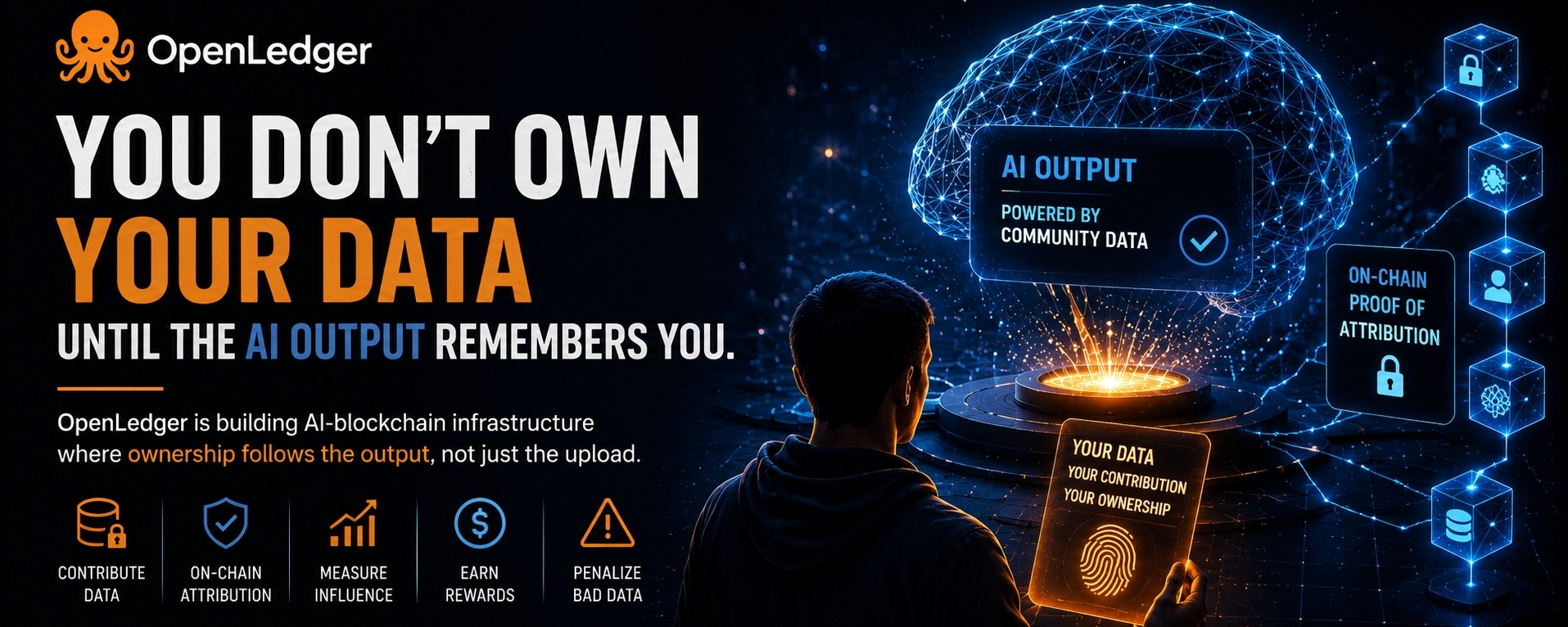
AI companies became trillion-dollar giants using data they never truly owned.
Users created the value.
Platforms kept the upside.
That is the part of the AI economy OpenLedger is trying to rewrite.
“You own your data” has become one of the most overused phrases in tech.
Because ownership means very little if it disappears the moment your data enters a model.
Own it where?
Own it how?
Own it after the AI system absorbs it and turns it into someone else’s product?
That is where the traditional data economy breaks down.
Most platforms treat data like fuel:
You contribute.
They train.
The model improves.
Your trail disappears.
OpenLedger is trying to make that trail permanent.
It describes itself as infrastructure for building specialized AI models using community-owned Datanets.
The important part is not just “AI + blockchain.”
It is attribution.
Its Proof of Attribution system attempts to connect AI outputs back to the data that helped create them through immutable on-chain records.
That changes the conversation completely.
Because if a dataset improves a model, the contributor should not become invisible once the system becomes valuable.
Ownership should not end at upload.
It should continue into the output itself.
OpenLedger’s Datanets push this idea further.
Instead of random unlabeled data collection, contributors submit domain-specific datasets that can be validated, traced, and rewarded.
The model becomes:
• Contribute data
• Verify attribution on-chain
• Measure influence and reputation
• Reward useful contributions
• Penalize biased or adversarial data
That last part matters.
The system is not only asking:
“Who deserves rewards?”
It is also asking:
“Who is accountable for bad data?”
That is a much more serious model than simple monetization narratives.
The difficult part is fairness.
AI attribution is messy.
A tiny expert dataset may matter more than millions of generic samples.
Some contributions heavily influence outputs.
Others barely matter.
Recording data is easy.
Measuring true influence is the real challenge.
But the direction still feels important.
Because OpenLedger is not just trying to monetize data.
It is trying to make contribution traceable after the model becomes valuable.
In the old AI economy, ownership ended when platforms captured the input.
In OpenLedger’s model, ownership attempts to follow the output.
And if that works, contributors stop being invisible raw material for AI systems.
They become part of the record itself.
Because this time, the blockchain remembers.