

In Web3, one problem keeps coming back again and again: users are surrounded by too many tools, too many chains, too many dashboards, and too many promises.A trader may need one platform for signals, another for execution, another for bridge movement, and another for tracking assets.A builder may have an idea but gets stuck between cloud setup, smart contract logic, chain compatibility, testing, deployment, and user experience.......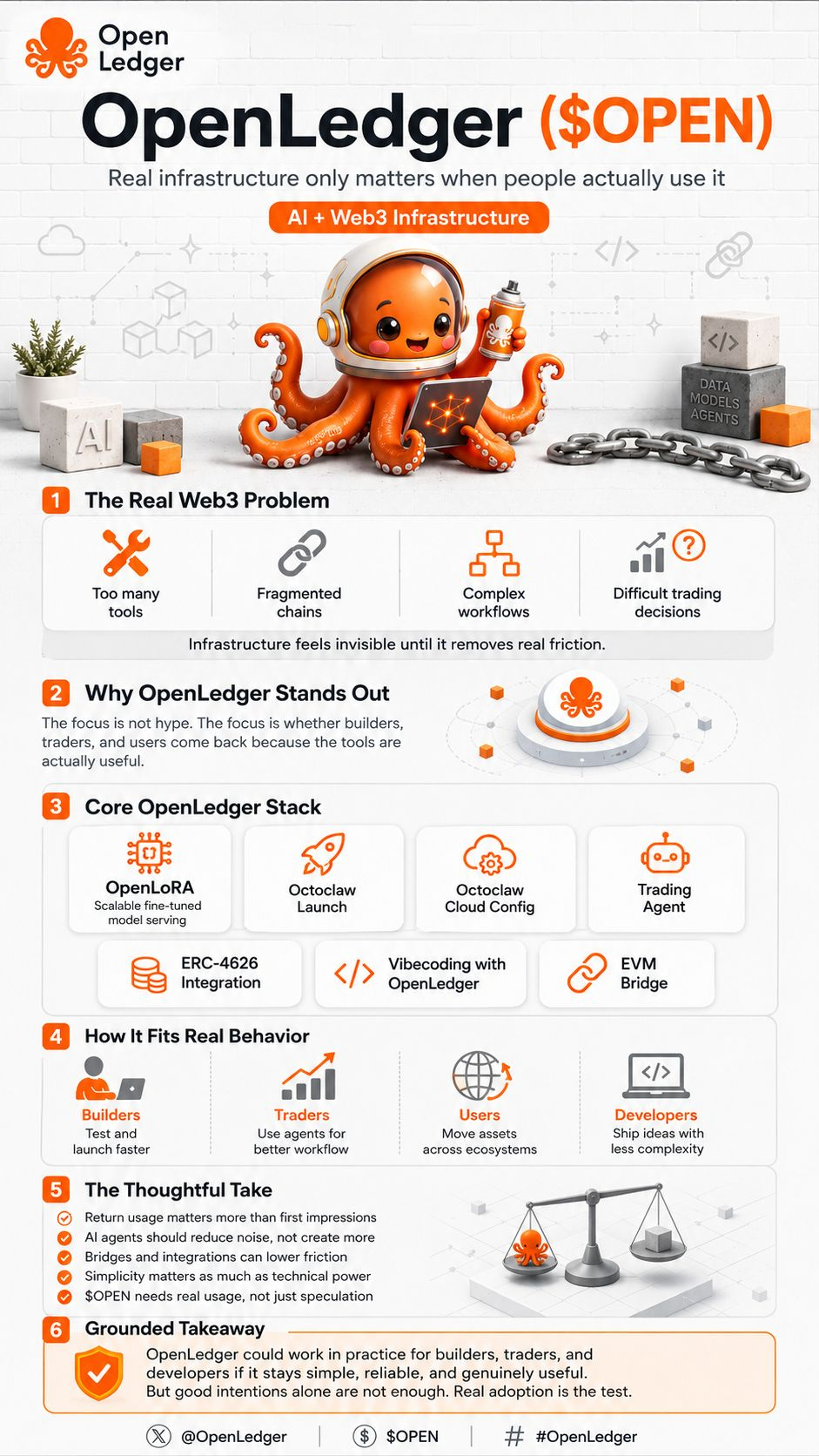
This is where most infrastructure projects sound exciting on paper but feel distant in real life.
The reason is simple.Many Web3 projects build features before understanding actual user behavior. They announce “powerful infrastructure,” “AI tools",or “cross-chain support,” but the average user does not care about infrastructure until it removes friction from daily actions. Infrastructure is mostly invisible. People notice it only when it breaks, slows them down, or makes something easier than before.
That is why I look at @OpenLedger and $OPEN with cautious interest, not blind hype.
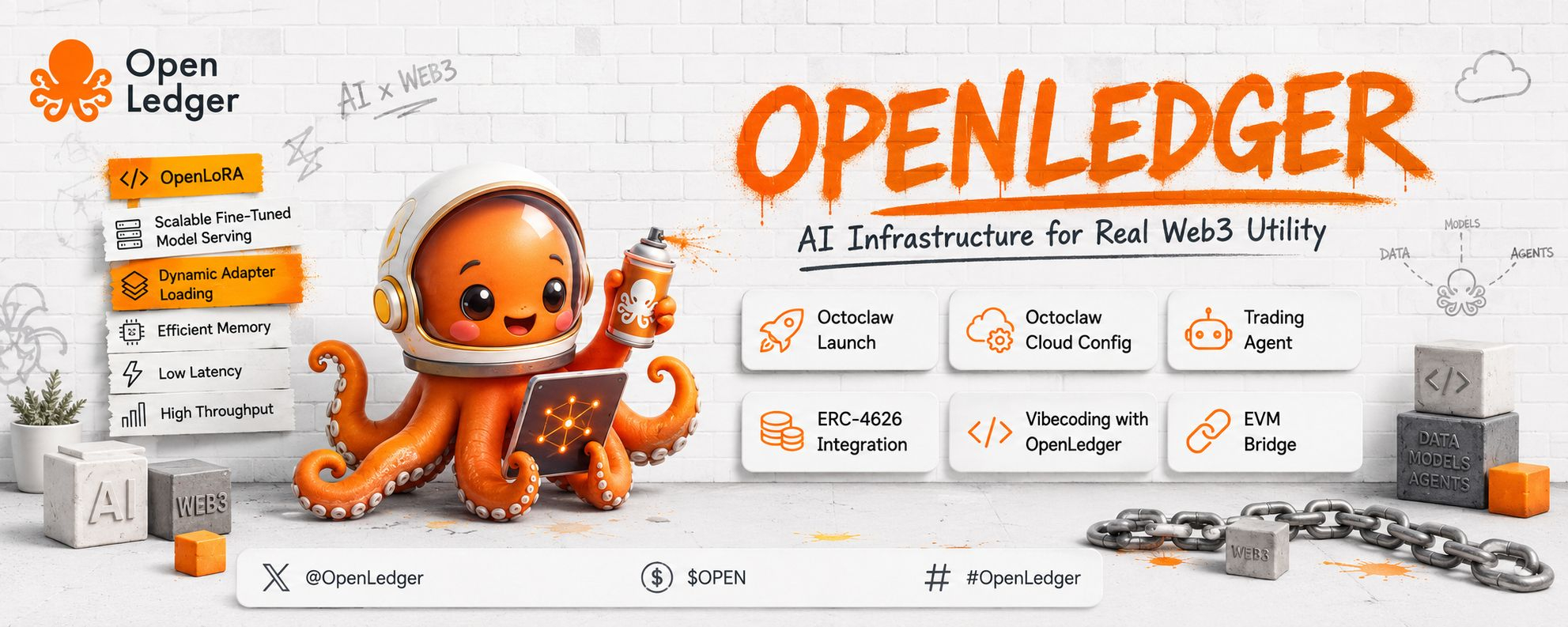
For me,OpenLedger is not just about one feature. It is more about whether its ecosystem can become useful repeatedly for builders, traders, and developers.The idea around Open LoRA, scalable fine-tuned model serving, and tools like Octoclaw launch, Octoclaw cloud config, trading agent, ERC-4626 integration, Vibecoding with OpenLedger, and EVM Bridge all point toward one bigger question: can OpenLedger reduce the daily complexity that Web3 users face?
Take builders first.A lot of developers want to test apps faster, but Web3 development can become messy quickly. If Vibecoding with OpenLedger helps developers move from idea to working prototype with less confusion, that could matter. But simplicity is the key here. Developer tools do not win only because they are technically strong. They win when people can understand them, repeat the process, and ship without feeling trapped inside complicated setup steps.
This is where something like Octoclaw cloud config becomes relevant. Cloud configuration may not sound exciting to retail users, but for builders, easier setup can save serious time. If Octoclaw launch helps projects deploy or test faster, then OpenLedger starts becoming practical infrastructure instead of just another name in the market.
Now think about traders. AI agents are becoming popular, but I am honestly skeptical by default. A trading agent can help organize workflow, reduce manual checking, and support better decision-making. But it can also create more noise if it gives too many signals without context. The value of a trading agent depends on whether it helps users think better, not whether it simply produces more alerts.
This is important for $OPEN attention as well. Short-term speculation can bring volume, but real usage brings return behavior. Users come back when a tool saves time, reduces mistakes, or helps them make cleaner decisions. If OpenLedger’s trading agent becomes part of a trader’s daily process, then it has a stronger story than hype alone.
Then comes movement across ecosystems. Web3 is still fragmented. Users often hold assets on one chain, find opportunities on another, and face friction while moving funds. An EVM Bridge can reduce that friction if it is reliable, simple, and safe enough. Bridges are powerful, but they also carry trust issues because the market has seen many failures in this area. So OpenLedger’s bridge-related utility will depend heavily on security, uptime, and user confidence.
ERC-4626 integration also fits into this bigger picture. Vault standards can make yield-related products more structured and easier to integrate. But again, the real test is not whether integration exists. The real test is whether builders and users actually find it useful in live conditions.
This is how value is created in a Web3 ecosystem. Not by announcing many tools, but by making people return after the first try. Communities care about tools only when those tools become useful repeatedly. A project can have strong technology, but if the user journey feels confusing, the market moves on.
That is why #OpenLedger should be viewed with patience. It may work if builders use it to launch faster, traders use agents to improve workflow, developers use Vibecoding to reduce complexity, and users rely on bridges and integrations without constantly worrying about friction. But it can still fail if the tools become too complex, if AI agents add noise, if infrastructure reliability drops, or if OPEN becomes only a speculation story without real product behavior behind it.
My grounded takeaway is simple: OpenLedger has potential as practical infrastructure, especially for builders, traders, and developers who need smoother workflows. But potential is not proof. The real test for @OpenLedger will be daily usage, reliability, and whether people return because it genuinely makes Web3 easier.
