
Artificial intelligence is becoming part of everyday life. People use AI to write, research, code, trade, design, automate tasks, and make better decisions. But behind every AI tool, there is one thing that matters more than anything else: data.AI does not become smart on its own. It learns from information created by people, businesses, developers, researchers, communities, and users across the internet. The problem is that most of these contributors never receive proper credit or payment for the value their data creates.
This is where OpenLedger comes in.
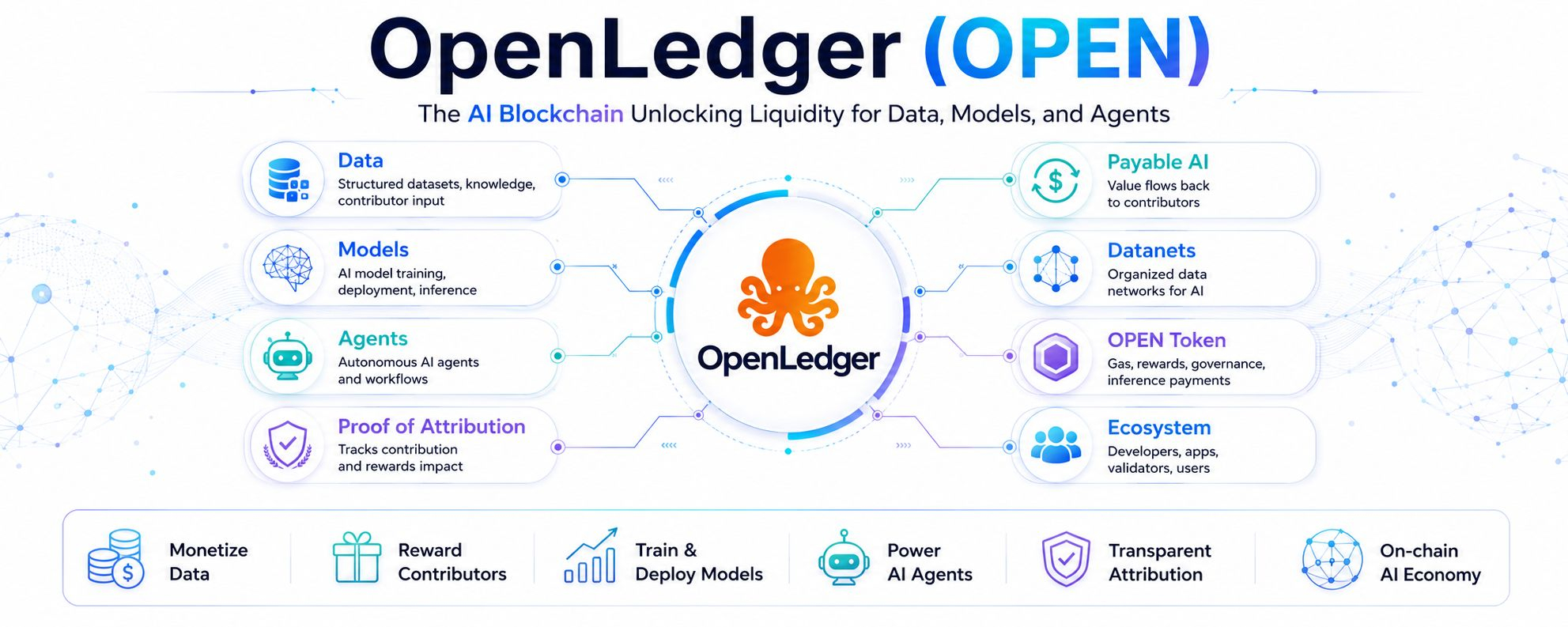
OpenLedger, powered by the $OPEN token, is an AI-focused blockchain project that wants to make the AI economy more fair, open, and transparent. Its goal is to help people monetize the three most important parts of artificial intelligence: data, models, and agents.
In simple words, OpenLedger wants to make sure that if your data, model, or AI agent creates value, you have a way to earn from it.
What Is OpenLedger?
OpenLedger is a blockchain built for artificial intelligence. It is designed to support the full AI journey, from data contribution to model creation, AI usage, and reward distribution.
Most blockchains are built for payments, DeFi, NFTs, or general applications. OpenLedger is different because it focuses directly on AI.
The project is built around three major assets:
Data
This includes datasets, research, knowledge, user information, business data, and any useful content that can improve AI systems.
Models
These are AI models created or trained by developers. Models can generate answers, analyze information, make predictions, or power applications.
AgentsAI agents are smart systems that can perform tasks automatically. They can research, plan, interact with tools, and complete workflows.
OpenLedger wants to make these assets easier to track, use, and monetize. Instead of data and models being locked inside private platforms, OpenLedger wants them to become part of an open AI economy.
Why OpenLedger Matters
Today, most AI systems are controlled by large companies. These companies train models using huge amounts of data, but the people who helped create that data usually do not receive anything in return.
writer may publish useful content.
developer may share open-source code. researcher may create valuable reports.business may collect high-quality industry data.A community may produce discussions full of real knowledge.All of this can help AI become better.But when AI companies use that information, the original contributors are often left out.
OpenLedger is trying to fix this problem by creating a system where contributions can be tracked and rewarded. It wants to build an AI economy where value does not only go to big platforms, but also to the people and builders who helped create it.
That is why OpenLedger’s mission is important. It is not only about crypto. It is about fairness in the future of AI.
The Main Idea Behind OpenLedger
The core idea of OpenLedger is very simple:
If your contribution helps AI create value, you should be able to earn from it.
This could change how people think about AI ownership.
Instead of AI being a one-way system where users give data and companies take the profit, OpenLedger wants to create a two-way system. Contributors provide value, and when that value is used, they can be rewarded.
This can include:
Data providers earning from useful datasets.
Model builders earning when their models are used.AI agents earning from tasks they complete.
Developers building apps on top of shared AI infrastructure.Users accessing more transparent AI tools.
penLedger is trying to create a marketplace where AI value can move more fairly between everyone involved.
Payable AI: OpenLedger’s Big Vision
One of the most interesting ideas behind OpenLedger is Payable AI.
Payable AI means that AI should not only create answers. It should also be able to send value back to the people and resources that made those answers possible.
For example, imagine an AI model gives a financial analysis, a legal explanation, or a technical answer. That answer may be influenced by many sources of data, training, and expert knowledge.
In the normal AI world, the platform earns money when the user pays. But the contributors behind the knowledge usually get nothing.
OpenLedger wants to make this different.
With Payable AI, the value can be shared across the whole AI chain:
The user pays for the AI result.The model creator earns for building the model.The data contributor earns if their data helped improve the result.
The network earns for supporting the system.
This creates a more balanced AI economy where more people can benefit from the value they help create.
Proof of Attribution: The Heart of OpenLedgerThe most important technology concept in OpenLedger is Proof of Attribution.
Proof of Attribution is designed to track which data, model, or contributor helped influence an AI output. Once that contribution is identified, rewards can be distributed more fairly.
This is important because AI attribution is difficult.
When an AI model gives an answer, it is not always clear where that answer came from. The model may have learned from millions of pieces of information. OpenLedger wants to make this process more transparent.
Proof of Attribution tries to answer questions like:Who provided the data?Which dataset helped the model?Which model created the result?
Who should receive rewards?How should the reward be divided?
This is what gives OpenLedger its unique identity. It is not only building an AI token. It is trying to build a reward system for the AI economy.
How OpenLedger Makes Data More Valuable
In the AI age, data is one of the world’s most powerful assets. But most data is not easy to price, sell, or monetize.
OpenLedger wants to change that by making data more liquid.
Liquidity means that something can be used, exchanged, or turned into value more easily. OpenLedger applies this idea to AI data.
For example, a high-quality dataset about finance, healthcare, law, coding, science, or blockchain could help create better AI models. If that dataset is useful, the person or organization that provided it should be able to earn from it.
This is especially important for specialized data.General online data is already everywhere. But expert-level and industry-specific data is much harder to find. That kind of data can make AI tools more accurate and more useful.
OpenLedger gives this data a possible path to become an income-generating asset.
What Are Datanets?
major part of the OpenLedger ecosystem is the idea of Datanets.Datanet is a structured network of data created for AI use. It is not just a random pile of information. It is organized, cleaned, attributed, and prepared so that AI models can use it properly.Datanets can help connect data contributors with AI developers.Here is a simple example: contributor provides useful data.That data becomes part of a Datanet.A developer uses the Datanet to train or improve an AI model.
Users pay to access the model.Rewards go back to the model builder and the data contributor.This creates a healthier cycle for AI development.Better data leads to better models.Better models attract more users.More users create more payments.More payments reward contributors.
More rewards attract better data.That is the kind of economy OpenLedger wants to build.The $OPEN TokenThe native token of OpenLedger is OPE
.OPEN is the token that powers the OpenLedger ecosystem. It is used for payments, rewards, gas fees, governance, model activity, and ecosystem growth.
The total supply of OPEN is:1,000,000,000 OPENOPEN is designed to connect every major participant in the network, including:
Data contributors.
AI model developers.AI agent builders.Application developers.Validators.Users.Governance participants.
The goal is for OPEN to become more than just a trading token. It is meant to be part of the real activity happening inside the OpenLedger AI blockchain.
Main Uses of OPEN
OPEN has several important roles in the ecosystem.Network Fees
OPEN is used to pay for activity on the OpenLedger network.
AI Inference Payments
When users interact with AI models, OPEN can be used to pay for those outputs.Data Contributor RewardsIf a dataset helps create AI value, the contributor may receive OPEN through Proof of Attribution.
Model Builder Rewards
AI model developers can earn OPEN when people use their models.
AI Agent ActivityAI agents can use OPEN for payments, services, and automated actions.
GovernanceOPEN holders may help make decisions about the future of the protocol.
Ecosystem GrowthOPEN can be used for grants, rewards, airdrops, developer programs, hackathons, and community incentives.
This gives OPEN a wide role across the OpenLedger economy.
OpenLedger Tokenomics
OpenLedger has a fixed supply of 1 billion OPEN tokens.
The token allocation is:
Category Allocation
Community Rewards and Ecosystem 61.71%
Investors 18.29%Team 15.00%Liquidity 5.00%
The biggest allocation goes to the community and ecosystem. This is important because OpenLedger depends on people actually contributing data, building models, launching agents, and creating applications.The ecosystem allocation can support:Data rewards.Datanet development.Model incentives.Developer grants.Community campaigns.Hackathons.Airdrops.Bounties.Public goods.This shows that OpenLedger is trying to build a participation-based network, not just a token projecat.OpenLedger MainnetOpenLedger also has its own blockchain network built for AI activity.The mainnet is designed to support things like:Model registration.
AI inference.Data attribution.Agent deployment.Governance.Staking and validation.Reward distribution.OpenLedger also supports Ethereum-compatible infrastructure, which can help with wallets, exchanges, liquidity, and Web3 connectivity.This gives OpenLedger two important advantages:
It can connect with the wider crypto market.It can build AI-specific tools on its own network.
OpenLedger and AI AgentsAI agents are becoming a major part of the future of artificial intelligence.
Unlike simple chatbots, agents can actually perform tasks. They can search for information, make plans, interact with tools, manage workflows, and complete actions.
OpenLedger includes AI agents as a key part of its ecosystem.
This matters because agents will need trust and transparency. If an AI agent makes a decision or completes a task, users may want to know:
Which model powered it?What data did it use?Who created it?What actions did it take?
Can the result be verified?OpenLedger can provide an on-chain layer for this type of transparency.
In the future, AI agents on OpenLedger could use data, pay for model access, complete services, earn rewards, and build reputation.OpenLedger Buyback ProgramOpenLedger has also introduced a buyback program to support liquidity and strengthen the token economy.
A buyback means the project uses funds to buy back tokens from the market. This can sometimes support confidence and improve liquidity, especially if it is done transparently.
For OpenLedger, the buyback program is connected to liquidity management and enterprise activity.
However, buybacks should always be checked carefully. A buyback only matters if it is actually executed, visible on-chain, and supported by real revenue.
Still, the program shows that OpenLedger is paying attention to token health and long-term ecosystem stability.
Why Developers May Be Interested in OpenLedger
OpenLedger can be attractive for developers because it gives them a way to build and monetize AI products.
data provider can contribute useful datasets.
model builder can publish AI models.
An app developer can build tools using those models.
An agent creator can launch autonomous AI systems.
Each of these participants can potentially earn through the OPEN economy.
This makes OpenLedger more than just infrastructure. It can become a marketplace for AI value, where data, models, and agents work together.Strengths of OpenLedgerOpenLedger has several strong points.
focuses on a real problem in AI.
gives data contributors a possible way to earn.
connects blockchain with a practical AI use case.
gives OPEN several utilities.supports data, models, and agents in one ecosystem. introduces Proof of Attribution.is positioned for the growth of AI agents.has a community-focused token allocation.
These strengths make OpenLedger one of the more interesting projects in the AI blockchain space.
Risks and Challenges
OpenLedger also has important risks.
The first risk is execution. Building an AI attribution blockchain is difficult.
The second risk is accuracy. Proof of Attribution must work properly for rewards to be trusted.
The third risk is legal complexity. Data ownership, copyright, privacy, and licensing can be complicated.
The fourth risk is adoption. OpenLedger needs real users, developers, data contributors, and enterprise demand.
The fifth risk is token supply. Future unlocks canincrease circulating supply and affect price.
The sixth risk is competition. Many projects are building in decentralized AI, AI agents, and data monetization.OpenLedger has a strong vision, but it still needs to prove that the vision can work in the real world.What OpenLedger Needs to ProveFor OpenLedger to become successful, it needs more than a good idea. It needs real usage.The project needs to show:Active Datanets.Useful AI models.Real AI agents.Developers building applications.Users paying for AI services.Contributors earning rewards.Transparent attribution.Enterprise adoption.Healthy token demand.
The future of OpenLedger will depend on execution, not hype.
Future OutlookOpenLedger is building in a very important area: the meeting point of AI and blockchain.
As AI grows, people will care more about ownership, transparency, attribution, and payment. They will want to know where AI outputs come from. They will want to know who deserves credit. They will want systems that are more open and fair.
OpenLedger is trying to become part of that future.If the project succeeds, it could help create an AI economy where data contributors, model builders, and AI agents all earn from the value they create.
But if it fails to attract real users and builders, it may remain only a strong idea.That is why the next stage is very important for OpenLedger.Final Thoughts
OpenLedger is a project with a clear and powerful message:
If data helps AI create value, the people behind that data should have a way to earn.
Through OPEN, Proof of Attribution, Datanets, AI model monetization, and agent infrastructure, OpenLedger is trying to build a fairer AI economy.
The project has strong potential, but it also has real challenges. It must prove that its technology works, that developers want to build on it, and that users are willing to use it.
For now, OpenLedger is one of the most interesting AI blockchain projects to watch. It is not just trying to create another token. It is trying to bring ownership, rewards, and fairness into the AI world.
And if OpenLedger can deliver on its vision, it could become an important part of the future of artificial intelligence
