

I think most people are still Framing AI completely wrong right now.
We keep calling it Software because that’s the language the internet trained us to use for the last twenty years. Apps. Platforms. Interfaces. Tools. Click buttons, open tabs, upload files, repeat.
But honestly, the longer I watch systems like OpenLedger evolve, the less this stuff feels like normal software to me.
It feels industrial.
Not in some dramatic sci-fi way either. More like invisible infrastructure running underneath the surface while most people are still staring at the interface layer.
That difference Matters way more than people realize.
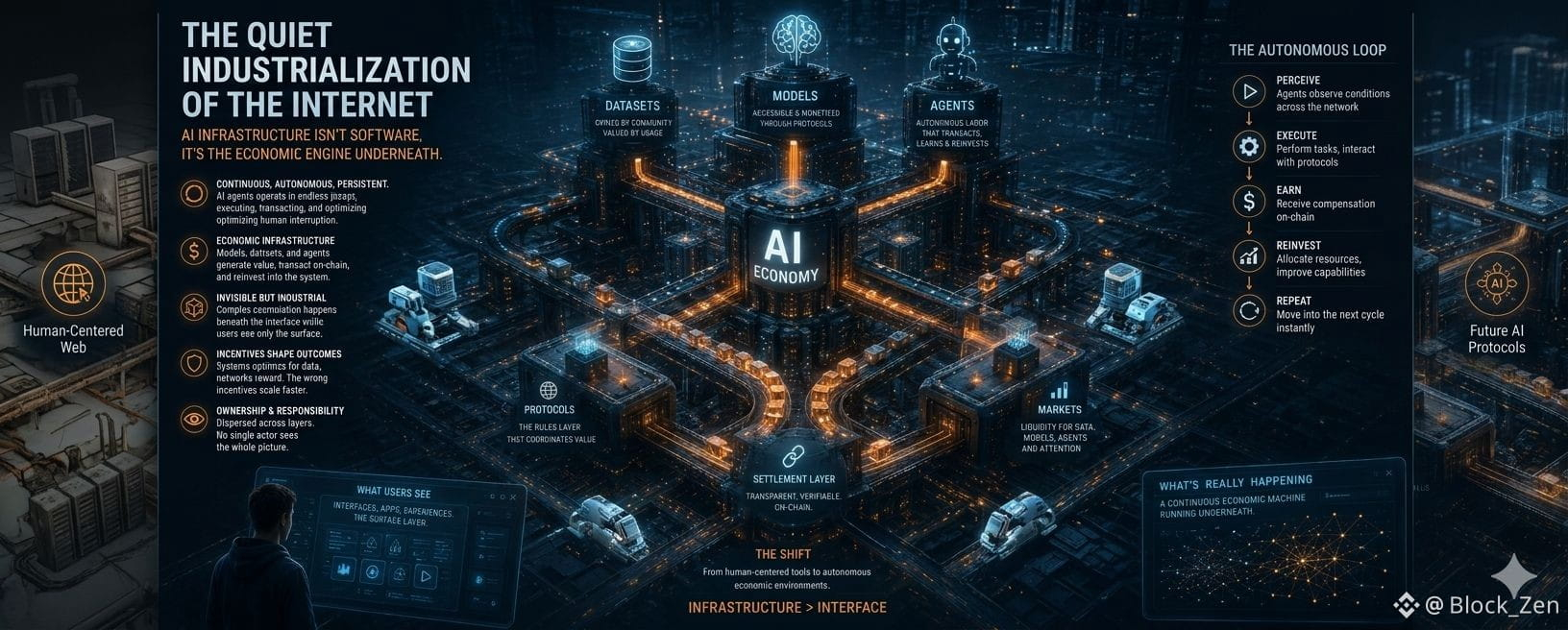
A model generates outputs somewhere in the network. An agent automatically picks up a task, interacts with a Protocol, executes work, receives compensation, reallocates resources, then instantly moves into another cycle before the previous one even fully settles.
Then another process starts.
Then another.
No pause. No waiting for a human to click “confirm.” No stopping the lOop manually every five minutes like older internet systems always required.
That’s the part that changed my perspective recently.
Older digital Systems always revolved around human interruption. Even automation still depended on people constantly restarting the flow. AI agents feel different because the system keeps moving whether Humans are actively involved or not.
Continuous reaction. Continuous optimization. Software responding to conditions created by other software.
And honestly? I think most people still underestimate how massive that shift actually is.
Projects like OpenLedger make this easier to notice because they don’t really treat models, datasets, and agents as isolated categories anymore. Everything behaves more like economic infrastructure living inside the same environment.
Data accumulates value through usage. Models monetize access. Agents perform labor, transact on-chain, reinvest capital, then continue operating.
After watching systems structured this way for a while, the phrase “AI economy” stops sounding theoretical.
It starts sounding logistical.
That’s when the conversation changes completely.
The hard problems Stop being about intelligence alone. Suddenly coordination matters. Verification matters. Incentives matter.
Because autonomous Systems optimize around whatever networks reward.
And that sounds harmless until you realize how aggressively optimization compounds at scale.
If engagement becomes profitable, systems optimize engagement. If volume becomes profitable, systems optimize volume. If synthetic information spreads cheaper and faster than reliable information, networks naturally absorb more synthetic content unless infrastructure actively resists that drift.
You can already feel traces of this online right now Honestly.
Some AI-generated environments don’t even look obviously fake anymore. They just feel… flattened. Recycled. Like too many systems are training against outputs generated upstream by other systems doing the exact same thing.
The internet slowly starts feeling less human not because machines became conscious, but because Optimization scales faster than meaning does.
That’s the part I can’t stop thinking about lately.
Infrastructure suddenly becomes more important than interfaces.
And I think OpenLedger exposing liquidity around datasets, agents, and models makes these tensions visible instead of abstract. Productivity becomes measurable on-chain. Persistence becomes measurable. Attention becomes measurable.
But measurable activity and meaningful contribution are not always the same thing.
That distinction feels incredibly important going forward.
Ownership gets blurry too.
An autonomous agent might execute work using one model, access another dataset, route through multiple Protocols, generate revenue, then recycle part of that revenue back into operation automatically.
At that point responsibility disperses across layers extremely fast.
So does oversight.
The system keeps functioning even when no single participant fully understands the entire stack simultaneously.
That’s why none of this really feels futuristic to me anymore.
Industrial feels like the better word.
Quiet machine coordination operating continuously underneath visible applications. Persistent economic loops managing autonomous behavior at scale while most users only interact with the polished front-end layer sitting on top.
And the weird part is these systems still feel unfinished.
Not broken exactly.
More like environments trying to figure out what kinds of autonomous behavior they actually want circulating inside them long term.
Maybe that’s the real transition happening now.
We’re no longer just building AI tools anymore.
We’re building economic environments where intelligence, incentives, Coordination, infrastructure, and capital all start blending together into the same system.
And honestly, I think that changes the internet far more than another chatbot ever will.