
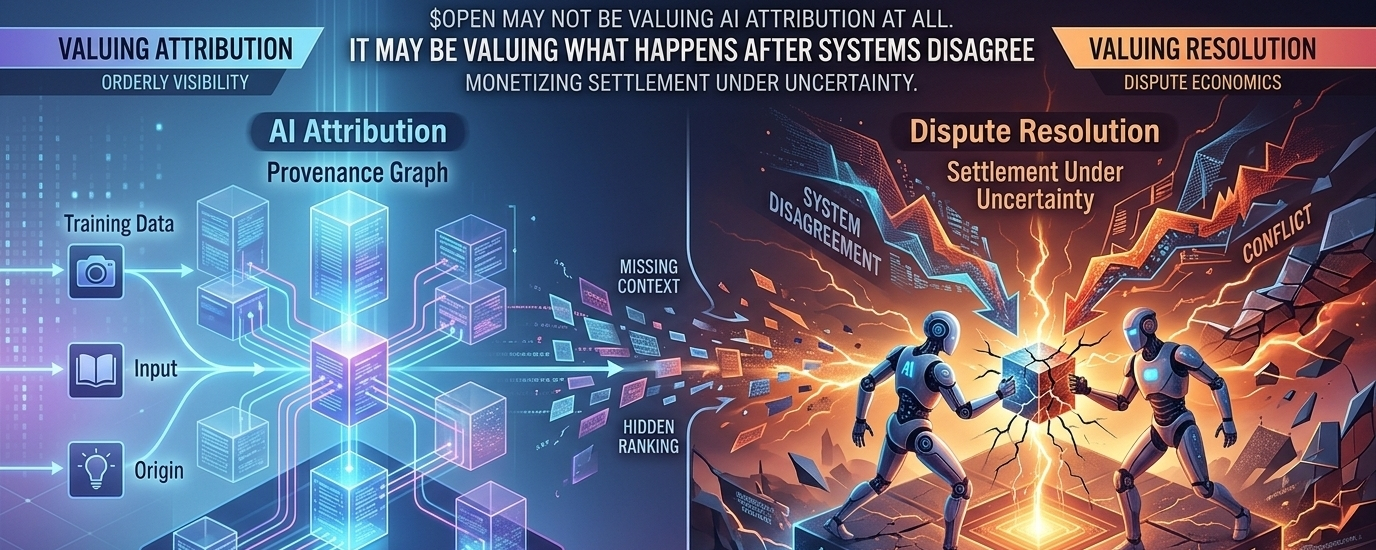
@OpenLedger For a long time, I thought attribution was the entire point of AI infrastructure. That felt intuitive because nearly every serious conversation around AI eventually circles back to ownership, provenance, contribution tracking, training data, and the endless question of who influenced what. The industry keeps framing the future around visibility. Who created the input. Which model touched the output. Where the data originated. What can be proven. And honestly, that narrative is attractive because it sounds orderly. If everything can be traced, then everything feels manageable. But the more I think about it, the more incomplete that explanation starts to feel. Attribution may only be the visible layer people are comfortable discussing. The deeper economic layer may emerge later, at the moment when systems stop agreeing with each other and someone has to decide which version of reality becomes actionable.
That shift sounds subtle at first, but it changes almost everything. Attribution answers a historical question. Dispute resolution answers a financial one. One explains where something came from. The other determines what happens next when consequences already exist. A model generates a recommendation. Another agent consumes it. A ranking engine prioritizes one interpretation over another. A payment gets executed. A creator’s visibility changes because an AI system judged one signal as more trustworthy than the rest. Then later, someone challenges the outcome. Maybe a downstream application claims the model produced one thing while the model provider insists context was missing. Maybe an AI agent made a decision based on inherited outputs from systems nobody fully understands anymore. Maybe the chain of causality exists somewhere in fragments, but by the time anyone investigates, most of the original environment is already gone. That is where attribution starts feeling less like a final product and more like evidence waiting for a courtroom that does not exist yet.
And maybe that is the part people underestimate when they talk about infrastructure tokens like $OPEN. Everyone focuses on whether AI contribution can be tracked, but maybe the real test is whether disagreement itself becomes economically valuable. Because systems do not need sophisticated infrastructure when everything works perfectly. Provenance graphs feel elegant when ownership is uncontested. Reputation systems look rational when agents behave predictably. Transparency sounds powerful when nobody is under pressure. But real demand usually appears when coordination fails. When money is lost. When authority becomes contested. When a system cannot explain why a decision happened the way it did, yet somebody still needs an answer that is stable enough to move forward with. At that point, attribution stops being passive metadata and starts becoming procedural infrastructure. And procedure is expensive.
That realization changed how I look at transparency itself. We often speak about transparency like it is automatically valuable, but transparency without consequence is strangely inactive. A perfectly recorded trail means very little unless someone eventually needs to rely on it during uncertainty. Otherwise, it becomes archival comfort more than economic necessity. What actually creates recurring pressure is conflict. Payments became critical because settlement was necessary when trust failed. Courts exist because agreements collapse. Identity systems matter because access becomes disputed. Even social ranking systems operate this way beneath the surface. What looks like a simple visibility algorithm is usually a massive compression engine reducing endless competing claims into one usable output. Relevance scores, credibility weighting, freshness filtering, engagement signals — these are all forms of soft dispute resolution. Platforms cannot manually interpret every conflict, so they compress ambiguity into decisions people can interact with. Not perfect truth. Just operational truth.
That distinction keeps bothering me because AI infrastructure may be moving toward the same reality. If OpenLedger or similar systems eventually support environments where AI agents collaborate, transact, inherit knowledge, consume outputs from other models, and trigger real economic activity, then provenance is probably only the beginning. The expensive layer may come later, when somebody needs to determine whose version of events survives downstream. Because by the time disputes appear, so much of the original context is already missing. Prompt history disappears. Intermediate reasoning never fully survives. External APIs behave differently depending on timing. Hidden ranking logic shapes outcomes silently. Human interventions leave partial traces. Temporary permissions vanish. Failures happen quietly. Systems evolve faster than their audit layers can keep up with. So when conflict emerges, nobody is recovering objective reality in its pure form. They are reconstructing a version of events that fits whatever evidence remained visible long enough to matter.
And maybe that is normal. Maybe all large systems work this way. Legal systems do not perfectly recover truth either. Markets do not price every variable accurately. Governance does not fully capture intent. Every scalable structure eventually relies on compression because complete reality is too expensive to preserve. But AI makes that compression feel heavier because machine-generated decisions can propagate consequences instantly and at scale. One agent may rely on multiple models, external retrieval systems, delegated sub-agents, ranking layers, and third-party tools before producing a single output that influences money, reputation, access, or trust. When harm emerges from that stack, the issue is no longer whether attribution exists somewhere in theory. The issue becomes whether the attribution is admissible enough to resolve liability after the fact.
That is why I no longer think the strongest thesis for $OPEN is simple contribution tracking. If demand depends only on recording who contributed to what, usage may remain shallow and cyclical. People register outputs, farm incentives, generate proofs, and move on. But if the economic loop starts forming around replay attempts, validation, challenge resolution, liability tracing, governance conflicts, and machine-origin disputes, then the infrastructure becomes much harder to replace. Because disagreements repeat. Complexity compounds. AI systems do not become simpler as they scale. They become denser, more composable, more dependent on outputs produced by other uncertain systems. And the more interconnected they become, the more expensive unresolved ambiguity becomes.
That is the part I cannot stop thinking about. Maybe the future demand is not built on memory at all. Maybe it is built on the cost of unresolved disagreement. Because once AI systems begin making decisions that affect real outcomes, somebody eventually has to decide which interpretation survives long enough to act on. Not which interpretation is philosophically perfect. Just which one becomes authoritative enough for the system to continue functioning. And if infrastructure tokens end up sitting inside that process, then they are not simply monetizing attribution. They are monetizing settlement under uncertainty.
I still do not know whether that is a stronger thesis or a darker one. But it feels far more real than the cleaner story people usually tell.