
Most of my best trading ideas never make it past the notes app.
Not because the ideas are weak.
Because building them into something usable feels like hitting a wall every single time.
I’m a trader, not an engineer.
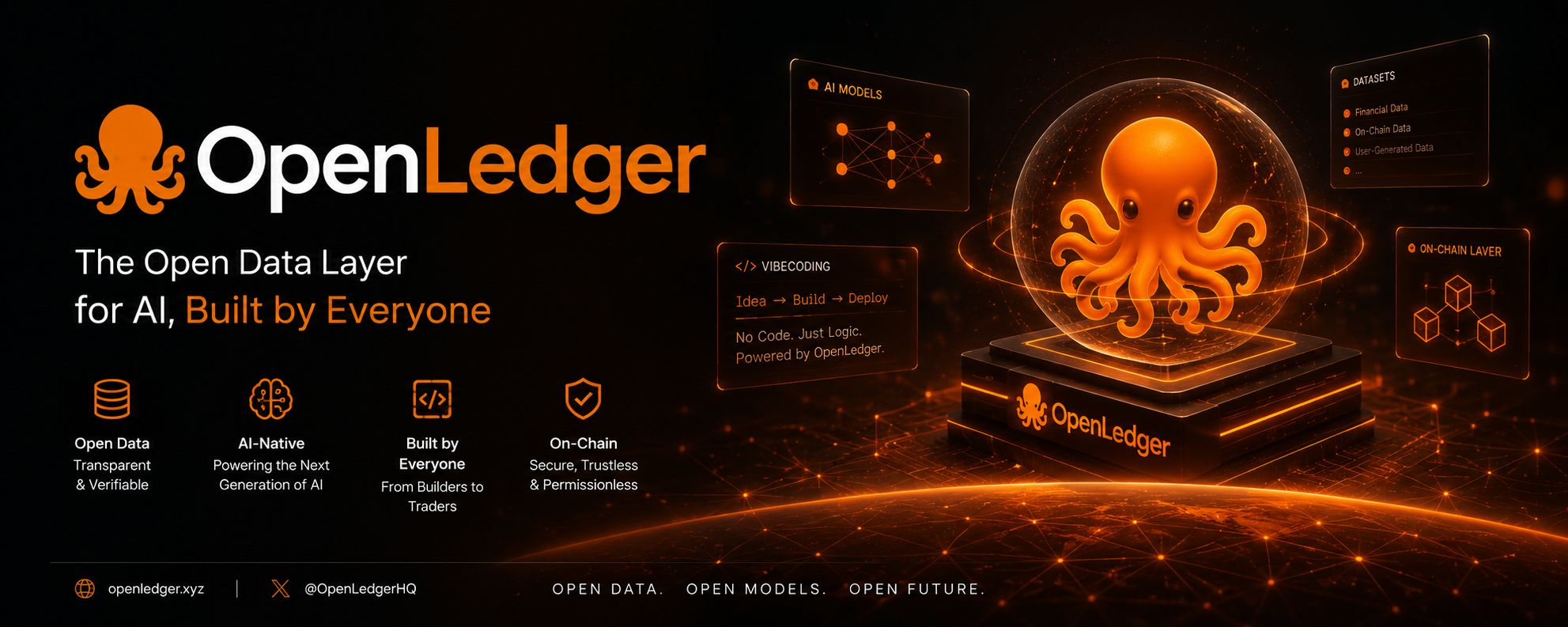
That’s why @OpenLedger and this whole “vibecoding” concept actually caught my attention differently than most AI narratives floating around crypto right now.
This isn’t another shiny dashboard.
It’s about reducing the distance between:
“I have an edge”
and
“I can actually deploy it.”
For years we’ve heard:
“AI can write code.”
Cool.
But generating a random function isn’t the hard part.
The hard part is building something that actually works in live conditions:
• pulling data from multiple APIs
• handling latency
• surviving rate limits
• interacting with wallets
• staying online during volatility
• not breaking the second market conditions change
That’s the real bottleneck.
And honestly, most current AI tooling only solves the easy 20%.
The messy 80% still kills momentum.
A simple example:
For months I wanted a system that alerts me when:
funding flips negative while open interest spikes across multiple exchanges at the same time.
The logic itself is simple in my head.
The implementation is not.
To build it properly I’d need:
• exchange integrations
• backend infrastructure
• monitoring
• hosting
• debugging
• failover handling
So the idea stayed in my notes.
Along with a dozen others.
That’s why vibecoding matters conceptually.
If I can describe a workflow naturally and get something functional without becoming a full-stack developer first, that changes the equation completely.
And timing matters here too.
A couple years ago this probably wouldn’t work:
• AI models hallucinated too much
• blockchain tooling was fragmented
• standards across ecosystems were inconsistent
Now both sides matured at the same time.
Models became usable collaborators.
Infrastructure became more standardized.
That convergence is what makes this moment interesting.
Still, I’m cautious.
Fast building does NOT automatically mean safe systems.
If AI wires up a strategy incorrectly or misunderstands how a contract behaves, the market won’t care whose fault it was.
Losses are still real.
So anything built this way still needs:
• testing
• sandboxing
• verification
• human judgment
No shortcuts there.
But the bigger shift is this:
When building becomes cheap, the edge moves.
The advantage no longer belongs only to people who can code.
It shifts toward:
who has the better ideas,
better market understanding,
and better testing discipline.
That changes the landscape completely.
Simple strategies get saturated faster.
But original thinking becomes more valuable.
The trader who deeply understands their setup and can finally build around it gains leverage that didn’t exist before.
As for $OPEN , the real question isn’t hype.
It’s utility.
Does vibecoding create tools people genuinely keep using after launch day?
Do those systems survive real market conditions?
Does value actually flow back into the ecosystem?
Because if #OpenLedger becomes infrastructure where traders, researchers, and builders consistently ship working on-chain tools, then the narrative has substance.
If it’s just another AI wrapper with marketing attached, the market will expose that eventually too.
I’m not looking at this purely as a trade.
I’m looking at it as an environmental shift.
The tools traders use eventually reshape the market itself.
And if the barrier between “idea” and “deployment” collapses this much, strategy development accelerates for everyone.
More builders.
More automation.
More competition for the same edges.
That’s worth paying attention to long before it becomes obvious.