
Artificial intelligence has entered an era where scale dominates the conversation.
Every few months, new models emerge with larger parameter counts, bigger training datasets, and increasing computational requirements. These advancements have undoubtedly accelerated AI capabilities, but they have also distracted attention from a fundamental challenge that remains largely unresolved: attribution.
Behind every successful AI system exists an enormous network of contributors.
Data creators generate information.
Researchers improve architectures.
Developers refine performance.
Communities provide feedback and evaluation.
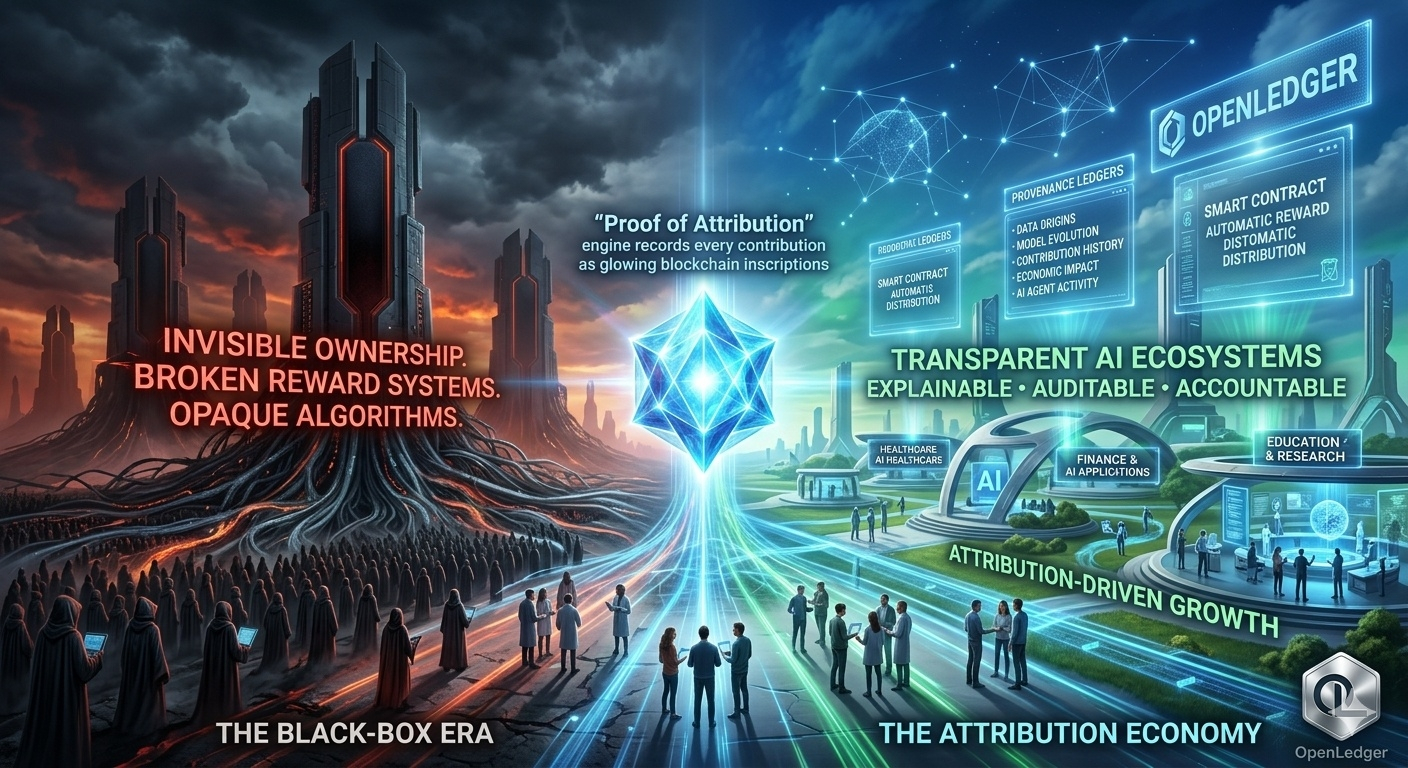
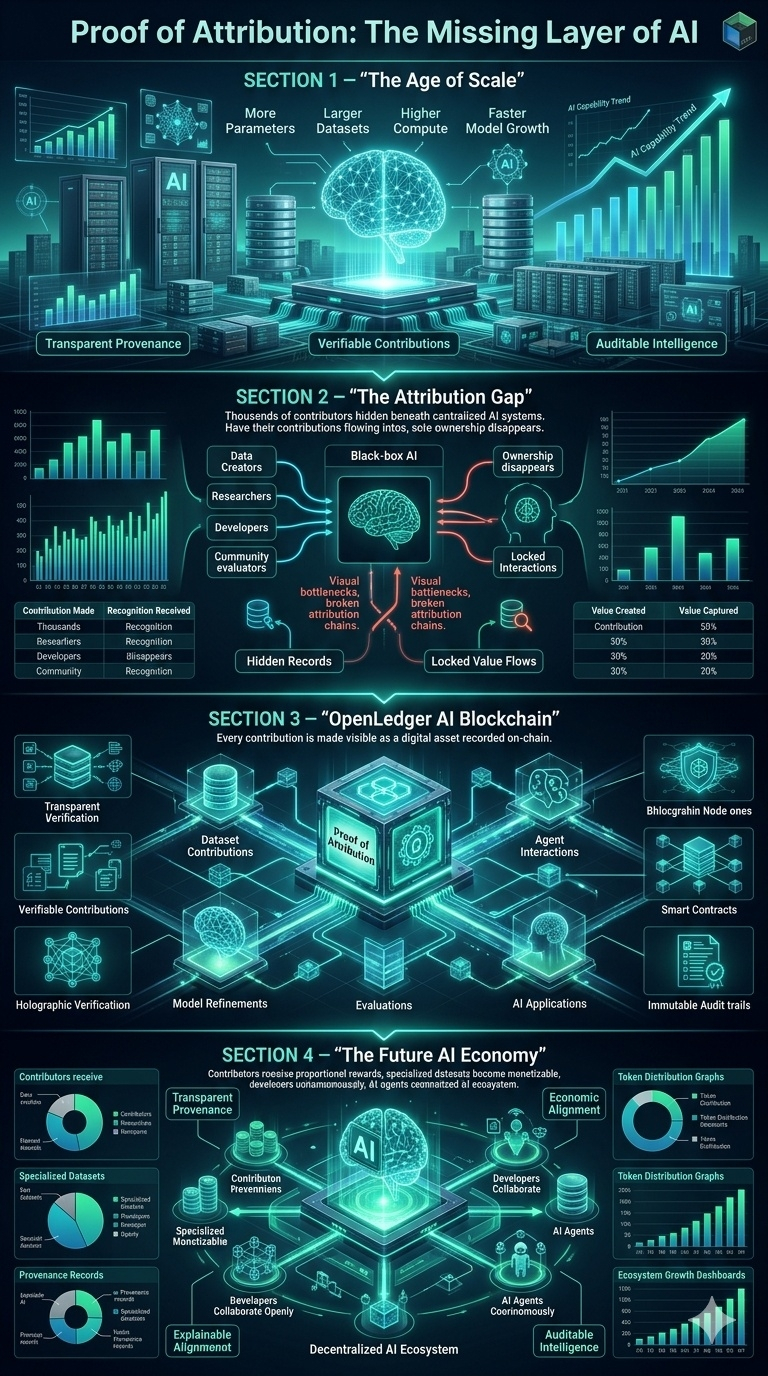
Yet in most AI ecosystems, these contributions disappear into centralized systems where ownership becomes unclear and economic rewards rarely reach those responsible for creating value.
This creates a structural inefficiency.
As AI evolves toward specialized applications in healthcare, finance, education, legal services, and enterprise automation, the demand for high-quality domain-specific data continues to increase. However, obtaining and maintaining such datasets becomes difficult when contributors have no transparent mechanism for proving ownership or receiving compensation.
This is where Proof of Attribution becomes increasingly important.
OpenLedger introduces the concept of an AI Blockchain designed to record contributions throughout the entire AI lifecycle. Rather than treating data collection, model refinement, and application development as isolated processes, every contribution becomes traceable and verifiable through on-chain records.
The significance extends beyond transparency.
Proof of Attribution creates economic alignment between participants. Data providers, model developers, evaluators, and AI application builders can potentially receive recognition and rewards proportional to the impact of their contributions.
This transforms attribution from a simple record-keeping mechanism into an economic foundation for decentralized AI development.
Another critical benefit is trust.
Modern AI systems are often criticized for operating as black boxes. Users frequently lack visibility into where data originated, how models evolved, and what factors influenced outcomes. By introducing transparent provenance and contribution tracking, OpenLedger seeks to create AI systems that are more explainable, auditable, and accountable.
The long-term implication is significant.
The next generation of AI may not be defined solely by larger models or greater computational power. Instead, success may depend on the ability to create ecosystems where contributors are fairly recognized, data quality is sustainably incentivized, and intelligence can be traced back to its origins.
In that future, Proof of Attribution is not simply a feature.
It becomes essential infrastructure.