
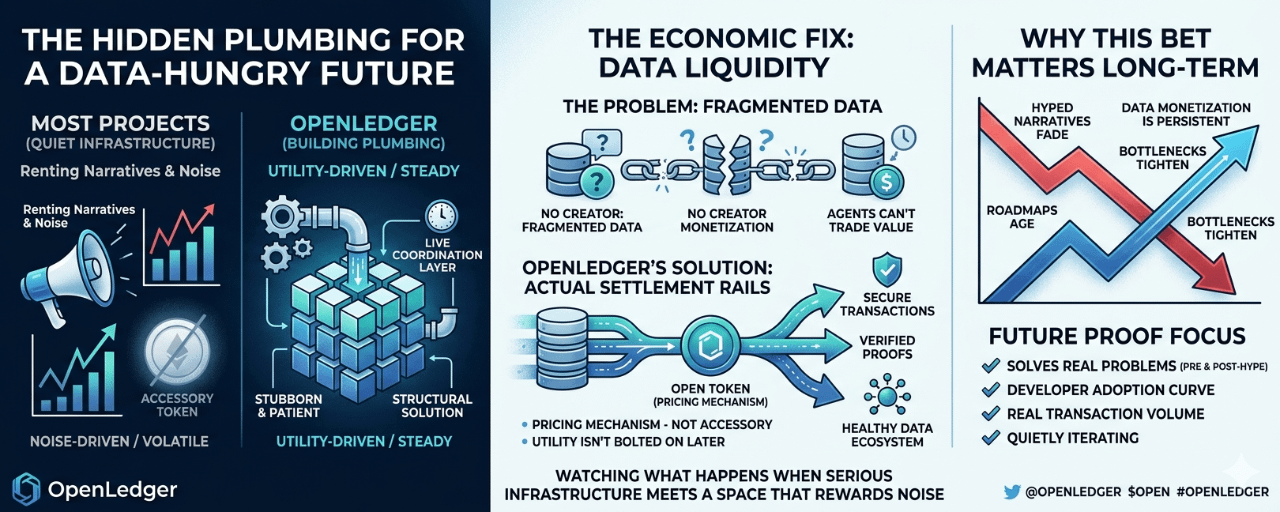
I've been watching the AI-crypto space long enough to recognize the difference between projects that rent narratives and ones that build plumbing. OpenLedger falls into that second category quiet, stubborn, and oddly patient in a market that punishes patience.
I keep coming back to the idea of data liquidity. Everyone talks about AI models needing more compute and scale. But nobody wants to discuss the awkward truth: the data underneath is fragmented, gatekept, and economically broken. Creators can't monetize what they build. Agents can't trade value autonomously. OpenLedger is trying to fix the coordination layer here not with buzzwords, but with actual settlement rails.
I'm looking at whether the OPEN token earns its place or just tags along for the ride. Too many projects launched tokens as accessories. Here, the token is the pricing mechanism. That distinction matters. I've seen enough governance tokens collect dust to know utility isn't something you bolt on later.
I focus on what happens when the spotlight moves. The AI narrative won't stay hot forever. It never does. The projects that remain relevant solve problems that existed before the hype and persist after it fades. Data monetization isn't a trend. It's a structural bottleneck that's only getting tighter as models become more data-hungry.
I'm still waiting to see the developer adoption curve and real transaction volume. Those are the only metrics I trust anymore. Roadmaps age poorly. Whitepapers gather dust. Live coordination between incentives and actual utility that's the rare stuff.
OpenLedger doesn't feel certain. It feels like a bet. A thoughtful one, but still a bet. The projects that matter rarely arrive fully formed. They arrive uncertain, quietly iterating, while the market chases louder things.
I'll keep watching. Not because I'm convinced, but because I'm curious what happens when serious infrastructure meets a space that usually rewards noise instead.