
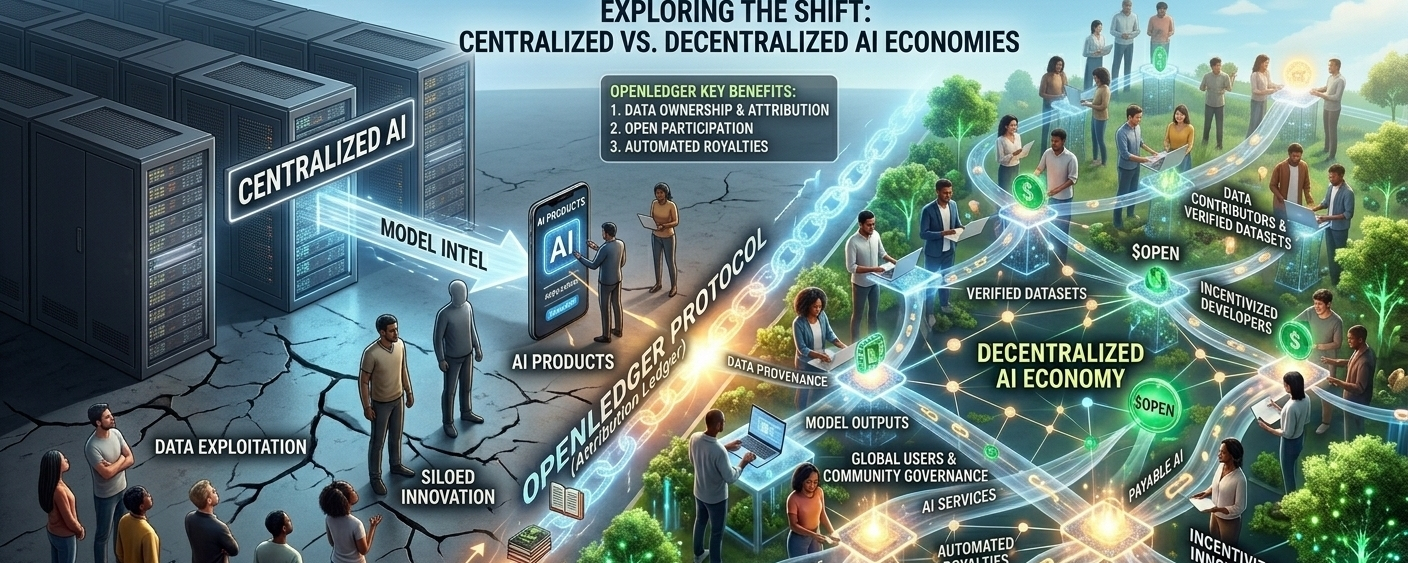
Artificial Intelligence is growing faster than ever, but one major problem still exists: most AI systems are controlled by a small group of centralized companies. These platforms collect massive amounts of data, build powerful models, and generate huge profits, while the people contributing data, ideas, and development often receive little recognition or reward.
That’s why projects like @OpenLedger are becoming increasingly interesting in today’s market. Instead of building another closed AI ecosystem, OpenLedger is focused on creating a decentralized AI economy where contributors can participate directly and benefit from the value they help create.
What stands out to me is the combination of blockchain transparency with AI infrastructure. In traditional systems, ownership and attribution are often unclear. Developers, data contributors, and creators may help improve AI models without having any long-term incentive. OpenLedger appears to approach this differently by introducing transparent ownership and monetization mechanisms for datasets, AI models, and intelligent agents.
This could become very important as AI adoption continues expanding globally. The demand for high-quality data and reliable AI services is increasing every day, but centralized control creates limitations. Decentralized ecosystems may encourage more innovation because contributors are rewarded fairly and openly.
Another interesting aspect is how OpenLedger focuses on building an ecosystem rather than only launching a token. Many projects talk about AI, but very few are trying to solve the ownership and participation problem at scale. If contributors know they can retain value from their work, stronger collaboration could naturally develop inside the ecosystem.
The integration of blockchain also adds transparency that traditional AI platforms often lack. Verifiable ownership, open participation, and on-chain attribution can help build trust between developers, users, and contributors. In the long run, this model may create a healthier digital economy for AI-related products and services.
Of course, the AI sector is becoming highly competitive, and execution will matter more than hype. But the overall vision behind OpenLedger feels aligned with where technology is heading — community-driven infrastructure, transparent value distribution, and decentralized innovation.
As both blockchain and AI continue evolving, projects connecting these two industries could play a major role in shaping the next generation of digital ecosystems. OpenLedger is definitely one of the projects I’ll be watching closely in the coming months.
Do you think decentralized AI platforms like OpenLedger can compete with traditional centralized AI systems in the future?