
There was a time when the internet still felt human.
People shared ideas because they cared. Artists posted their work hoping someone, somewhere, would understand it. Developers spent nights building tools for strangers they would never meet. Researchers collected data, cleaned information, translated languages, organized knowledge, and quietly laid the foundation for the digital world we live in today.
Nobody imagined that one day all of that human effort would become fuel for artificial intelligence.
Yet here we are.
Every AI model people admire today was shaped by millions of invisible contributions. Conversations. Articles. Images. Code. Research papers. Communities. Opinions. Questions. Human experiences. Entire lives transformed into datasets.
And somehow, the people behind that intelligence slowly disappeared from the story.
That feeling — the feeling that human contribution has become invisible — is exactly where OpenLedger begins.
Not from hype.
Not from marketing.
But from a very uncomfortable truth.
Modern AI has become incredibly powerful, but the system behind it often forgets the people who made it possible.
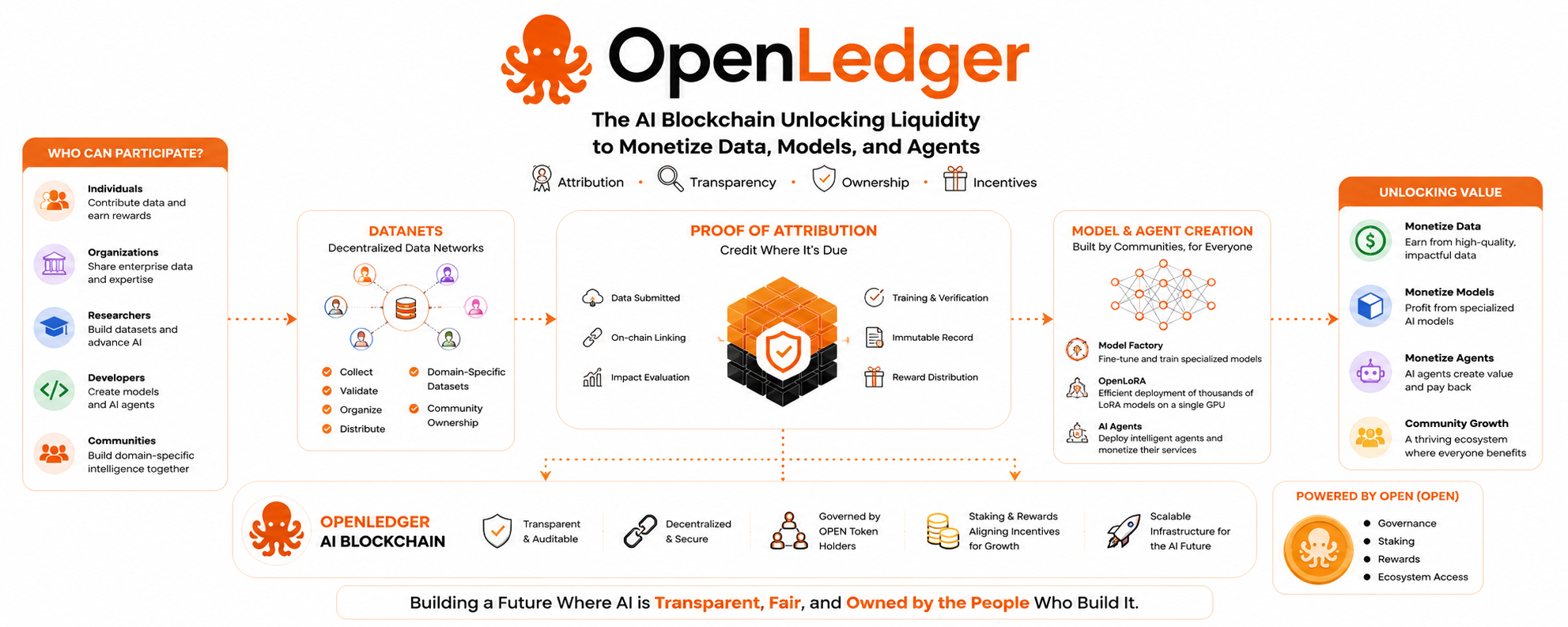
When you look at OpenLedger closely, it does not feel like another blockchain project trying to chase trends. It feels more like a response to something broken. The project describes itself as an AI blockchain built to unlock liquidity for data, models, and agents, but beneath those technical words is a much deeper idea: intelligence should not exist without accountability, attribution, or shared ownership. (openledger.xyz)
That idea hits differently when you really sit with it.
Because today, most people contribute to AI without even realizing it. Every interaction online becomes part of some larger machine. People create value constantly, yet very few own any piece of what that value becomes. The internet trained the future, but the internet rarely gets credit for it.
OpenLedger seems to ask a simple question nobody was seriously asking before:
What if AI actually remembered who helped build it?
Not symbolically.
Not emotionally.
But structurally.
The project’s infrastructure revolves around something called Proof of Attribution, a system designed to track how datasets influence AI models and outputs. According to OpenLedger’s documentation, contributors can be linked to the intelligence their data helps create and potentially rewarded based on impact. (openledger.gitbook.io)
That may sound technical at first, but emotionally it changes everything.
For years, AI has felt like a giant machine absorbing human knowledge into darkness. People contribute, the system evolves, and the rewards move upward toward centralized platforms. Attribution disappears somewhere in the process.
OpenLedger is trying to reverse that disappearance.
It is trying to build a world where contribution leaves fingerprints.
And honestly, there is something deeply human about that.
People do not just want money for their work.
They want acknowledgment.
They want to matter.
They want to know that what they gave to the world was not swallowed whole and forgotten.
That emotional layer is what makes OpenLedger different from most projects in crypto and AI. The technology matters, of course, but the emotional philosophy underneath it matters even more.
The project introduces something called Datanets — decentralized ecosystems where communities can gather, validate, and contribute specialized datasets for AI training. (openledger.gitbook.io)
And this is where the vision starts becoming powerful.
Imagine doctors building medical intelligence together instead of relying entirely on giant corporations.
Imagine researchers contributing scientific datasets while remaining connected to the value they create.
Imagine local communities preserving language, culture, and knowledge before it disappears.
Imagine developers training specialized coding models owned collectively by contributors.
Imagine creators no longer being reduced to disposable training material.
That is the world OpenLedger seems to be chasing.
A world where AI becomes collaborative instead of extractive.
Where intelligence becomes something communities can participate in rather than something they are silently harvested for.
And maybe that is why the project feels emotional to so many people paying attention to decentralized AI right now.
Because beneath the blockchain terminology is a very human fear:
The fear of becoming invisible.
The internet gave people a voice, but modern AI risks turning those voices into raw material without identity. OpenLedger appears to understand that emotional tension deeply. Its entire architecture seems designed around preserving connection between contribution and outcome.
Even the technical side reflects that philosophy.
The platform talks about specialized AI instead of only giant general-purpose systems. Through its AI Studio, model infrastructure, and OpenLoRA framework, OpenLedger aims to make it easier for communities and smaller builders to create and deploy focused AI models efficiently. (openledger.xyz)
That matters because the future of intelligence may not belong solely to massive centralized models controlled by a handful of companies.
It may belong to specialized communities.
Smaller ecosystems.
Focused expertise.
Human-centered intelligence built around real-world knowledge.
OpenLedger seems to believe that intelligence should grow more organically, almost like cities instead of empires. Thousands of interconnected systems built by people who actually understand the domains they are shaping.
And there is something hopeful about that vision.
Especially right now.
Because honestly, a lot of people are scared of where AI is heading.
They are scared of losing jobs.
Scared of losing creativity.
Scared of losing control.
Scared that human beings are slowly becoming secondary to the systems they built.
OpenLedger does not pretend those fears do not exist.
Instead, it tries to build infrastructure where humans remain visible inside the intelligence economy.
That distinction matters.
The OPEN token itself also feels tied to that larger vision rather than existing purely for speculation. According to the project’s documentation, the token plays roles in governance, incentives, participation, and ecosystem rewards. (openledger.gitbook.io)
And while many crypto projects throw around words like “community,” OpenLedger’s structure seems genuinely focused on participation. The people contributing data, improving models, and helping ecosystems grow are not supposed to sit outside the system. They are meant to become part of it.
That changes the emotional relationship entirely.
Instead of AI feeling like a distant corporate machine, it starts feeling more like shared infrastructure.
Shared intelligence.
Shared ownership.
Of course, none of this guarantees success. The AI and blockchain industries move brutally fast. Many ambitious ideas fail long before reaching maturity. OpenLedger still has enormous challenges ahead — adoption, scalability, competition, trust, execution.
But sometimes the importance of a project is not only about whether it wins immediately.
Sometimes the importance lies in the question it forces the world to confront.
And OpenLedger forces an important one:
Who deserves ownership in the age of artificial intelligence?
That question is bigger than crypto.
Bigger than blockchain.
Bigger than one company.
It touches creativity, labor, identity, economics, and the future relationship between humans and machines.
Because intelligence has never truly belonged to machines alone.
It has always belonged to people.
To conversations.
To cultures.
To experiences.
To communities.
To human beings sharing pieces of themselves with the world.
And maybe that is the real reason OpenLedger resonates emotionally with so many people right now.
Not because it promises profits.
Not because it uses trendy technology.
But because, in a world rushing toward automation faster than anyone can emotionally process, it is trying to protect something deeply human:
The right to still be seen inside the systems we create.