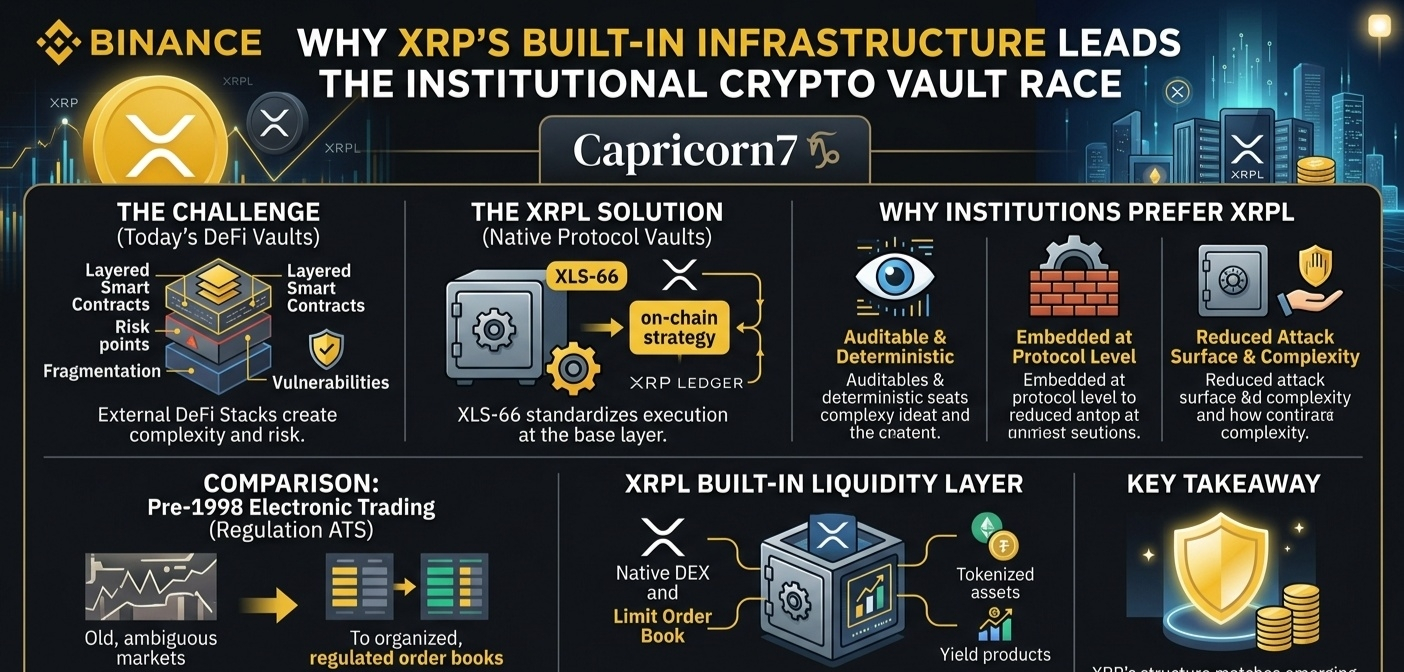
$XRP 🚀 As Washington signals a shift from crypto crackdowns toward formal rulemaking, a new concept is quietly moving into focus: Crypto Vaults. 🏛️✨
🏛️ SEC Chair Paul Atkins Signals a New Era — XRP Leads the Conversation
SEC Chair Paul Atkins recently hinted at a new crypto vault framework, marking a major move toward structured yield rules. Digital asset research firm Evernorth argues this transition could have massive implications for XRP and the XRP Ledger. 📊📈Earlier this month, Atkins drew a direct parallel between today’s digital asset landscape and the pre-1998 era before Regulation ATS redefined electronic trading, bringing it out of regulatory ambiguity and into Wall Street’s formal structure.
🧐Instead of enforcement, the SEC is signaling a move toward formally defining blockchain-based yield products as a distinct regulatory category. 📜⚖️
⚙️ What Makes a Crypto Vault?
A crypto vault is a pooled deposit system that executes predefined on-chain strategies like:
💰 Yield generation
💧 Liquidity management
🏦 Treasury allocation
The Problem: In most DeFi environments, these vaults are built on top of multiple complex smart contracts layered over a base blockchain, adding extra risk points. ⚠️🧩
The XRPL Solution: The difference with the XRP Ledger is that this functionality is being brought directly into the protocol itself through XLS-66. 🛠️🔒
Instead of relying on risky external DeFi stacks, vault mechanics are embedded directly into the ledger. This reduces fragmentation, standardizes execution, and gives institutions access to on-chain yield without third-party dependencies! 🛡️🤖
🏗️ Why Institutional-Grade Infrastructure Taps the Balance
Traditional finance (TradFi) institutions favor systems that are:
Auditable 🔍
Deterministic 🎯
Embedded at the protocol level 🏗️
Native vault architecture reduces operational complexity and attack surfaces, making it a perfect fit for regulated environments. 🏦🔐
Just like Regulation ATS unlocked massive institutional capital for electronic trading decades ago, a clear framework for crypto vaults could shift them from experimental DeFi into formally recognized financial infrastructure. 🌊💸
While many crypto ecosystems are trying to retroactively adapt to compliance, the XRPL was designed for institutional interoperability from day one. 🎯🌐
📊 Market-Ready Infrastructure Amid the SEC Shift
According to on-chain analytics provider RippleXity, the XRP Ledger is increasingly viewed as a settlement infrastructure that already maps to key requirements in regulated capital markets. 🏛️📈
Built-in Liquidity: Unlike newer blockchains relying on fragmented external solutions, the XRPL integrates a native decentralized exchange (DEX) and a central limit order book at the protocol level. 💧🔄
Global Recognition: Ripple’s climb to 16th on CNBC’s Disruptor 50 signals growing recognition that the real battleground in blockchain is foundational financial infrastructure. 🏆🌍
🤔The Bottom Line: If the SEC defines a formal category for crypto vaults, XRP won't need to chase the trend—because the exact infrastructure regulators are describing already exists on the XRP Ledger. 🚀🎯