The AI industry moves fast.
New models arrive every month. Companies compete for larger datasets, faster chips, and more powerful infrastructure. Every conversation revolves around scale, intelligence, and performance.
But beneath all that progress, there is a problem the industry still refuses to confront:
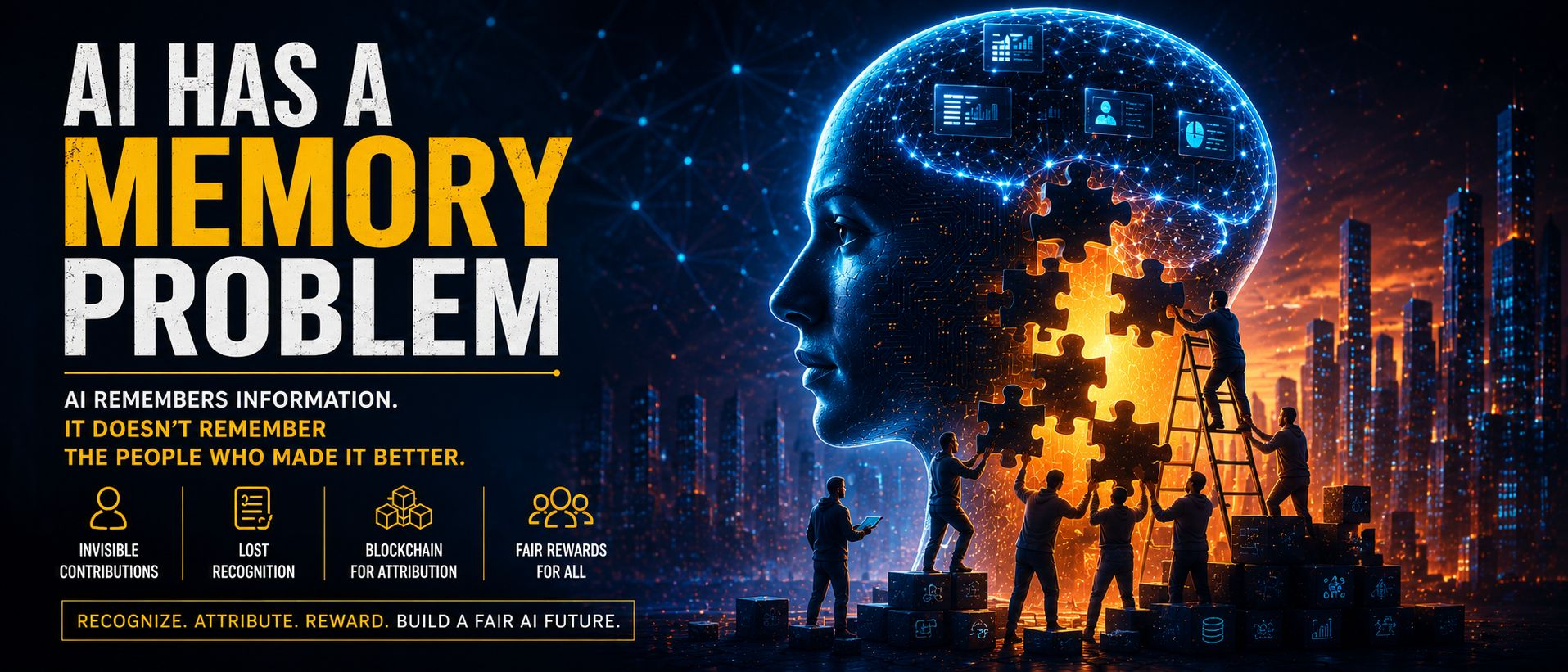
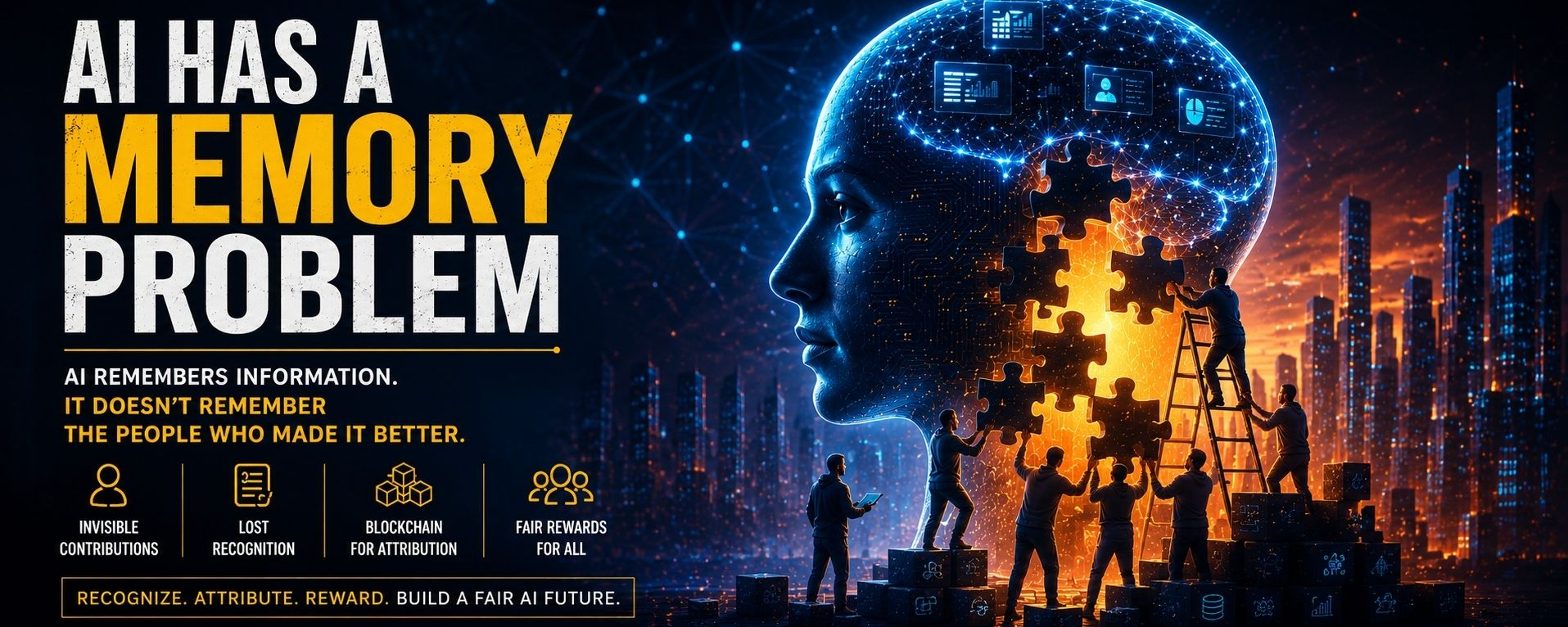
AI remembers information.
It does not remember the people who made it better.
That failure is not small. It is structural.
Every useful AI system is built on invisible human effort. Someone gathers data. Someone labels it. Someone filters bad outputs, corrects mistakes, improves prompts, fine-tunes models, and gives feedback that transforms weak systems into useful ones.
Most of that work disappears.
The model gets the attention.
The company captures the value.
The people who helped shape the system fade into the background.
For years, this was treated as normal because AI development was heavily centralized. A small number of companies controlled the data, infrastructure, training process, and final products. That structure helped AI advance quickly, but it also created a deep imbalance.
The people improving AI systems rarely receive visibility, ownership, or recognition inside the systems they helped build.
As AI becomes more powerful, that imbalance becomes harder to justify.
The next phase of AI may not be defined only by smarter models.
It may be defined by attribution.
Because AI does not only need compute power.
It also needs memory.
Not technical memory.
Economic memory.
Human memory.
A system that benefits from contribution should also be capable of recognizing contribution.
That matters because the future of AI will not be built by a single company or one research lab. It will be built by networks of contributors: developers, researchers, communities, data providers, and everyday users interacting with models every day.
The more collaborative AI becomes, the more important attribution becomes.
Without clear contribution tracking, rewards disconnect from effort.
Without verification, ownership becomes meaningless.
Without transparency, trust begins to collapse.
This is where blockchain technology starts to matter beyond hype and marketing.
Blockchain creates permanent and verifiable records. In AI systems, that could mean tracking where data originated, who improved a model, what contributions created value, and how rewards should be distributed.
The important question is no longer:
“Who owns the AI model?”
The better question is:
“Who helped make the model valuable?”
That shift changes everything.
Most blockchain systems were originally designed for financial activity — transactions, tokens, NFTs, and DeFi. Those systems work well for moving assets.
But AI is different.
AI does not simply move value.
It accumulates intelligence.
That means AI systems require deeper provenance, attribution, and contribution tracking than most existing blockchain infrastructure was designed to handle.
This is why attribution layers matter.
What makes OpenLedger interesting is not simply that it combines AI and blockchain. Many projects already make that claim.
The more important idea is that it focuses on a missing layer in the AI economy: contribution memory.
In collaborative AI systems, remembering contribution may become just as important as improving performance.
Because without attribution, AI risks creating an economy where value flows upward while contribution disappears underneath it.
That model cannot last forever.
Contributors are becoming more aware of the value they provide. Developers no longer want their work absorbed into black-box systems without recognition. Data providers do not want to remain invisible. Communities do not want to help build billion-dollar ecosystems while receiving nothing in return.
This issue is no longer only technical.
It is economic.
It is cultural.
And eventually, it becomes political.
The future AI economy cannot continue relying on invisible labor feeding opaque systems.
Transparency alone will not solve every problem. But it changes the foundation. It creates accountability. Traceability. And most importantly, the possibility of fair participation inside systems that increasingly shape the digital world.
The next generation of AI will still produce smarter models.
But the systems that matter most may be the ones that finally remember where intelligence came from in the first place.
Because intelligence without attribution creates concentration.
And intelligence without memory creates imbalance.
AI is being built by millions of people.
It is time the systems behind it remember every single one of them.