


The first time I seriously thought about the future of AI economies, it wasn’t because of a breakthrough model or a flashy headline. It was because I noticed how deeply fragmented the ecosystem already felt. One centralized platform controls the models, another siloes the data and somewhere in the middle, everyday users generate immense value without owning a single piece of the system. This exact imbalance keeps showing up across Web3 and AI. The companies building models desperately need high-quality data, the people providing that underlying data rarely benefit fairly and the processing infrastructure remains heavily centralized. That is why @OpenLedger is capturing serious attention right now. They aren't trying to build just another generic AI application or chase short-term hype. Instead, they are targeting a much deeper structural play. Becoming the foundational coordination and infrastructure layer for how decentralized AI economies function. Much of the current AI boom relies on a high degree of centralization. A handful of massive tech conglomerates control large-scale compute, proprietary models and massive datasets. While this has made AI tools incredibly powerful, it forces the entire ecosystem into a state of total dependence. As AI agents and machine learning become deeply embedded into financial rails, content production and autonomous automation, a hard question arises. Who actually owns the value that AI creates? Right now, the answer is almost always the hosting platform. This is where the engineering architecture of OpenLedger becomes highly relevant. At its core, OpenLedger focuses on decentralized AI infrastructure. The goal isn’t simply to host a model on-chain or attach a token wrapper to an API. It is a structured framework where data contributors, model builders, developers and users can seamlessly interact and transact within a single, unified economic system. AI economies depend entirely on multi-party coordination. Models require verified, high-quality data inputs, applications require low-latency model routing and contributors require transparent, programmatic incentives. Without a robust data and verification layer connecting these pieces, the entire ecosystem remains siloed. One of the strongest technical narratives surrounding $OPEN is precise data attribution. Traditional AI models absorb massive amounts of data but the original creators rarely know how their information is utilized, whether it genuinely improved the model, or if they will ever receive compensation. 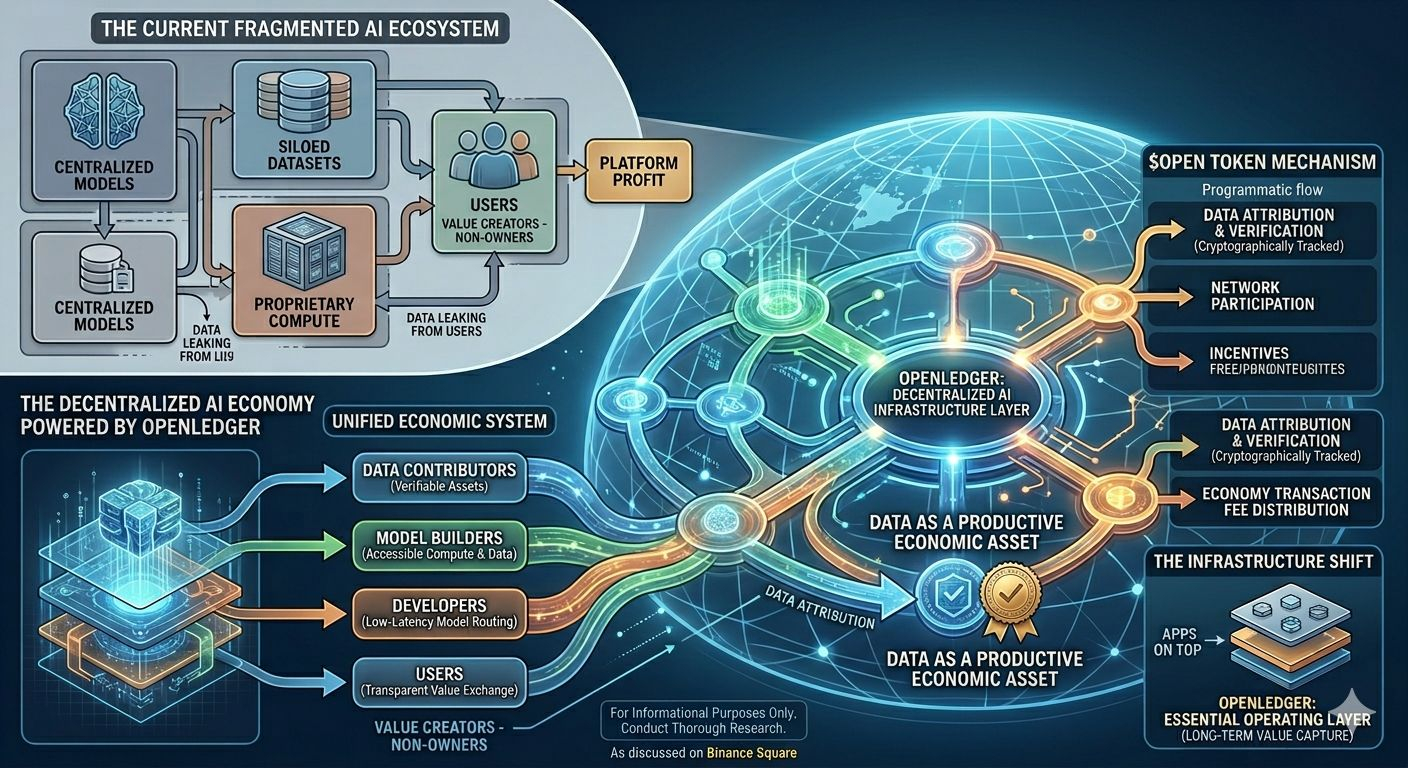 The OpenLedger approach restructures this flow by tracking individual data contributions cryptographically, verifying network participation via immutable ledger states and distributing economic value transparently based on actual utility. If AI economies grow at the scale many industry analysts predict, data will transition from a passive resource that companies quietly harvest into a verifiable, productive economic asset. Historically, underlying infrastructure layers capture far more sustainable long-term value than the individual applications built on top of them. Most everyday users never think about the complexities of cloud architecture, internet protocols, or payment rails yet those invisible systems quietly dictate how the global economy functions. OpenLedger is positioning itself exactly there not as the loud, consumer-facing frontend of AI, but as part of the essential, underlying operating layer. This is a fundamentally different strategy from projects built purely on marketing narratives. The conversation in Web3 is finally maturing past the hype, developers and investors are prioritizing cryptographic proof, auditability and decentralized coordination over raw speculation. While the architectural angle is incredibly strong, infrastructure plays live and die by network effects and developer adoption. Infrastructure only matters if developers actively build on it and data providers actively supply it. Furthermore, the environment moves at breakneck speed. Systems designed today can face rapid obsolescence if they do not iterate aggressively. OpenLedger faces direct competition from entrenched, web2 centralized giants who possess massive capital, compute reserves and pre existing ecosystems. Because mainstream AI developers prioritize execution speed, efficiency, and raw performance over pure philosophy, the network must continuously prove that its decentralized framework is not just ethically sound but practically superior and friction-free to onboard. If it successfully mitigates that onboarding friction, it stands as a major contender to anchor the upcoming machine-to-machine economy. This post is for informational purposes only and represents original analysis regarding the OpenLedger ecosystem. Content on Binance Square does not constitute financial advice. Always conduct your own thorough research before engaging with any cryptographic protocols.
