
There’s a small coffee shop near my apartment that still writes orders by hand. Not because they have to, but because the owner says it helps him remember people. Every cup leaves the counter carrying something slightly personal with it — a name written a certain way, an inside joke, a familiar order he memorized months ago without trying.
I think that’s why the place feels different from the chain cafés nearby. Nothing there feels optimized for maximum efficiency. It feels remembered.
I’ve been thinking about that a lot lately while watching OpenLedger.
Most crypto projects talk about scale long before they talk about memory. Throughput. Liquidity. Automation. Faster settlement. Infinite abstraction. The language is usually about removing friction until users themselves almost disappear behind the system.
OpenLedger, at least from what I’ve seen so far, seems to be aiming at something slightly different. Attribution.
Who contributed the data. Who trained the model. Who deserves compensation when an AI system creates value from human input. The project is trying to build an economic layer around intelligence itself, where datasets, models, and autonomous agents can be tracked, verified, and monetized instead of disappearing into the black-box machinery most AI systems have quietly become.
That idea isn’t completely new, of course.
Crypto has spent years trying to tokenize invisible labor. Creator economies. Attention markets. Decentralized compute. Data ownership. I’ve watched multiple cycles where the promise sounded almost identical: people would finally reclaim the value they generate online instead of endlessly feeding centralized platforms for free.
Most of those experiments either collapsed into speculation or slowly faded once the incentives stopped feeling exciting.
So when I first looked at OpenLedger, I honestly assumed it would follow the same path. Another AI narrative wrapped around blockchain infrastructure during a period where the market seems willing to attach “AI” to almost anything as long as it feels tradeable enough.
And to be fair, some of that dynamic is clearly still there.
The token had the usual explosive debut. Trading volume surged. Social sentiment accelerated into that familiar cycle where excitement starts feeding itself faster than fundamentals can keep up. I’ve been around long enough to know markets often confuse momentum with permanence.
But I keep coming back to one detail that makes OpenLedger slightly harder to dismiss.
The team isn’t only talking about AI outputs.
They’re talking about provenance.
That distinction matters more than people realize.
Most AI systems today function like extraction engines. Human data goes in. Capital accumulates somewhere else. The people who contributed to the process become almost impossible to identify once the machine starts generating value at scale.
OpenLedger’s “Proof of Attribution” framework seems to be trying to reverse that logic by creating traceable relationships between training data, model behavior, and economic rewards. In practical terms, they’re asking a question the broader AI industry still seems uncomfortable answering:
If intelligence is increasingly built from collective human input, who actually gets paid for it?
I don’t know if blockchain is the perfect answer to that problem.
But I do think it’s one of the few corners of crypto still attempting to wrestle with something structurally important instead of purely financial theater.
The timing also feels intentional.
OpenLedger emerged during a period where AI regulation, copyright disputes, synthetic media concerns, and data ownership debates are becoming impossible to ignore. Their partnerships around rights-cleared AI training and verifiable agent infrastructure feel positioned around that pressure rather than disconnected from it.
That’s noticeably different from older “decentralized AI” projects that mostly revolved around speculative compute marketplaces nobody genuinely used outside farming incentives.
Still, the distance between a compelling idea and durable behavior is enormous.
Crypto consistently overestimates how much users care about ideals once convenience enters the equation. People say they value decentralization, transparency, ownership, fairness. But historically, most people migrate toward products that feel fast, simple, and emotionally frictionless.
Web2 didn’t dominate because it was ethical. It dominated because it was effortless.
That’s the part I keep questioning with OpenLedger.
Will developers actually choose attribution-heavy infrastructure if centralized AI systems remain cheaper and easier to use? Will ordinary users care where AI outputs came from as long as the results feel useful? Can token incentives sustain a healthy data economy without collapsing into farming behavior the way so many Web3 systems eventually do?
Because once you attach tokens to contribution systems, human behavior changes immediately.
Participation becomes strategic. Quality declines. Sybil activity appears. Communities slowly stop acting like communities and start behaving like labor markets optimized around extraction.
I’ve seen that transformation happen repeatedly in crypto. The language always begins with ownership and eventually drifts toward emissions schedules and yield optimization.
To OpenLedger’s credit, the project at least seems aware of that tension.
Their roadmap increasingly focuses on accountability, auditability, and machine-to-machine coordination instead of leaning entirely on speculative hype cycles. The ecosystem appears to be evolving from narrative-stage branding into actual infrastructure attempts — attribution engines, AI marketplaces, verifiable agent systems, rights management layers, mainnet deployment.
But honestly, this is also the phase where most crypto projects quietly fail.
Narrative momentum can carry almost anything upward for a while. Sustained utility is much harder.
Right now OpenLedger feels like it’s sitting in that uncomfortable space between post-hype recalibration and cautious expansion. The broader market still cares about AI, but investors are becoming more selective than they were a year ago. The “AI x crypto” label alone no longer guarantees attention.
People want evidence now.
They want products people continue using after the excitement fades.
And user experience still matters more than ideology. If onboarding feels complicated, if attribution systems become cumbersome, if rewards feel delayed or abstract, most people won’t care how elegant the underlying economics look on paper.
That’s something crypto builders often forget.
Humans rarely experience systems philosophically.
They experience them emotionally.
People stay because something feels intuitive, meaningful, empowering, or strangely human. They leave when participation starts feeling coldly transactional.
There’s also a deeper philosophical tension underneath projects like OpenLedger that I can’t quite stop thinking about.
They’re trying to turn human contribution into measurable infrastructure. Every dataset attributable. Every interaction trackable. Every creative trace potentially assigned economic value.
Part of me understands why that future feels attractive. The current AI economy genuinely does feel asymmetrical and extractive in ways most people still underestimate.
But another part of me wonders what disappears once every human action becomes part of a compensation graph.
There’s a difference between memory and accounting.
The internet used to feel messy in a human way. Imperfect. Unstructured. Increasingly it feels optimized for capture — attention capture, behavioral capture, data capture. AI accelerates that tendency even further.
OpenLedger doesn’t really seem to be resisting that shift. It feels more like an attempt to make the extraction process fairer, more transparent, and economically visible instead of pretending it can be stopped entirely.
Maybe that’s realistic.
Or maybe it’s just another layer of financialization wrapped around creativity and human behavior.
I honestly can’t tell yet.
What I do know is that the broader direction of technology is clearly moving toward autonomous agents, machine economies, and verifiable AI systems. Even outside crypto, institutions are beginning to take those ideas more seriously than they did a few years ago.
In that environment, OpenLedger doesn’t feel disconnected from where things are heading.
The real question is whether being directionally correct is enough.
A lot of projects are early.
Very few survive long enough to become necessary.
So I’m still watching OpenLedger carefully. Not because I’m convinced. Not because I think success is guaranteed. But because the questions underneath the project feel larger than the token itself.
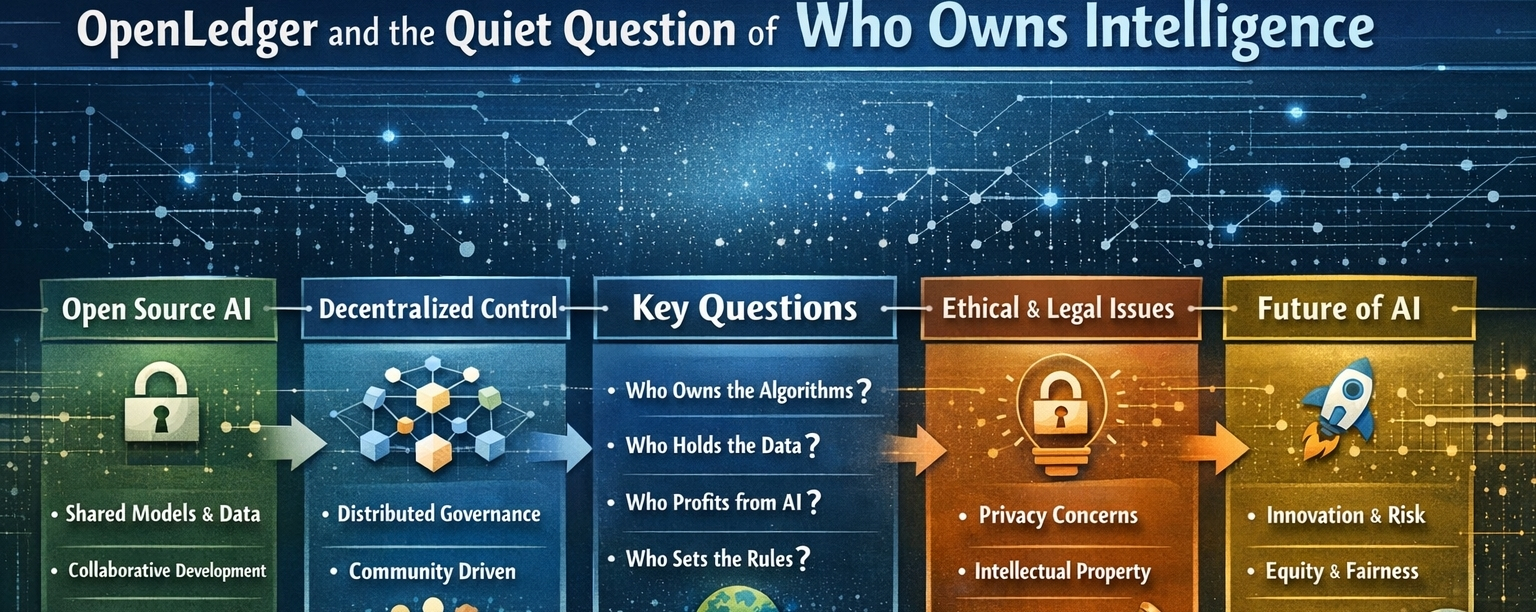
Who owns intelligence?
Who gets compensated when machines generate value from human contribution?
What does fairness even look like once creativity, labor, and intelligence become partially automated?
Crypto rarely answers those questions cleanly.
Sometimes it just exposes them more honestly.
And maybe that uncertainty — more than certainty itself — is what keeps this project interesting to me.
