
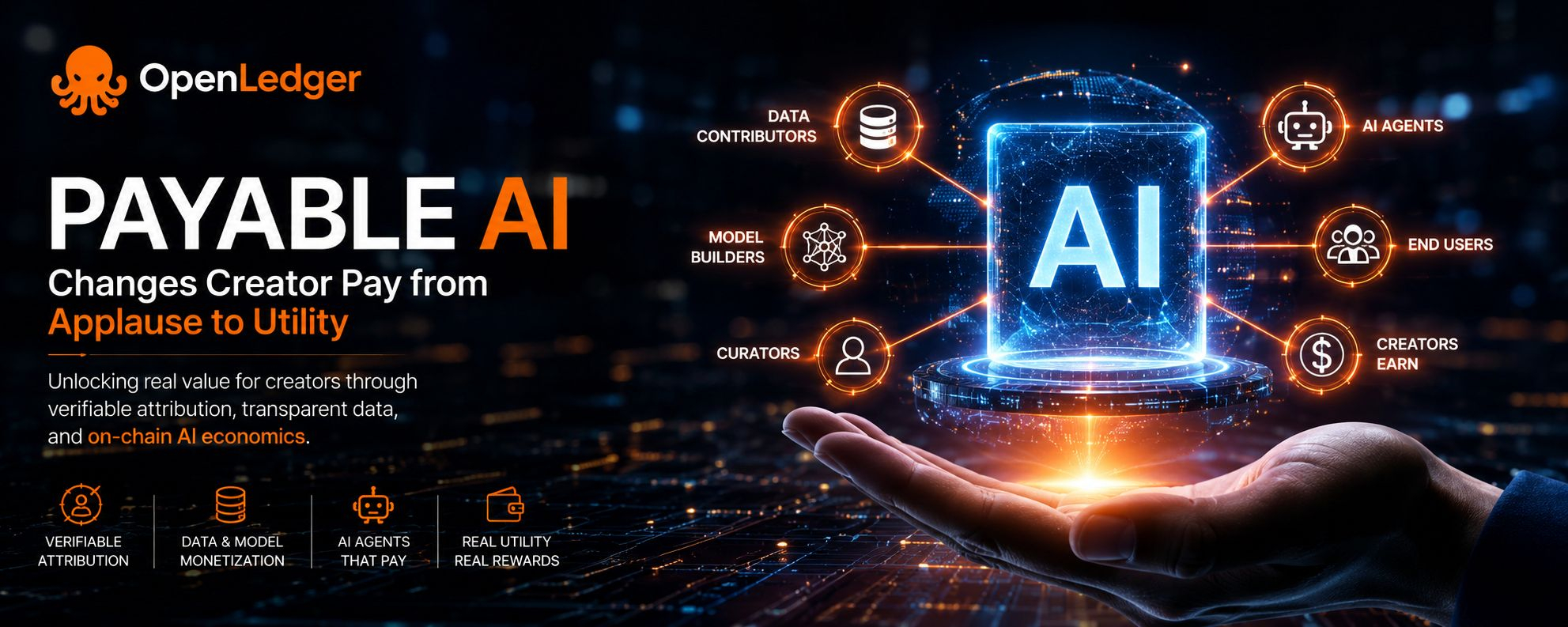
The more I watch AI develop, the more obvious it becomes that most creators are still getting paid the wrong way. Platforms reward noise, visibility, timing, and distribution tricks, but rarely reward actual long-term usefulness. Someone can dump a massive dataset online, collect attention for a week, and disappear, while another contributor quietly improves a model’s answers every single day without ever being noticed. That imbalance is exactly why the idea behind OpenLedger feels more important than people realize.
OpenLedger describes itself as an AI blockchain built to monetize data, models, and agents, but the interesting part is not the blockchain label. The real shift is its focus on attribution during inference itself. Its recent Proof of Attribution research paper explains a system where AI outputs can be traced back to the contributions that genuinely influenced them. That changes the conversation completely. Instead of rewarding people just for uploading something once, the system attempts to reward them because their contribution kept proving useful over time.
That sounds technical on paper, but emotionally it feels very human. Think about how creative work works in real life. A good teacher is not valuable because they spoke once in a classroom five years ago. They are valuable because their influence keeps showing up in people long after the lesson ended. A musician is not remembered because they uploaded a song. They matter because that song keeps affecting people years later. OpenLedger’s idea of payable AI feels closer to that kind of logic. Influence matters more than the initial upload.
The project’s attribution framework is built around something called DataNets, where contributions carry metadata, provenance, licensing information, and usage history. The system then tries to measure how much a dataset or contribution actually shaped an AI response. What stood out to me is that OpenLedger is not treating data like a static object sitting in storage. It treats data more like labor that continues working inside the model after the upload is over. That is a very different philosophy from the current AI economy, where most contributors lose visibility the moment their content enters the training pipeline.
I also think the project’s recent direction matters here. Their 2025 updates around AI apps, real-time RAG systems, wallet integrations, and agent infrastructure suggest they are trying to move attribution into actual user experiences instead of leaving it as an academic concept. The Trust Wallet collaboration especially caught my attention because it hints at a future where AI actions inside wallets can remain auditable and attributable. That may sound small today, but it changes how value flows. If an AI agent saves users time, improves decisions, or automates repetitive actions, someone helped create that intelligence. OpenLedger seems focused on making sure those invisible contributors do not disappear from the economics.
Most token reward systems feel temporary to me. They often resemble marketing incentives more than sustainable creator economies. Payable AI feels different because it connects compensation to ongoing relevance. The reward is not tied to hype at the moment of upload. It is tied to whether your contribution still matters later when the AI is actually being used. That creates a healthier relationship between creators and the system itself.
Honestly, I think this changes the definition of a creator. In AI, value rarely comes from one person alone anymore. The person cleaning the data, the researcher structuring it properly, the developer building the agent layer, and the contributor improving inference quality are all shaping the final output together. OpenLedger’s framework acknowledges that reality instead of pretending creativity is isolated. That is probably the most mature thing about the project.
The internet spent years building systems that rewarded attention. AI may end up building systems that reward measurable influence instead. That is a subtle difference, but it changes everything. Attention fades fast. Influence compounds quietly over time. OpenLedger seems to be betting that future AI economies will care more about the second one.
