
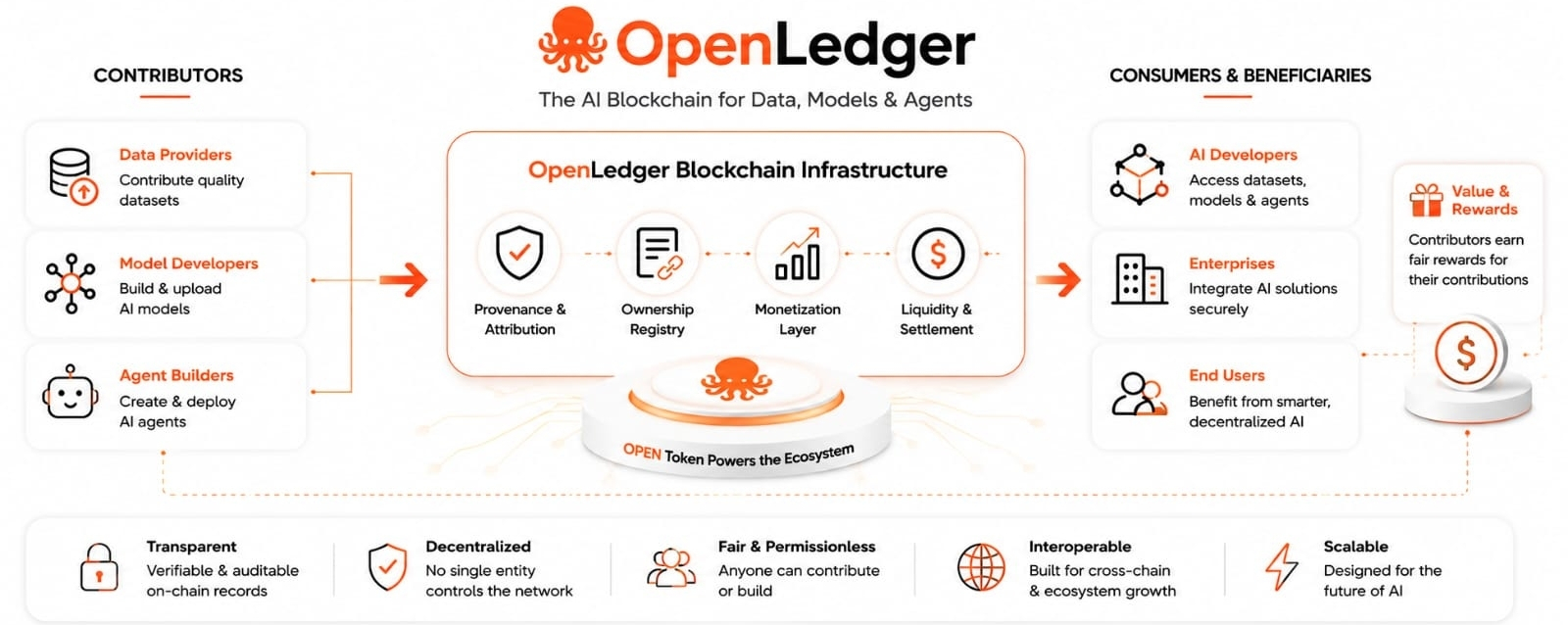
OpenLedger makes me think about one of the most annoying parts of crypto: value gets created everywhere, but only a few places actually capture it. Data, models, agents, users, builders, communities — everyone adds something. Then somehow the reward usually ends up under the hood of a closed system, or inside a token chart that most people don’t fully understand.
Look, that mess is familiar.
We have all seen it before.
Bad airdrops. Fake users. Sybil farms. Points campaigns that turn normal people into spreadsheet addicts. Bridges that feel like gambling with your own money. Gas fees that make simple actions feel stupid. And then, after all that, some project comes out and says it is “building the future.”
Sure.
OpenLedger is not interesting to me because it says AI. That word is already everywhere. Too everywhere. The second a project adds AI to the sentence, I get more skeptical, not less.
But the thing is, the problem here is not fake.
AI runs on data. Models need training. Agents need context. Outputs come from somewhere. But most of that value is invisible. People contribute. Systems learn. Data gets used. Models improve. And then nobody really knows who deserves what.
That is the part OpenLedger seems to be poking at.
Not the shiny part of AI.
The plumbing.
The boring layer where ownership, attribution, and monetization actually need to make sense.
Honestly, that is where crypto might have a role. Not in pretending every chatbot needs a token. Not in slapping “agent economy” on a pitch and calling it innovation. But in building infrastructure that can track contribution, move value, and maybe make the AI economy a little less one-sided.
Maybe.
Because this is still hard to build.
Really hard.
A system like OpenLedger has to deal with ugly questions. What data is actually useful? Who proves it? Who gets paid? How do you stop people from dumping garbage into the network just to farm rewards? How do you stop fake activity? How do you make sure the token has a real job and is not just there because crypto projects need a ticker?
That part matters.
A token without real demand is just noise with a chart.
And crypto already has enough noise.
What I like about OpenLedger, cautiously, is that it is not trying to sell some perfect fantasy if you look past the surface. The idea is more grounded than most AI hype. It is saying that data, models, and agents need a better economic layer. That is not sexy. It is not loud. It is not the kind of thing that gives retail an instant dopamine hit.
But it is necessary if AI keeps growing.
Because right now, AI feels powerful but messy. Useful, but opaque. Fast, but not always trustworthy. You get outputs, but you rarely see the trail behind them. You don’t know what data shaped them. You don’t know who contributed. You don’t know if the agent is smart, lucky, or just confidently wrong.
That is the mess.
OpenLedger is trying to build around that mess.
Still, I would not pretend this is solved just because the project exists. Adoption will take time. Builders need a reason to use it. Data providers need a reason to trust it. AI users need a reason to care. And the network has to prove it can handle real value, not just narrative value.
That is the gap.
Crypto loves narrative value.
Real value is harder.
OpenLedger has to prove that its infrastructure is useful when the hype cools down. When the campaigns end. When the token is not the only reason people are paying attention. When someone actually asks, “Does this make AI data, models, or agents easier to trust and monetize?”
That is the real test.
Not the branding.
Not the AI label.
Not the exchange noise.
Just whether the plumbing works.
Maybe OpenLedger becomes something useful. Maybe it takes longer than people expect. Maybe the market overprices the story before the product proves itself. That happens all the time here.
But I can at least understand why this exists.
That is more than I can say for a lot of AI crypto projects.
OpenLedger is not perfect. It is not guaranteed. It is not some clean answer to the AI economy. But it is aiming at a real crack in the system: the fact that AI value is being created in messy, hidden ways, and the people or assets behind that value often have no clear path to ownership or reward.
That is worth watching.
Carefully.
Not with blind hype.
Just with the tired curiosity of someone who has seen crypto break enough times to know that boring infrastructure is sometimes the only thing that actually matters.