
Data has become the foundation of modern artificial intelligence.
Every model, recommendation engine, AI assistant, and autonomous agent relies on vast amounts of information to learn, improve, and generate outcomes. Despite this reality, one of the largest challenges facing the AI industry remains largely unresolved: the economic structure surrounding data itself.
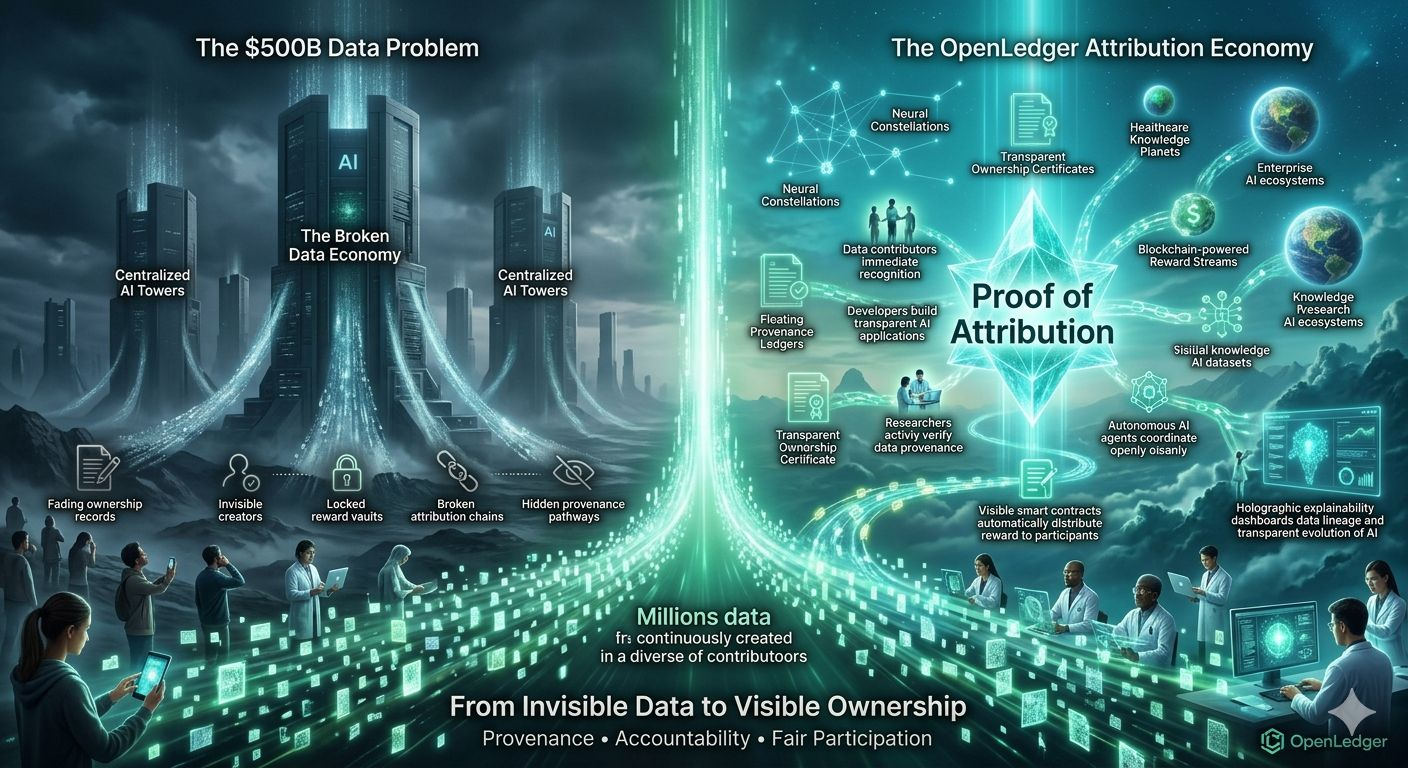
Across the world, valuable datasets are continuously created by individuals, communities, businesses, and institutions. These datasets power innovation, improve model performance, and create commercial value worth hundreds of billions of dollars.
Yet the contributors responsible for generating that value often remain invisible.
Most existing AI systems provide limited transparency regarding where data originates, how it influences model behavior, or who should be rewarded for their contributions. Data flows through centralized platforms where attribution is difficult to verify and economic participation is concentrated among a small number of stakeholders.
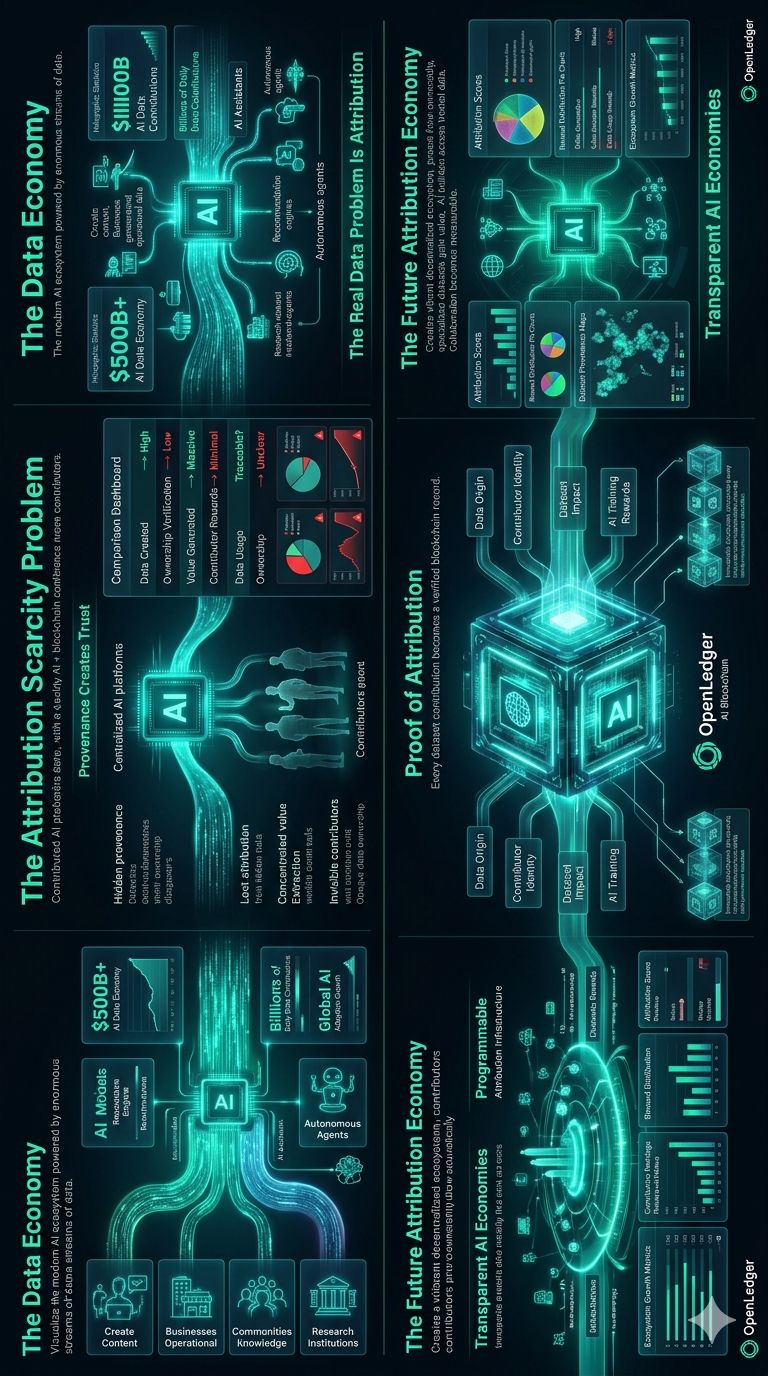
This creates what OpenLedger describes as the $500B data problem.
The issue is not data scarcity.
The issue is attribution scarcity.
Without transparent attribution, contributors cannot prove ownership. Without ownership, incentive structures weaken. Without incentives, maintaining high-quality specialized datasets becomes increasingly difficult.
OpenLedger's proposed solution is the AI Blockchain.
Rather than treating data as an invisible input, OpenLedger records contributions directly on-chain through its Proof of Attribution framework. Every contribution can be linked to its origin, measured for impact, and incorporated into a transparent system of recognition and rewards.
This approach introduces several important advantages.
First, it improves provenance. Data sources become traceable, creating stronger trust and accountability throughout the AI lifecycle.
Second, it aligns incentives. Contributors gain a mechanism for participating in the value they help create rather than remaining passive providers.
Third, it supports specialized AI development. As industries increasingly demand domain-specific models, sustainable access to high-quality datasets becomes a competitive advantage.
Perhaps most importantly, OpenLedger transforms attribution into infrastructure rather than an afterthought.
In traditional systems, attribution is often manual, incomplete, or absent altogether. Within an AI-native blockchain environment, attribution becomes programmable, verifiable, and economically meaningful.
The broader implication extends beyond individual datasets.
It points toward an AI economy where collaboration is transparent, contributions are measurable, and value flows more fairly across the entire ecosystem.
As artificial intelligence continues to expand into every sector of society, solving the data problem may become just as important as improving the models themselves.
OpenLedger is building around the belief that the future of AI requires not only intelligence, but accountability, provenance, and fair participation.