

Lately I have been thinking about something that honestly keeps Sticking in my head more than most AI announcements do.
Every single week there’s another “breakthrough.”
Bigger models. Smarter agents. Faster inference. Better automation. Infinite scaling. Revolutionary infrastructure. Same headlines every timeline Scroll lol.
And do not get me wrong, some of it is impressive.
But after a while the language starts sounding weirdly interchangeable. Every project claims it’s building the Future. Every thread explains why this changes everything forever. Every roadmap loOks like it was Generated from the same template with different branding slapped on top.
And underneath all of it, I keep coming back to one question:
Where did the output actually come from?
Not technically.
Economically.
Because right now AI still feels strangely disconnected from its own production process.
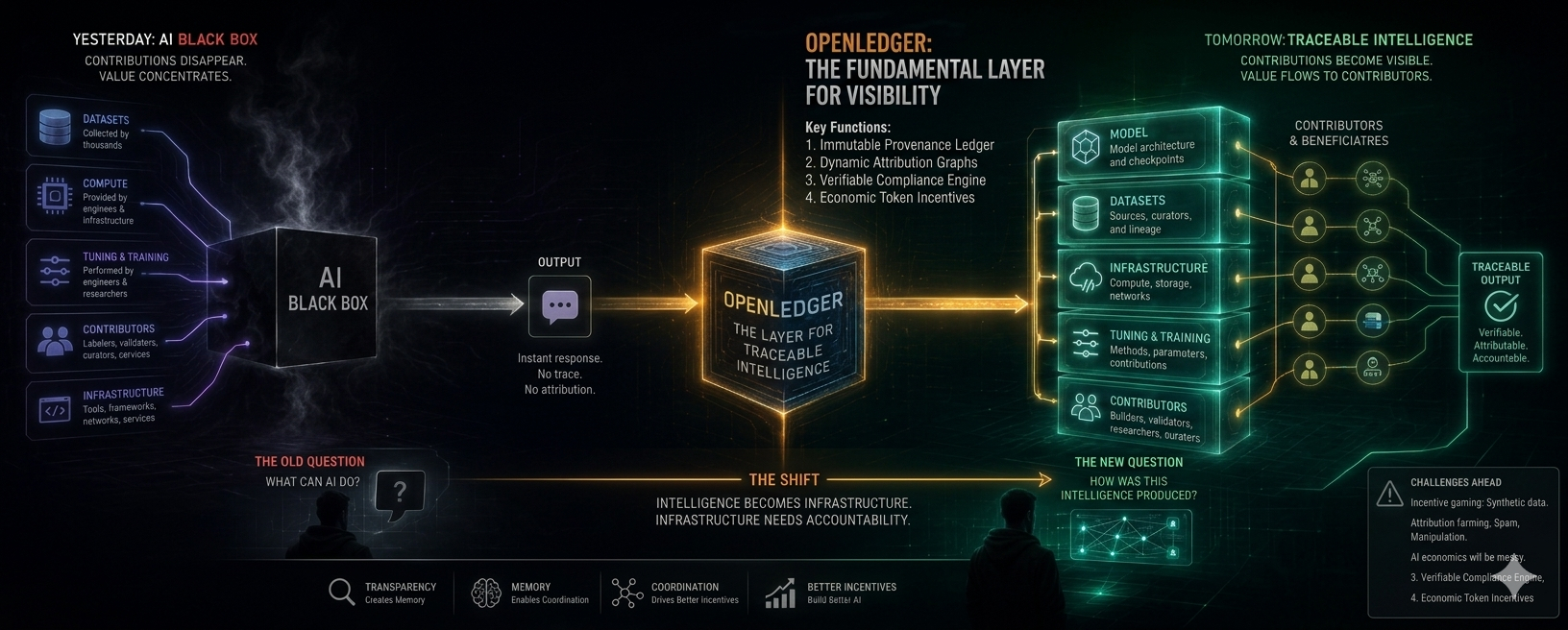
You type into a Clean interface, get a polished answer back in two seconds, and the entire chain underneath that output basically disappears from view. The datasets disappear. The tuning disappears. The infrastructure disappears. The people contributing value disappear too.
The output feels detached from its origins.
And Honestly…. the more I think about it, the stranger that feels.
Crypto spent years teaching markets to care about traceability. Every transaction leaves a footprint. Wallets interact publicly. Liquidity movements become Visible. Even when People try hiding behavior, the chain itself still remembers.
That Transparency changed how people think.
Not because crypto suddenly became “honest” lol. If anything, Crypto showed how fast humans learn to exploit incentives the second money gets attached to a system.
But transparency still created memory.
And memory changes coordination.
AI doesn’t really have that yet.
Most AI Systems today still operate like economic black boxes. Thousands of people contribute datasets, compute, validation, tuning, infrastructure, and research… and eventually all that complexity Collapses upward into one polished interface layer.
The production graph disappears.
That’s honestly why OpenLedger caught my attention recently.
Not because I think it’s some magical final solution. I’m way too skeptical these days to believe any project instantly “solves AI.”
But the framing itself feels important.
The idea that AI outputs could become traceable almost like on-chain transactions.
That part stuck with me.
Because once an AI output can actually connect backward to the model, the datasets, the infrastructure, the tuning process, and the contributors involved… the output stops feeling isolated.
It becomes part of an Economic chain.
And that changes the conversation completely.
The question stops being:
“What can AI do?”
And starts becoming:
“How was this intelligence produced?”
Those are VERY different conversations.
And honestly I do not think the industry fully understands where that leads yet.
Especially once AI agents stop being experimental toys and start Participating in real economic activity.
Because eventually agents won’t just generate text or images anymore.
They’ll negotiate APIs. Execute workflows. Move assets. Coordinate services. Automate research. Handle operations for businesses.
At that point AI outputs stop being passive content.
They become actions.
And once actions create real downstream consequences, people naturally start asking harder questions.
Which model shaped this decision? Which datasets influenced the reasoning? Who contributed to the intelligence layer underneath it? Who benefits economically from deployment?
Suddenly the AI stack starts looking less like software and more like Infrastructure.
That’s the part I think people still underestimate badly.
Most conversations today are still obsessed with visible intelligence. Better reasoning. Faster responses. Smarter outputs.
But infrastructure usually matters more long term than interface quality alone.
Quiet coordination systems often outlast louder narratives.
Of course none of this magically fixes AI economics either.
Honestly it probably creates entirely new problems lol.
The second attribution becomes financialized, people will start farming attribution itself. Synthetic contribution loops will appear. Spam datasets will flood systems. Visibility metrics will get manipulated.
Crypto already showed exactly how aggressively markets optimize incentives once rewards become measurable.
AI will probably be even messier.
Because measuring meaningful intelligence contribution is WAY harder than measuring capital contribution.
A liquidity provider is easy to quantify.
Useful data contribution? Not even close.
Sometimes bad data looks valuable until much later.
So no, I do not look at systems like OpenLedger and think “this is solved.”
Not even remotely.
But I do think the direction matters.
Because right now AI still feels Economically blurry underneath the surface. Most users only see the interface layer while the production ecosystem remains invisible.
Maybe that works during the hype phase while AI still feels magical.
But infrastructure changes once it becomes essential.
Eventually markets stop caring only about outputs.
They start caring about origins. Coordination. Incentives. Accountability.
And honestly…. that’s why the idea of traceable intelligence keeps staying in my head longer than most AI narratives lately.
Not because it feels finished.
Mostly because it doesn’t.
There’s friction everywhere inside this model. Coordination problems too. Probably incentive failures nobody has even discovered yet.
But the attempt to make intelligence economically traceable instead of economically invisible?
Yeah… I think that changes the shape of the conversation way more than people realize right now.
And that alone makes it worth paying attention to.