
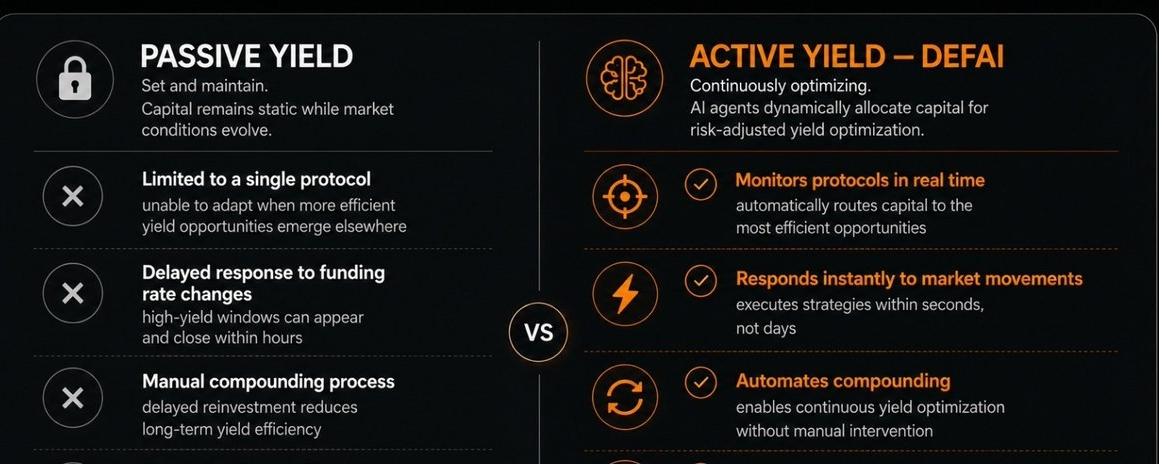
The promise of decentralized finance was always about giving users more control. Yet as the ecosystem expanded across protocols, chains, liquidity pools, and yield opportunities, managing positions manually became a full time activity. Monitoring market movements, adjusting allocations, minimizing risk exposure, and reacting to changing conditions demanded constant attention.
Now a new layer is emerging: AI agents designed to watch DeFi positions continuously and rebalance portfolios in real time.
Imagine opening your dashboard and realizing that the portfolio adjustments already happened before you noticed market movement. Exposure was reduced, capital was shifted, rewards were optimized, and risk thresholds were respected. No endless switching between tabs. No staying awake for volatility. No manual calculations. For many users, the immediate reaction is simple: finally, technology is solving a problem that felt impossible to scale manually.
But enthusiasm rarely arrives alone.
The second reaction appears almost instantly: trust the automation, but verify every move anyway. That tension captures the current moment in decentralized finance. Users want speed and intelligence, yet they still want transparency and accountability. AI can execute faster than humans, but financial decisions carry consequences, and users do not want to surrender understanding in exchange for convenience.
This creates an interesting shift in expectations.
People no longer want systems that only act. They want systems that explain.
If an AI agent reallocates liquidity, users want to know why. If it exits a position, they want to understand what triggered the decision. If yield changes, they expect reasoning that feels understandable rather than hidden behind technical language.
The ideal experience is not silent automation. It is intelligent automation with clear communication.
In practice, these systems are designed to track variables such as portfolio allocation drift, market volatility, liquidity depth, protocol performance, transaction costs, and changing opportunities across chains. When certain conditions are reached, the agent can recommend or execute rebalancing actions according to predefined rules or adaptive strategies.
Supporters argue this approach removes emotional decision making and reduces operational fatigue. Markets operate continuously, while human attention does not. AI systems can observe conditions around the clock and react in seconds instead of hours. At the same time, critics point out an important reality: intelligent execution depends entirely on intelligent inputs. If an agent interprets incomplete data, misunderstands protocol activity, or acts on flawed assumptions, automation can amplify mistakes instead of preventing them. Better decision making requires clean data, understandable logic, and clear safeguards. That is why the strongest vision for the future may not be full replacement.
It may be collaboration.
AI handles monitoring, execution, and optimization. Humans set objectives, define acceptable risk, review outcomes, and maintain strategic control. And perhaps that is where the original reactions become meaningful. Some people will celebrate because this is exactly what they needed. Some will trust the system but still check manually. Some will wonder whether they are becoming less necessary. And some will keep asking the AI to explain every decision in the simplest possible way. The interesting part is that none of those responses are wrong. They may simply describe the evolution of finance itself.