
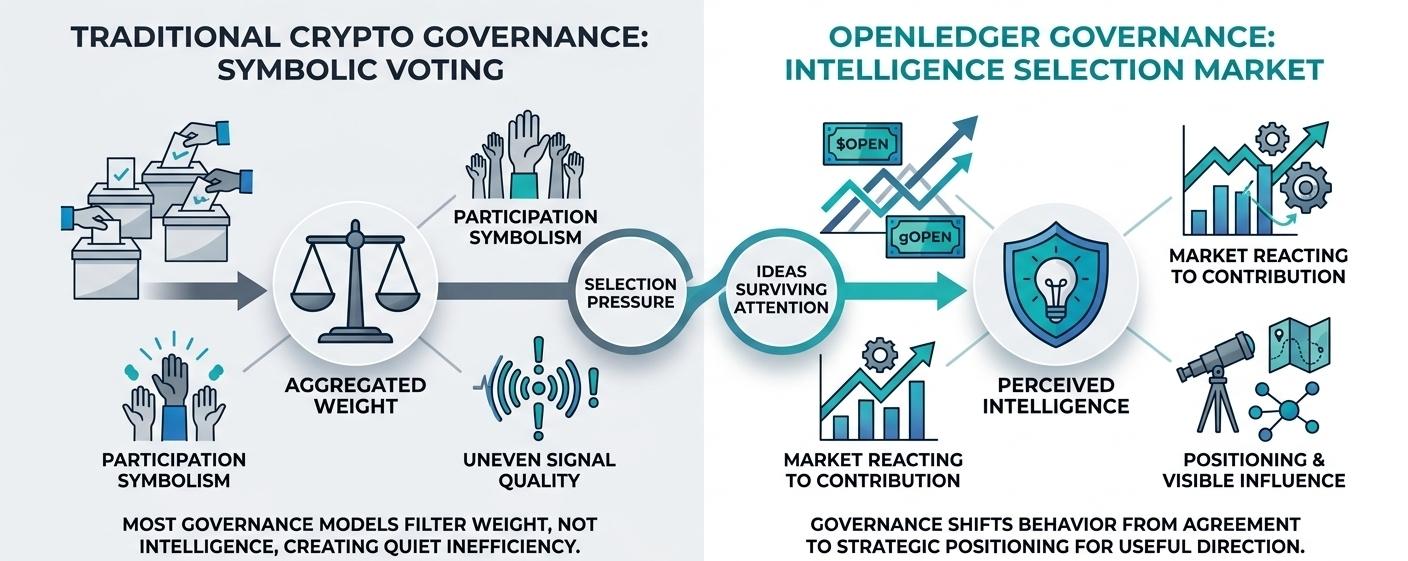
I noticed something interesting while thinking about how governance systems in crypto usually behave. On the surface, they look participatory, but in practice they often feel like symbolic voting rather than real selection of direction.

The more I think about it, most governance models don’t actually filter intelligence they just aggregate weight. That creates a quiet inefficiency where participation is present, but signal quality is uneven.
What’s interesting here is how this changes inside OpenLedger, where $OPEN and gOPEN-linked governance starts to feel less like casting votes and more like a market reacting to perceived intelligence and contribution.
It made me realize that when influence becomes visible and economically aligned, behavior subtly shifts from agreement to positioning rather than simple preference. 👀

That small shift changes the way we think about governance itself not as democracy of opinion, but as selection pressure for useful direction.
In that sense, governance stops being a question of “who votes” and becomes “what ideas survive attention.”