
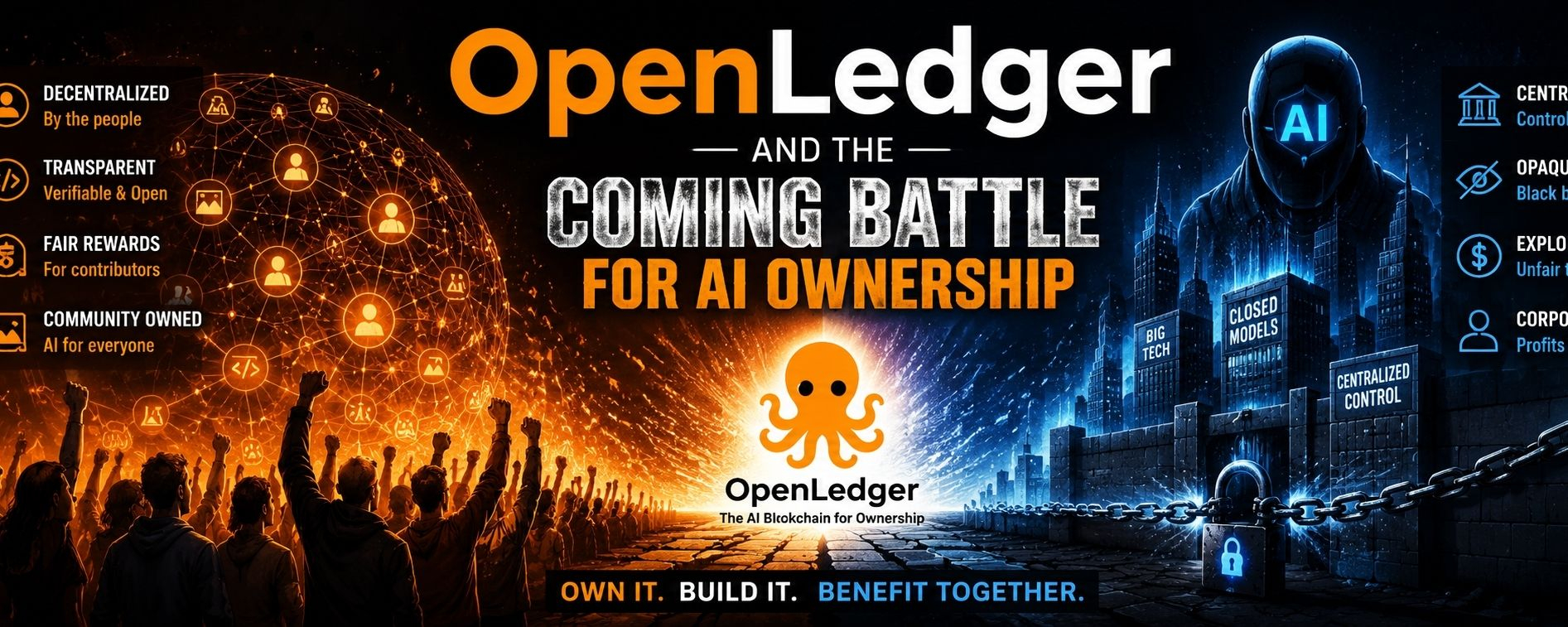
I keep thinking about a question that feels simple on the surface but becomes unsettling the longer I sit with it: if artificial intelligence is learning from all of us, then why does the value mostly flow back to only a handful of companies?
The more I use AI systems, the more obvious this becomes to me. Every prompt, correction, conversation, search pattern, image upload, and interaction feeds into a much larger machine. AI does not emerge from nowhere. It is shaped by billions of human inputs layered together over time. In a strange way, modern AI is one of the largest collective human projects ever created, yet most people participating in it do not actually own any part of the intelligence economy they are helping build.
That is why OpenLedger caught my attention.
Not because it presents itself as another blockchain project promising a revolution, and not because I think every crypto narrative deserves blind optimism, but because it touches a deeper issue that many people still avoid discussing honestly: ownership in the age of AI.
When I first looked into OpenLedger, I realized it was trying to approach AI from a direction that feels fundamentally different from the current dominant model. Most AI companies today operate like massive black boxes. They gather data, train models, improve systems behind closed doors, and concentrate the economic value internally. Users contribute intelligence constantly, but the structure remains centralized.
OpenLedger seems to ask a very uncomfortable question: what happens if intelligence itself becomes an asset class, but ownership of that intelligence stays extremely concentrated?
That question matters more than people realize.
Historically, every technological era created a new form of economic power. Industrialization monetized physical labor. The internet monetized attention. Social media monetized engagement and behavior. AI, in my opinion, is beginning to monetize cognition itself. Human thinking, creativity, pattern recognition, communication, and problem-solving are slowly becoming raw material for machine intelligence.
What fascinates me is that OpenLedger is attempting to build infrastructure around that transformation instead of simply building another application on top of it.
The idea of unlocking liquidity for data, models, and agents initially sounds technical, but I think the concept is actually deeply human. Data today is valuable, but most individuals cannot monetize it directly. AI models generate enormous economic potential, but ownership is limited to whoever controls the infrastructure. AI agents are becoming increasingly autonomous, yet the economic systems surrounding them are still immature.
OpenLedger appears to be trying to connect these fragmented pieces into a decentralized economic layer where intelligence can move, interact, and generate value more openly.
And honestly, I think this touches a nerve that many people already feel intuitively.
There is growing discomfort around the fact that AI systems are trained on collective human knowledge while the rewards remain disproportionately centralized. Artists worry about their work being absorbed into training datasets without compensation. Writers question whether creativity is quietly being extracted at scale. Developers contribute to open ecosystems that larger entities often commercialize more effectively than the communities themselves.
I do not think OpenLedger is simply trying to solve a technical issue. I think it is reacting to a structural imbalance that may become impossible to ignore over the next decade.
At the same time, I also think people underestimate how difficult this challenge actually is.
Decentralization sounds attractive philosophically, but centralized systems dominate for a reason: they are efficient, coordinated, and easy for users. Most people choose convenience before ownership almost every time. That behavioral reality is powerful. Blockchain projects often assume users will prioritize ideals over simplicity, but history repeatedly shows the opposite.
So for OpenLedger to succeed, it cannot rely only on ideology. It has to create a system that is genuinely useful, economically sustainable, and frictionless enough for real adoption.
That may be the hardest part.
Because decentralized AI is not only competing against other crypto projects. It is competing against trillion-dollar technology ecosystems with massive computational resources, existing user bases, and near-unlimited data pipelines. That is not a small obstacle. It is probably one of the largest competitive gaps in modern technology.
Still, I think something important is changing beneath the surface of the AI conversation.
For years, people talked about AI mainly in terms of automation. Replacing jobs. Improving productivity. Accelerating workflows. But I think the deeper shift is actually about ownership and economic participation.
Who owns the intelligence layer of society?
That sounds dramatic, but it is becoming a real question. AI systems already influence search results, media visibility, recommendations, financial decisions, education, and communication. Future AI systems may shape nearly every digital interaction humans experience. If those systems become centralized beyond accountability, the concentration of influence could become unprecedented.
That is why decentralized AI infrastructure interests me conceptually, even if I remain cautious about execution.
I also think there is a geopolitical dimension that people rarely discuss openly. Countries with large populations contribute enormous amounts of digital behavior and data into global AI systems, yet the financial upside often leaves those regions entirely. Entire populations become contributors to intelligence economies they do not meaningfully own.
In theory, networks like OpenLedger could create more distributed participation models where contributors capture part of the value they help generate. Whether that works in practice is another matter entirely, but the idea itself feels increasingly relevant.
What I find especially interesting is the possibility of AI agents eventually becoming independent economic actors. That sounds futuristic until I look at how quickly AI systems are evolving already. We are approaching a world where autonomous agents may perform research, execute transactions, manage digital assets, negotiate services, or even operate businesses with minimal human oversight.
If that future emerges, blockchain infrastructure may become more important than many people currently expect because autonomous systems require transparent coordination layers. Traditional systems are not really designed for machine-native economies.
This is where OpenLedger’s vision becomes more than a speculative crypto concept to me. It starts looking like an attempt to prepare for an economy where intelligence itself becomes programmable and tradable.
And honestly, that possibility feels both exciting and slightly terrifying.
Because once intelligence becomes financialized, society enters completely unfamiliar territory. Human knowledge stops being just culture or education. It becomes infrastructure. Every interaction gains potential economic weight. Every behavioral pattern becomes monetizable. The line between participation and labor starts disappearing.
I think most people have not emotionally processed what that means yet.
We are entering a period where humanity is no longer just using machines. We are actively feeding them cognitive value every day. AI systems improve because millions of people unknowingly contribute to them continuously.
So when I look at OpenLedger, I do not only see another blockchain project. I see an early attempt to answer a question that will probably define the next technological era:
If intelligence is built collectively, should it also be owned collectively?
I do not know whether OpenLedger will ultimately succeed. The road ahead for decentralized AI infrastructure is incredibly difficult, and the crypto industry itself still struggles with credibility in many areas. But I think the underlying question behind the project is real, important, and impossible to avoid forever.
Because the future of AI may not only depend on how intelligent machines become.
