
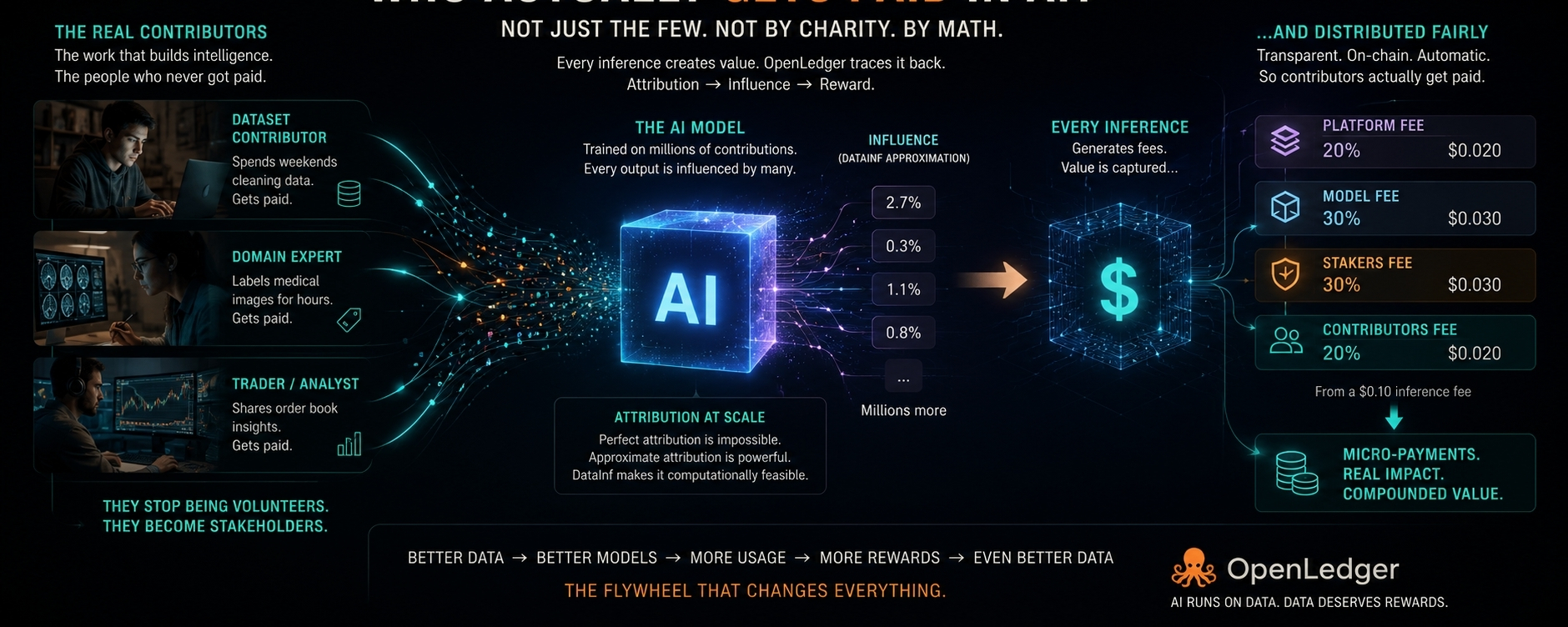
Not the VCs. Not the team. Not the validators. I mean the person sitting at home who spends a weekend cleaning a dataset. The domain expert who labels medical images for hours. The trader who shares their order book insights.
In today’s system? They get nothing.
Their work gets absorbed into a model. The model gets sold or licensed. And the contributor never sees a dime. That’s not a bug. That’s how the current infrastructure was designed. Extraction, not circulation.
OpenLedger’s thesis seems to be that this can change. Not through charity. Through math. Attribution that ties a model output back to the data that helped produce it. And if you can trace it, you can reward it.
That sounds simple. It’s not.
Because influence isn’t binary. A single data point doesn’t either matter or not matter. It matters a little. Maybe 0.3% on one output and 2% on another. And those tiny percentages have to be tracked across millions of inferences, aggregated, and turned into actual payments.
The DataInf approximation they’re using is an attempt to make that computationally feasible. I don’t understand every detail of the math. But I understand the trade‑off. Perfect attribution is impossible at scale. Approximate attribution, if done well, might be good enough to change behavior.
Here’s what I care about. Will a contributor actually feel the reward? If I submit a dataset and a model uses it a thousand times, will I see a stream of tiny payments that add up to something meaningful? Or will the fees eat everything?
That’s the real test. Not whether the math is theoretically elegant. Whether it moves money in a way that feels fair.
I’ve been watching the inference fee structure too. Platform fee, model fee, stakers fee, contributors fee. The split matters. If contributors get crumbs while validators get the feast, the system becomes extractive again. Just with extra steps.
OpenLedger’s allocation in the examples shows contributors getting around 20% of net fees after platform costs. That’s not nothing. But it’s also not a revolution yet. The question is whether that percentage grows as the ecosystem scales, or shrinks.
I don’t have the answer. Nobody does this early.
But I keep thinking about the psychological shift. When a contributor knows that every inference using their data will send them a micro‑payment, they stop thinking like a volunteer. They start thinking like a stakeholder. And stakeholders care about quality. They care about cleaning their data. They care about labeling correctly.
That’s the flywheel. Not tokens going up. Better data leading to better models leading to more usage leading to more rewards leading to even better data.
It works on paper. The hard part is making it work when humans are involved. When greed shows up. When someone figures out how to game the attribution math.
I’m not betting my whole portfolio on it yet. But I’m not ignoring it either. Because if this works, it changes who owns the value in AI. And that’s a shift worth watching from the front row.....
@OpenLedger #openledger #OpenLedger $OPEN
