

I've been checking token allocations more carefully lately because tokenomics sometimes explain a project better than the marketing does.
Many AI and infrastructure projects talk about "community, ecosystems" while the actual ownership structure tells a different story underneath. You open the allocation table and find that a large portion belongs to insiders before users even arrive.
That's partly why OpenLedger caught my attention recently.
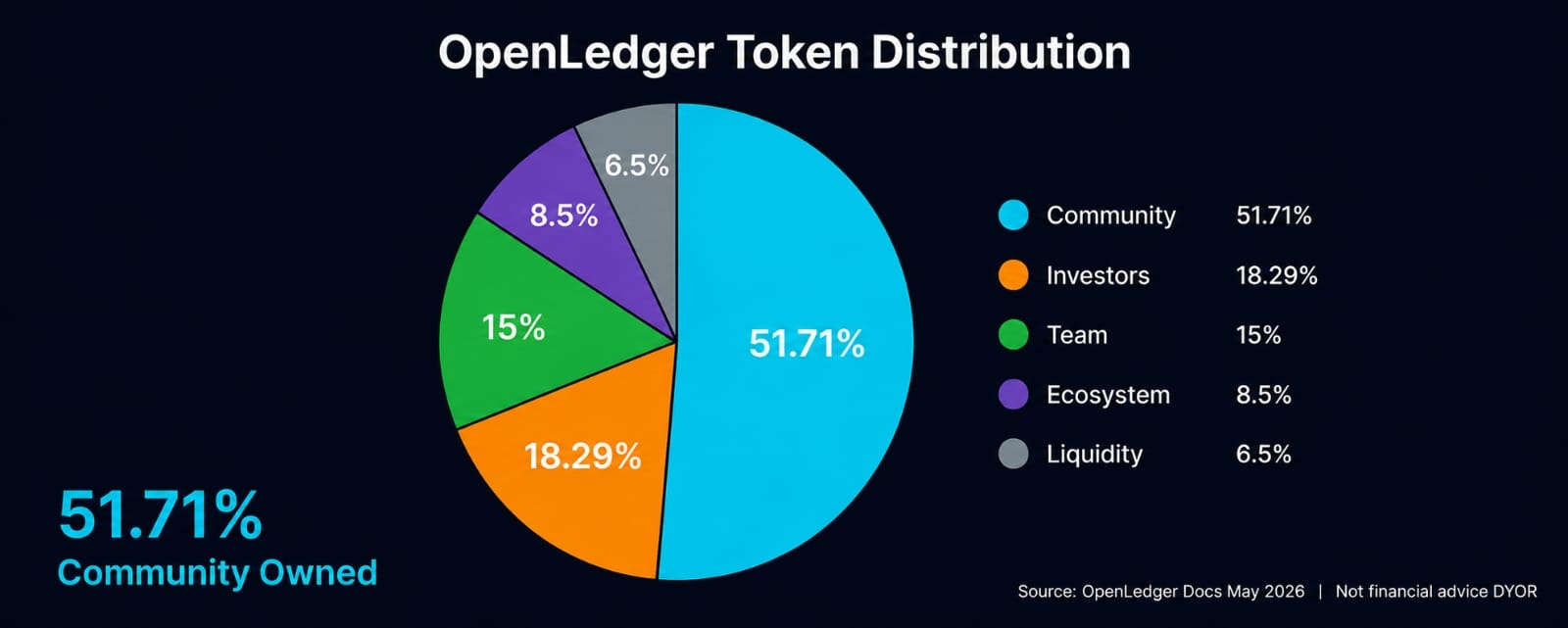
What stood out wasn't only the AI narrative or the infrastructure side. It was the fact that 51.71% of the $OPEN allocation goes toward the community while investor and team allocations stay comparatively lower. For a project built around attribution, data contributors, validators, and participation economies, that distribution feels relevant.
Because if contributors are supposed to help power the ecosystem long-term, then ownership likely cannot stay concentrated only around early capital and internal wallets. Otherwise, the idea of decentralized coordination starts feeling less credible over time.
The more I considered it, the more the token structure seemed to match the larger OpenLedger thesis. AI infrastructure depends on people continuously contributing datasets, models, governance participation, and ecosystem activity. If those participants never gain meaningful alignment with the network itself, the incentive layer may weaken.
And that's where $OPEN started feeling more connected to ecosystem mechanics than speculation for me. The token doesn't only sit at the edges of the system. It appears tied to participation, coordination, and long-term contributor alignment within the infrastructure itself.
Obviously, token allocation alone doesn't guarantee success. Adoption still matters. Execution still matters. Real usage matters too.
But I've started paying closer attention to projects where the ownership structure attempts to align with the people expected to keep the ecosystem active long-term. And OpenLedger feels notable from that perspective.
Token allocation data sourced from OpenLedger documentation, May 2026. This is not financial advice. DYOR. @OpenLedger #OpenLedger