
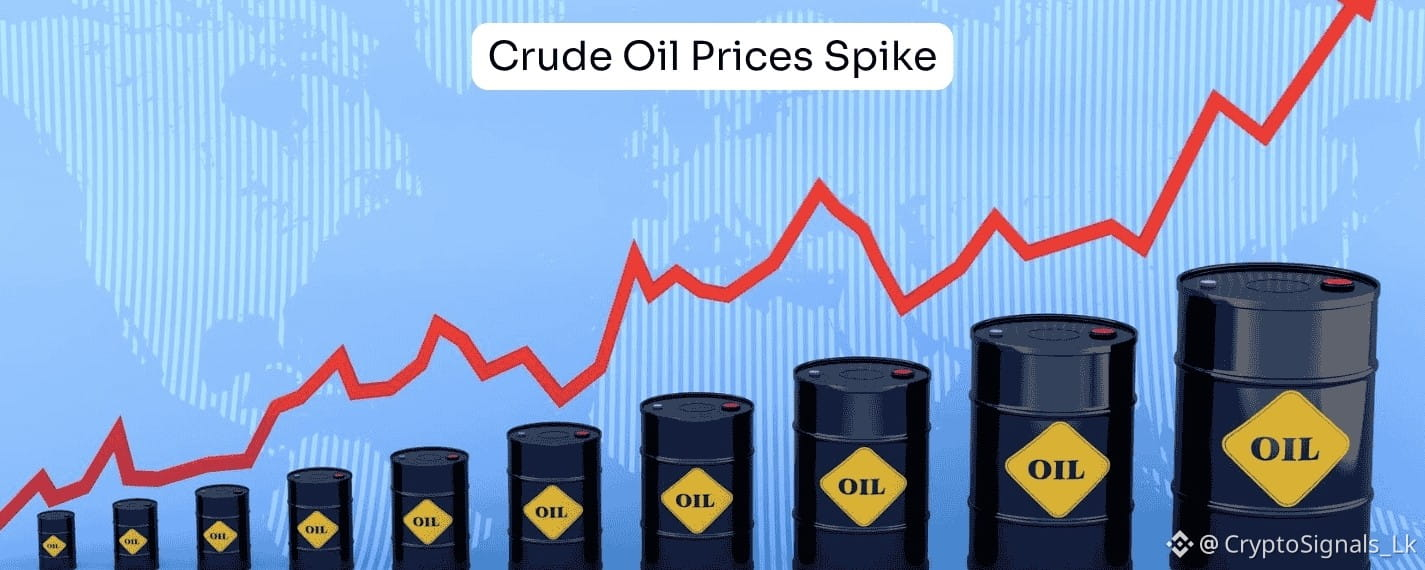
🛢️The global commodities market is currently locked in an intense game of tug-of-war. If you are looking strictly at current energy prices—with Brent hovering around $105/bbl and WTI pushing $100/bbl—the immediate signal feels undeniably bullish.
However, crypto and multi-asset traders know that the most profitable opportunities are found by looking past the immediate horizon. What we are witnessing right now is not a typical demand-driven commodity supercycle. It is a geopolitically engineered anomaly masking a massive, structural macro shift.
Here is exactly what is driving the upcoming global crude oil cycles, what the data reveals, and how it impacts broader financial markets.
🕒 The Current Cycle: Acute Deficit & The Hormuz Premium
The primary catalyst driving triple-digit oil prices is the ongoing supply crisis in the Middle East, specifically the closure and severe trade bottlenecks surrounding the Strait of Hormuz.
According to recent data from the International Energy Agency (IEA) and Wood Mackenzie, over 11 million barrels per day (b/d) of Gulf crude and condensate production has been effectively curtailed or choked off from seaborne trade.
Key Near-Term Data Points:
The Global Inventory Drain: Because of the shipping chokepoints, global oil inventories are being drawn down at a massive clip—estimated by the EIA at roughly **8.5 million b/d** for the current quarter.
Backwardation in Action: The futures market is in deep backwardation (where near-term spot prices are significantly higher than longer-dated future contracts). This signals that physical tightness is critical right now, but the market expects a cool-off down the line.
Demand Destruction: High prices are already doing their job—curbing consumption. Global oil demand growth is contracting by about 420,000 b/d this year as the aviation and petrochemical sectors aggressively ration fuel.
🔄 The Upcoming Shift: The Coming "Super Surplus" (2026–2027)
Wall Street is currently looking at two wildly divergent paths depending entirely on how the geopolitical friction resolves.
If the bottlenecks persist through the winter, analysts warn Brent could mathematically spike toward $115–$200/bbl, throwing the global economy into a shallow recession. However, commodities giant Trafigura and major institutional desks (like Goldman Sachs and J.P. Morgan) are actively warning about the opposite extreme: The Super Surplus.
The moment the Strait of Hormuz opens and trade flows normalize, the underlying fundamentals are primed to aggressively collapse the energy market.
Why a Crash Is Implied Long-Term:
1. The Western Supply Wave: While the Middle East has faced constraints, the Atlantic Basin—led by the US, Brazil, Guyana, and Argentina—has quietly continued expanding its capacity.
2. OPEC’s Massive Coiled Spring: OPEC+ is currently sitting on historic amounts of idle, spare capacity. The moment they choose to regain market share, a supply flood is inevitable.
3. The China Factor: China has been aggressively purchasing crude solely to fill its strategic stockpiles (at a rate of 1.0 million b/d). Once those strategic reserves hit capacity, a primary pillar of global demand vanishes.
💡 The Multi-Asset Takeaway: What This Means for Crypto & Markets
As a digital asset investor on Binance, you might wonder why a physical oil cycle matters. Commodities are the ultimate anchor of global liquidity.
⚠️ The Liquidity Squeeze: As long as oil prices remain elevated near $100+, headline inflation figures will remain sticky. This forces central banks to keep interest rates "higher for longer," which historically acts as a restrictive cap on risk-on liquidity (including Bitcoin and altcoins).
The Macro Playbook:
The Short-Term Play: Watch geopolitical headlines. Any formal progress toward structural trade normalization in the Gulf will trigger an immediate, sharp unwinding of the oil risk premium.
The Medium-Term Transition: A sharp drop in oil prices down to the $55–$65 range in late 2026/2027 will act like an emergency tax cut for the global economy. Lower energy costs will kill inflation, paving the way for aggressive central bank rate cuts.
The Structural Shift: High oil prices are fast-tracking global electrification. Wood Mackenzie indicates that major importing nations are permanently altering their infrastructure to reduce oil dependency—guaranteeing that the next structural commodity cycle will be defined by abundance, not scarcity.
Position accordingly. Don't mistake a temporary supply shock for a permanent bull market.
What's your take? Are you hedging with traditional energy, or waiting for lower oil to unleash the next massive crypto liquidity cycle? Let’s discuss below! 👇


