
I remember watching one of the earlier AI-related token launches where the market reaction looked almost too predictable.
Strong branding.
Aggressive excitement.
Exchange access.
Fast liquidity.
Everyone suddenly calling it “the future of AI infrastructure.”
For a while the chart moved exactly the way these narratives usually move in crypto. Attention compounds into speculation, speculation compounds into momentum, and momentum starts getting mistaken for validation.
But underneath all of that, something always bothered me.
The network activity rarely looked as durable as the valuation implied.
People were clearly trading exposure to the idea of AI infrastructure.
I was less convinced they were interacting with infrastructure that had already become economically necessary.
That distinction matters more than most traders think.
Because markets are extremely good at pricing stories about future adoption. What they consistently struggle to price correctly is recurring operational dependence. The systems that survive long term are usually not the ones with the loudest launch narratives. They are the ones users quietly become unable to operate without later.
That is partly why my perspective on OpenLedger changed over time.
At first I looked at it the obvious way.
AI attribution infrastructure.
Contributors provide datasets.
Models consume them.
Usage gets tracked.
Rewards get distributed.
$OPEN coordinates incentives across the network.
Reasonable thesis.
Crypto already understands marketplace-style infrastructure stories because they are easy to model. Networks attract contributors, contributors generate activity, activity generates value, and tokens coordinate the economy.
But the longer I thought about OpenLedger, the less interested I became in the contribution side of the equation.
The more interesting question was what happens after memory accumulates.
More specifically:
What happens when retaining AI memory becomes expensive?
That sounds abstract until you think operationally instead of philosophically.
Most AI narratives today treat memory like a permanent advantage.
More context means better outputs.
More historical data means smarter systems.
More retained influence means stronger intelligence.
Directionally, that is true.
But memory also creates obligations.
Training influence persists.
Contributor claims persist.
Licensing exposure persists.
Historical attribution persists.
Compliance requirements persist.
Disputes persist.
Intelligence does not just inherit knowledge.
It inherits baggage too.
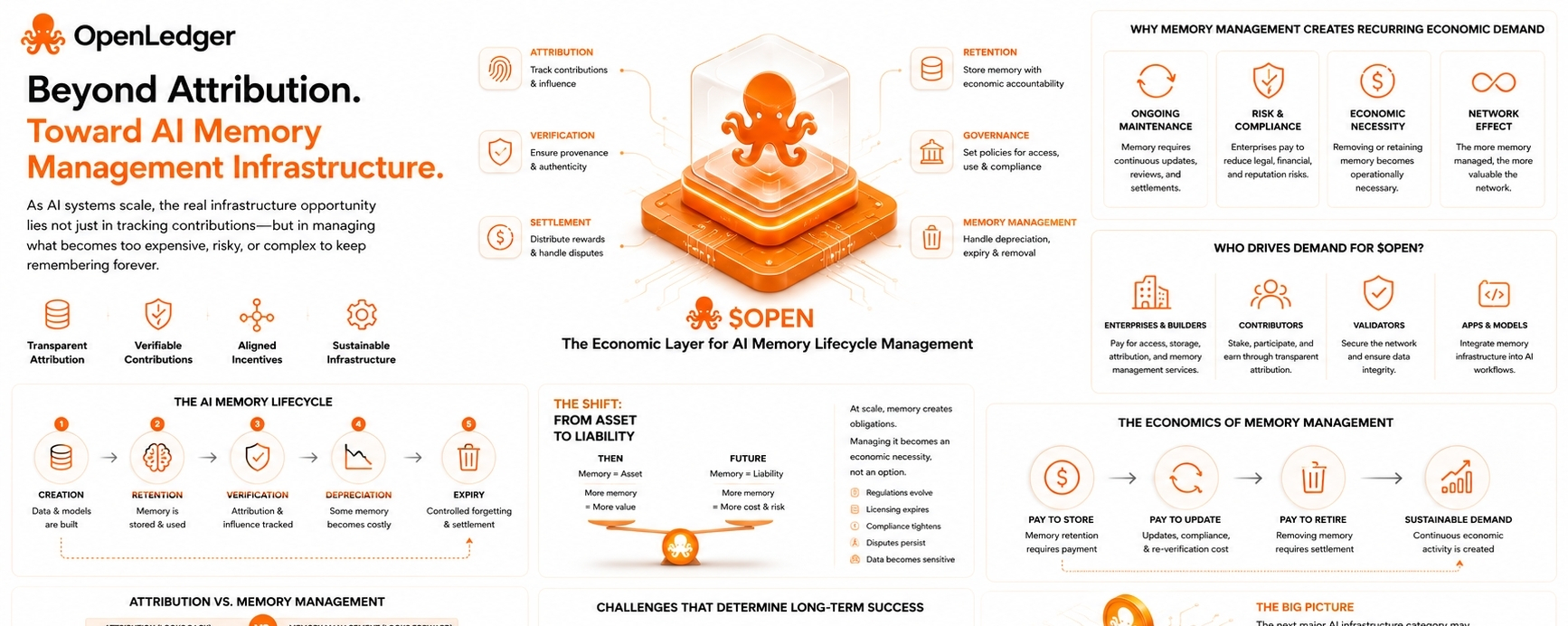
That is where OpenLedger starts looking less like simple attribution infrastructure and more like something potentially larger.
Memory management infrastructure.
Because eventually AI systems may not just need ways to remember.
They may need economically coordinated ways to manage what becomes too expensive, risky, outdated, or legally complicated to keep remembering forever.
And that changes the token model entirely.
A standard attribution network can easily fall into a familiar crypto problem.
Contributors arrive early because incentives exist.
Activity spikes during onboarding.
Metrics look strong.
Dashboards look healthy.
Then eventually participation slows because the system rewarded contribution without creating recurring necessity.
Crypto infrastructure projects fail there constantly.
The systems that survive are usually the ones that create ongoing economic obligations users repeatedly return to maintain.
That is why I think the memory management angle matters more than attribution alone.
Imagine an enterprise AI model trained partly through decentralized contributors providing financial, healthcare, or legal datasets.
Initially, retaining that information is valuable.
But over time the equation changes.
Regulations evolve.
Licensing agreements expire.
Certain datasets become commercially sensitive.
Compliance standards tighten.
Historical attribution becomes operationally expensive.
At that point, memory itself stops being a pure asset.
It becomes liability exposure.
Now the economically valuable service is not simply proving memory exists.
It is managing retention.
Managing depreciation.
Managing attribution persistence.
Managing influence expiry.
Managing controlled forgetting.
That is a much more interesting infrastructure category to me.
Because recurring token demand rarely comes from initial participation.
It comes from maintenance.
Ethereum gas works because transactions never stop.
Security models work because validation never stops.
Cloud infrastructure survives because businesses become operationally dependent on it.
The strongest infrastructure systems create loops users continuously re-enter because leaving becomes harder than staying.
That is the benchmark I would eventually apply to AI infrastructure too.
Not whether AI needs attribution.
Whether AI creates ongoing economic maintenance requirements around attribution, retention, and memory governance.
Those are very different things.
And if future AI systems eventually require auditable memory management, then retaining influence may carry economic cost while removing influence may require economic settlement too.
That is structurally more interesting than simple contributor rewards.
Still, elegant concepts and investable realities are not always the same thing.
Token economics still matter.
Supply pressure matters.
Unlock schedules matter.
Sustained fee generation matters.
Real token sinks matter.
Crypto infrastructure projects often look strongest before long-term issuance fully enters the market. Narrative momentum can temporarily hide weak demand foundations, especially when speculative liquidity overwhelms organic usage early on.
I have seen that pattern too many times to ignore it.
So the practical question is not whether OpenLedger sounds intelligent.
The real question is whether durable economic demand actually forms around the network.
Who repeatedly buys $OPEN?
Builders paying for access is one layer.
Contributors staking for participation is another.
Validators bonding capital can help if network security genuinely matters.
But sustainable infrastructure demand only emerges when usage becomes economically necessary even after speculation disappears.
That is the hard part.
And attribution itself is not simple.
How much of an AI output truly came from one contributor?
How should influence be weighted?
What happens when multiple contributors claim ownership?
How expensive does verification become at scale?
Those are not small implementation details.
They directly determine whether the infrastructure economy becomes sustainable or noisy.
There is also the optionality problem.
If developers can acquire equivalent datasets cheaper outside the network, token utility becomes supplementary instead of essential.
Optional utility rarely sustains long-term value.
The strongest infrastructure systems become deeply embedded into operational workflows where removing them creates friction, cost, or risk.
That is why I keep returning to the memory management framework.
Because attribution tracks historical contribution.
Memory governance manages future liability.
And I think markets may eventually realize the second category becomes economically larger than the first.
Most traders are currently pricing AI expansion.
Fewer are pricing AI maintenance.
Almost nobody is pricing AI memory decay.
But mature systems eventually need all three.
The internet did not become economically important simply because information existed. Entire industries emerged around securing, organizing, deleting, filtering, regulating, and monetizing information after scale arrived.
AI systems may evolve similarly.
At small scale, memory feels valuable.
At large scale, memory becomes governance.
And governance creates recurring economic activity.
That does not automatically mean OpenLedger wins this market.
Execution risk remains real.
Verification complexity remains difficult.
Enterprise adoption may move slower than expected.
Token emissions can still overpower demand.
But I do think the framework itself is becoming increasingly important.
Because future AI economies may eventually require infrastructure not just for intelligence creation, but for intelligence lifecycle management.
Creation.
Retention.
Verification.
Depreciation.
Expiry.
That is a much larger category than attribution alone.
And if that future emerges, traders may eventually realize they were valuing AI infrastructure backwards the entire time.
They priced intelligence first.
When the more durable economic layer may actually come from managing the consequences of accumulated memory afterward.
So when I look at $OPEN now, I spend less time asking whether AI systems need attribution infrastructure.
And more time asking whether future AI economies eventually require markets for controlled forgetting too.
Because the next major AI infrastructure category may not revolve around storing more intelligence forever.
It may revolve around deciding what becomes too expensive, too risky, or too complex to keep remembering.
@OpenLedger #OpenLedger #openledger $OPEN
