
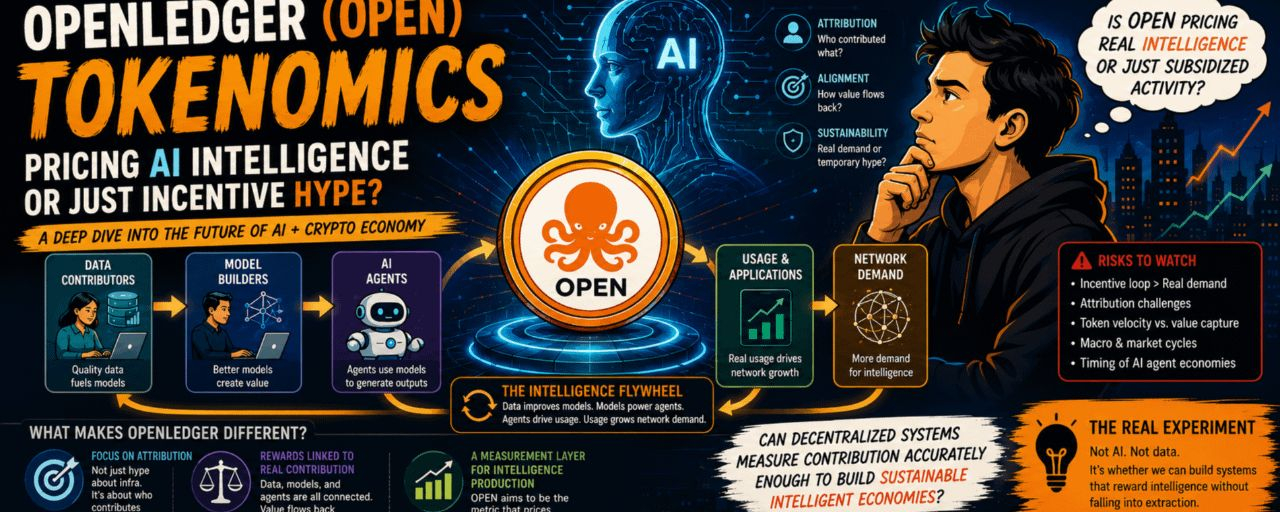
Somewhere beneath the excitement surrounding artificial intelligence, a quieter economic transformation is already unfolding. Most people still see AI as a product category — chatbots, image generators, autonomous assistants, recommendation engines — but the deeper shift is infrastructural. AI is slowly becoming a system that absorbs labor, behavior, creativity, decision-making, and knowledge from the internet itself. And once intelligence becomes infrastructure, ownership starts becoming political, economic, and deeply uncomfortable.
That discomfort matters because modern AI systems are not created in isolation. They are built on top of human civilization compressed into data. Every article, forum post, design, code repository, video, conversation, research paper, and online interaction contributes to the expanding intelligence layer powering modern AI models. Millions of people continuously generate the raw material that trains these systems, often without realizing they are participating in one of the largest economic transfers in digital history.
Yet the structure surrounding this process remains strangely incomplete.
The people generating value rarely own the systems extracting it. Contributors disappear into abstraction. Communities create datasets they never control. Open-source developers help build infrastructure that later becomes commercially enclosed. Entire cultures become training material for models owned by a small number of organizations with enough compute power and capital to operationalize collective intelligence at scale.
The internet became extraordinarily efficient at extracting value while remaining surprisingly bad at remembering where that value came from.
That is part of the tension projects like OpenLedger are trying to confront. Not simply by building another blockchain, but by asking a much larger question about the future architecture of AI economies themselves.
What happens when intelligence becomes programmable?
And more importantly, who gets paid when it does?
OpenLedger positions itself as an AI-native blockchain designed to monetize datasets, models, and autonomous agents as on-chain economic assets. On the surface, that sounds technical. Underneath, it is really an attempt to redesign attribution systems for a future where AI participation becomes economically significant. The project appears less interested in AI as a standalone product and more interested in AI as a continuously operating economic layer requiring ownership, coordination, settlement, and liquidity infrastructure.
That distinction matters more than people realize.
For years, blockchain projects largely focused on financial primitives: payments, lending, exchanges, speculation, stablecoins. OpenLedger shifts the focus toward intelligence infrastructure itself. The thesis is that datasets, AI models, and autonomous agents may eventually behave less like passive software and more like productive digital capital — assets capable of generating revenue, interacting with other systems, and participating in programmable economies.
And honestly, that may become the real economic battle of the AI era.
Because the future value of artificial intelligence may not belong exclusively to whoever builds the largest model. It may increasingly belong to whoever controls the coordination layer surrounding intelligence: attribution systems, ownership records, economic settlement, permissions, governance, and participation frameworks.
Historically, the most powerful infrastructure layers often looked unimportant in the beginning. The internet itself was once dismissed as experimental plumbing. Payment rails looked boring before they became essential. Cloud infrastructure initially seemed invisible compared to consumer applications built on top of it. But infrastructure quietly determines how power flows through systems.
The infrastructure layer usually matters more than people realize.
OpenLedger’s approach reflects this belief. Instead of treating AI systems as isolated tools, it treats them as economic actors operating within programmable networks. Datasets become monetizable assets. Models become traceable entities. Agents become autonomous participants capable of generating and distributing value on-chain. Ownership is no longer simply about possession — it becomes programmable participation.
At least in theory.
And theory is important to emphasize here, because many of these systems remain highly experimental. The broader vision is compelling, but the implementation challenges are enormous.
Attribution itself may become one of the hardest infrastructure problems in the AI economy. Modern AI systems are layered, probabilistic, and deeply compositional. A single model may be influenced by thousands of datasets, countless human contributors, fine-tuning processes, external APIs, retrieval systems, and reinforcement loops. Determining who contributed what value — and how much compensation they deserve — is extraordinarily difficult.
There may never be perfect attribution.
But imperfect systems can still reshape economies if they create enough transparency and trust to coordinate participation. Financial systems are imperfect. Copyright systems are imperfect. Royalty systems are imperfect. Yet they still create economic structures capable of distributing value at scale.
OpenLedger appears to be exploring whether AI economies require similar settlement infrastructure for intelligence itself.
That is where blockchain architecture becomes relevant.
The significance of putting AI participation on-chain is not necessarily about moving all computation onto decentralized systems. In many cases, centralized AI infrastructure will remain far more efficient for training and inference. The more important idea is economic coordination. If autonomous agents begin transacting with each other, licensing datasets, accessing models, executing contracts, or distributing revenue autonomously, then transparent ownership and settlement layers become increasingly valuable.
The internet may eventually contain vast numbers of continuously operating AI agents performing economic work around the clock.
Not conscious machines. Not science fiction.
Just autonomous systems handling logistics, commerce, research, financial activity, customer service, coordination, optimization, and digital production at machine speed. If those systems become economically productive, questions surrounding ownership and value distribution become unavoidable.
Who owns the agent?
Who owns the model powering it?
Who supplied the data that made it useful?
Who receives the economic upside generated by its activity?
Most internet infrastructure today cannot answer those questions clearly.
OpenLedger is attempting to build systems that can.
Its compatibility with Ethereum standards also matters strategically. Rather than existing as an isolated blockchain ecosystem, OpenLedger positions itself within broader decentralized infrastructure already connected to wallets, smart contracts, liquidity layers, and decentralized financial systems. This reduces friction significantly. AI-native assets can theoretically integrate into existing crypto-economic environments instead of requiring entirely separate ecosystems.
Liquidity becomes critical here because ownership without economic utility rarely matters. A dataset only becomes meaningful as an asset if it can be licensed, monetized, exchanged, collateralized, or integrated into broader economic systems. The same applies to AI models and agents. OpenLedger’s core proposition is not simply that these entities should exist on-chain, but that they should become economically composable.
That creates fascinating possibilities and equally serious risks.
One of the more uncomfortable realities surrounding modern AI is how rapidly power is concentrating. Training advanced frontier models increasingly requires extraordinary amounts of capital, compute infrastructure, energy, and engineering talent. As a result, AI capability is consolidating inside a relatively small number of corporations and state-aligned organizations.
Decentralized systems are unlikely to outperform centralized giants on raw compute efficiency anytime soon.
That’s simply reality.
But compute power may not ultimately be the only important layer. Ownership systems, attribution infrastructure, and coordination mechanisms could become equally influential over time. OpenLedger does not necessarily need to replace centralized AI systems to matter. It may instead function as a counterbalancing infrastructure layer — an open economic framework operating around increasingly powerful intelligence systems.
Even partial decentralization could prove meaningful if it creates greater transparency and participation around how AI economies distribute value.
Still, the gap between conceptual importance and actual adoption remains enormous.
Crypto history is filled with projects built around elegant narratives that failed to achieve meaningful usage. Infrastructure without participants is simply architecture. Coordination problems are harder than technical problems because they involve incentives, trust, governance, behavior, and network effects. OpenLedger faces the same reality.
Speculative farming could overwhelm genuine utility. Token incentives may distort participation quality. Low-value datasets could flood the ecosystem if reward systems are poorly designed. Attribution mechanisms may become manipulable or economically inefficient. Governance structures may centralize despite decentralization rhetoric. Developers may prioritize convenience over transparency. Large AI companies may have little incentive to adopt open attribution standards at all.
Execution matters more than narrative.
And the narrative alone is not enough.
Still, the underlying direction feels increasingly difficult to ignore. AI is beginning to reshape the structure of digital labor itself. The early internet monetized information. Social platforms monetized attention. AI economies may eventually monetize intelligence, coordination, and autonomous execution. That transition fundamentally changes how value moves through the internet.
The next generation of internet infrastructure may not simply connect people. It may coordinate machines, models, agents, datasets, and autonomous economic activity continuously operating across programmable networks.
If that future emerges, systems governing attribution, ownership, trust, and value distribution will become foundational infrastructure rather than optional features.
That is ultimately what makes OpenLedger interesting.
Not because it guarantees a decentralized AI future. Not because blockchain suddenly solves every structural problem surrounding artificial intelligence. And not because every infrastructure vision automatically becomes reality.
But because it recognizes something many people still overlook: the AI revolution is not only about intelligence itself. It is about the economic architecture surrounding intelligence.
Who participates. Who owns. Who extracts value. Who gets excluded. Who becomes infrastructure for someone else’s system.
Those questions are no longer philosophical abstractions. They are becoming design decisions embedded directly into the next generation of digital economies.
And somewhere inside projects like OpenLedger is an attempt — uncertain, imperfect, but increasingly relevant — to redesign those decisions before they become permanent.