
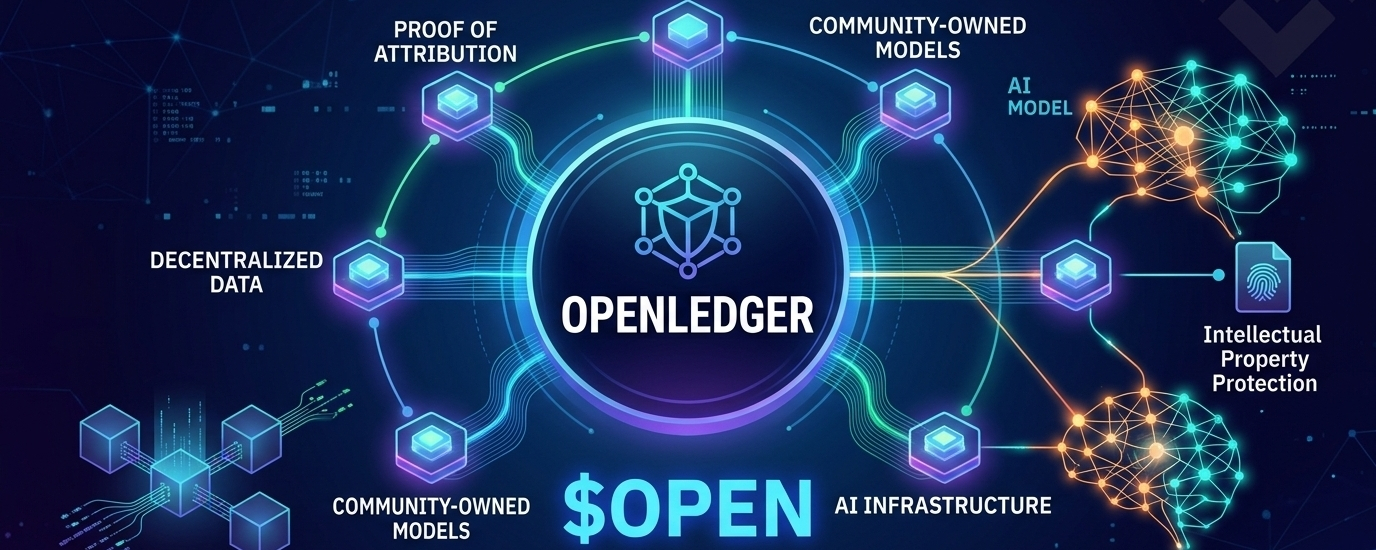
While the rest of the crypto market continues to chase short-term hype, a massive infrastructure transition is taking place right under our noses. Artificial Intelligence (AI) is scaling at an exponential rate, but it faces a structural crisis: data ownership, provenance, and black-box decision-making.
Enter @OpenLedger (https://www.binance.com/en/square/profile/openledger), the world's first AI-native blockchain designed specifically to solve these fundamental bottlenecks. Powered by its native utility token $OPEN, the network is quietly cementing its place as the underlying trust and attribution layer for the future of on-chain intelligence.
The Real Problem: The Black-Box AI Trap
In traditional AI systems, tech conglomerates scrap massive amounts of data from the public web without consent, training models that operate as centralized black boxes. Creators get zero compensation, and users have absolutely no way to audit why an AI arrived at a specific decision.
OpenLedger solves this through Proof of Attribution (PoA). This core consensus mechanism ensures that every single dataset, training run, and downstream inference is recorded immutably on-chain. When data is used to train or refine a model, the contributors are directly and transparently rewarded.
2026: The Year of Interoperability and Real Integrations
OpenLedger is not just a theoretical concept—it is a live, highly integrated ecosystem. In 2026 alone, the network has secured major partnerships that prove the real-world demand for verifiable on-chain AI:
Injective & Verifiable AI Execution: OpenLedger's integration with Injective allows AI agents to execute trades on-chain with full data-attribution tracing. No more blind faith; every automated decision has an immutable digital paper trail.
Theoriq & DeFi Autonomy: Partnering with Theoriq, OpenLedger is bringing these audit-friendly AI agents to live DeFi markets, allowing AI to manage treasury allocations and execute complex arbitrage strategies transparently.
Story Protocol & IP Protection: Perhaps the most critical development is the collaboration with Story Protocol. Story registers intellectual property on-chain, while OpenLedger enforces licensing terms and automatically distributes royalties to creators when models are trained. This provides a direct solution to the multi-billion-dollar AI copyright crisis.
Adoption of ERC-4626 Vaults: By integrating the ERC-4626 standard, OpenLedger has standardized AI-managed yield products, opening the door for seamless institutional-grade Web3 integrations.
The Economic Engine: The $OPEN Token
At the heart of this thriving ecosystem is the $OPEN token. Far from a speculative asset,
$OPEN is a multi-utility workhorse:
L2 Gas Fees: Powers all transactions on OpenLedger's high-performance Layer 2.
Staking & Governance: Protects the network and gives holders voting rights over which models and specialized "Datanets" are funded and deployed.
Developer Resources: Used to request permissioned specialized datasets and pay for compute power via the no-code ModelFactory GUI.
The Verdict
The intersection of DePIN and AI is crowded, but OpenLedger stands out by focusing on the "boring" but incredibly vital compliance, attribution, and data-rights layer. As AI eats the web, the demand for verified, clean, and legally compliant training pipelines will skyrocket.
Keep your eyes closely on @OpenLedger (https://www.binance.com/en/square/profile/openledger) and the $OPEN token. The infrastructure of tomorrow's AI revolution is being built today.