
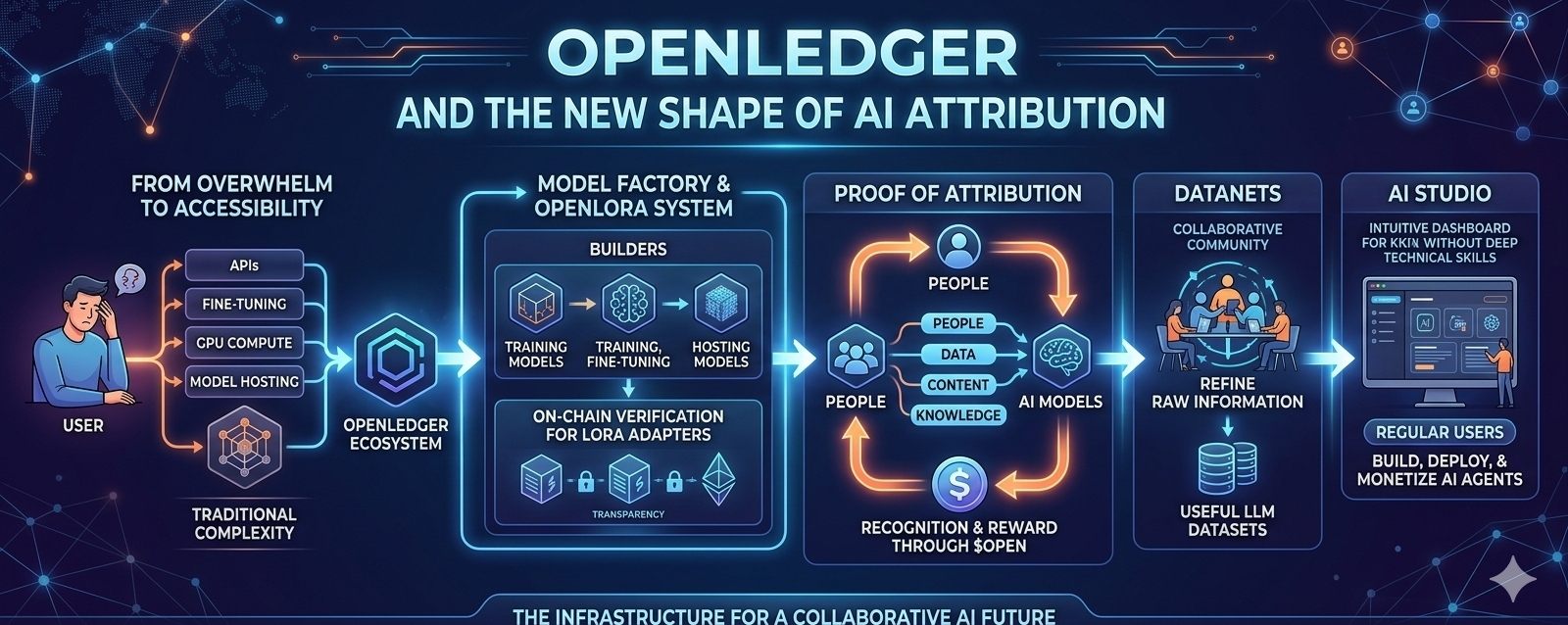
@OpenLedger A few weeks ago, I tried getting into AI tools because it felt like everyone around me was talking about AI agents like they were already the future. From the outside, it looked simple enough. Open a platform, connect a wallet, press a few buttons, and let the AI do its thing. But once I actually started exploring, I realized the experience was nothing like that. One platform expected coding knowledge, another spoke in deployment terms like everyone already understood them, and suddenly I was surrounded by things like APIs, fine-tuning, GPU compute, and model hosting. After a while, it stopped feeling exciting and started feeling overwhelming.
That is probably why OpenLedger caught my attention. It does not just ride the AI wave; it seems to be building the deeper layer that makes AI more usable, more transparent, and easier to work with. Its Model Factory and OpenLoRA system look designed to help builders train, fine-tune, and host models in a more complete way. But what really stood out to me was the idea of on-chain verification for LoRA adapters. In a space where AI often feels hidden behind black-box systems, that kind of visibility matters. It makes the whole process feel more open and more trustworthy.
The part that made the biggest impression on me was Proof of Attribution. AI is built on human contribution in so many ways. People create the data, write the content, share the conversations, and shape the knowledge that eventually helps these systems become useful. Yet most of that value disappears once the model starts producing results. Proof of Attribution feels important because it changes that. It tracks the influence of data on model outputs and makes it possible for contributors to be recognized and rewarded through $OPEN. That idea feels honest in a way the AI space has been missing for a long time.
Then there is Datanets, which makes the whole thing even more practical. A lot of people focus only on the model itself, but the truth is that good data is what really gives AI its strength. Datanets seems to let communities work together to collect, refine, and turn raw information into datasets that are actually useful for LLMs. That part matters because the future of AI will not just depend on bigger models. It will depend on better data, better organization, and better ways for people to contribute meaningfully.
AI Studio feels like the piece that most regular users would connect with first. It gives people a place to build, deploy, and monetize AI agents without needing to understand every technical layer from day one. That matters more than people think. Real adoption usually does not come from complexity. It comes when the experience becomes simple enough for ordinary people to join in without feeling lost.
What makes OpenLedger interesting to me is that it does not feel like another temporary AI and crypto trend. It feels like infrastructure for a future where AI is more collaborative, more transparent, and less centralized. And maybe that is the bigger question here. If AI is trained by people, shaped by people, and improved by people, shouldn’t the value eventually flow back to the people too?